Review
. 2020 Feb 9;21(3):1151.
doi: 10.3390/ijms21031151.

Expanding Role of Ubiquitin in Translational Control

Affiliations
Review

Expanding Role of Ubiquitin in Translational Control

Shannon E Dougherty et al. Int J Mol Sci. .

Abstract

The eukaryotic proteome has to be precisely regulated at multiple levels of gene expression, from transcription, translation, and degradation of RNA and protein to adjust to several cellular conditions. Particularly at the translational level, regulation is controlled by a variety of RNA binding proteins, translation and associated factors, numerous enzymes, and by post-translational modifications (PTM). Ubiquitination, a prominent PTM discovered as the signal for protein degradation, has newly emerged as a modulator of protein synthesis by controlling several processes in translation. Advances in proteomics and cryo-electron microscopy have identified ubiquitin modifications of several ribosomal proteins and provided numerous insights on how this modification affects ribosome structure and function. The variety of pathways and functions of translation controlled by ubiquitin are determined by the various enzymes involved in ubiquitin conjugation and removal, by the ubiquitin chain type used, by the target sites of ubiquitination, and by the physiologic signals triggering its accumulation. Current research is now elucidating multiple ubiquitin-mediated mechanisms of translational control, including ribosome biogenesis, ribosome degradation, ribosome-associated protein quality control (RQC), and redox control of translation by ubiquitin (RTU). This review discusses the central role of ubiquitin in modulating the dynamism of the cellular proteome and explores the molecular aspects responsible for the expanding puzzle of ubiquitin signals and functions in translation.

Keywords: degradation; oxidative stress; quality control; ribosomal protein; ribosome; translation regulation; ubiquitin.


Conflict of interest statement

The authors declare no conflict of interest.

Figures
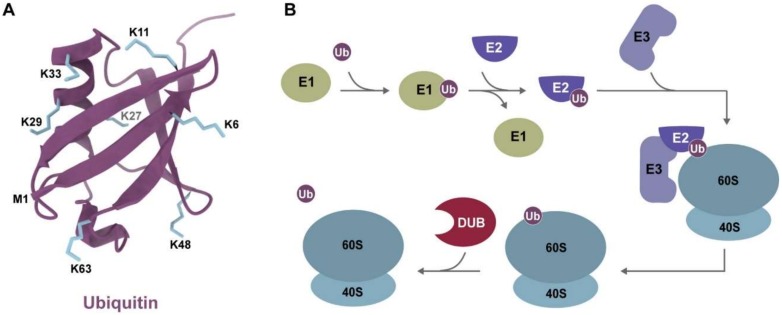
Figure 1
Figure 1
Ubiquitin and overview of the process of ubiquitination. (A) Structure of ubiquitin and the position of its lysine residues. The variety of roles for ubiquitin is in part mediated by the seven lysine residues (K) and the amino group of the first methionine residue (M1), where ubiquitin can form further polyubiquitin linkages. (B) Summary of the ubiquitin enzymatic cascade, in which a target, such as ribosomal proteins, can be ubiquitinated by the sequential functions of E1 activating enzyme, E2 conjugating enzymes, and E3 ligases. Ubiquitin modifications can lead to signaling functions or be reversed by deubiquitinating enzymes (DUB) [80,81,82].
Figure 2
Figure 2
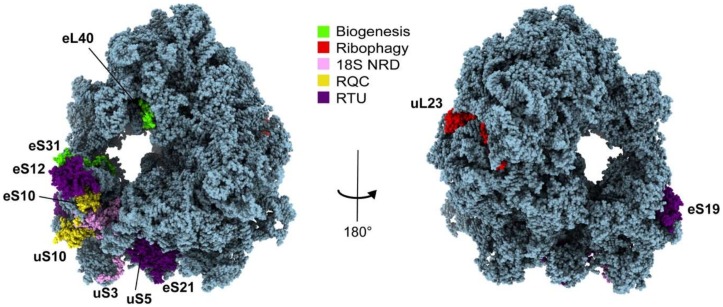
Spatial organization of ubiquitin-modified ribosomal proteins in translational control. Ribosomal proteins eL40 and eS31 are involved in ribosome biogenesis (green), uL23 is involved in ribophagy (red), uS3 is involved in 18S nonfunctional rRNA decay (pink), and eS10 and uS10 are involved in ribosome quality control (yellow). The ribosomal proteins found to be highly K63 ubiquitinated during oxidative stress and possibly involved in the RTU pathway (uS5, eS12, eS19, eS21) are highlighted in purple. This list includes uS3 and uS10, which are also involved in 18S NRD and RQC, respectively [81,82,127].
Figure 3
Figure 3
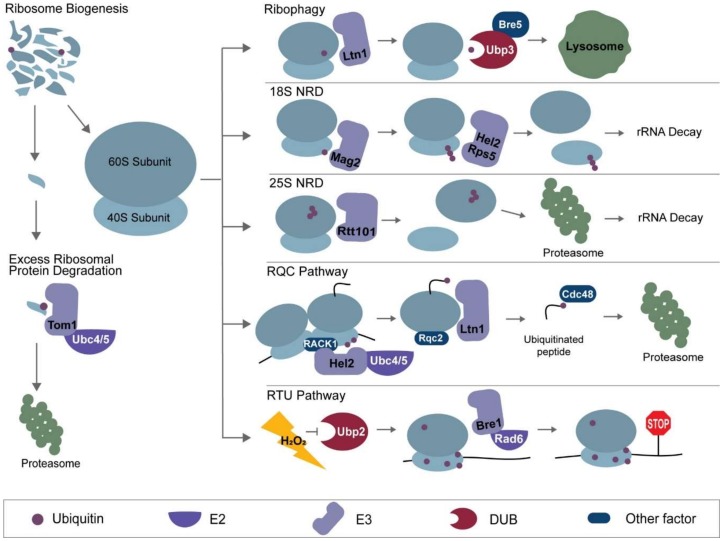
Summary of the ubiquitin-mediated pathways of translational control. The left panel highlights processes of ribosome turnover (ribosome biogenesis and excess ribosomal protein degradation). The right panel highlights ribosome fates through ubiquitin-mediated mechanisms, namely ribophagy, 18S non-functional rRNA decay (NRD), 25S NRD, Ribosome-associated protein Quality Control (RQC), and Redox control of Translation by Ubiquitin (RTU). Proteins involved in each mechanism are labeled as their yeast homologs, although some of these pathways have also been explored in mammalian systems.

References

    1. Wingender E. Compilation of transcription regulating proteins. Nucleic Acids Res. 1988;16:1879–1902. doi: 10.1093/nar/16.5.1879. - DOI - PMC - PubMed
    1. Mitchell P.J., Tjian R. Transcriptional regulation in mammalian cells by sequence-specific DNA binding proteins. Science. 1989;245:371–378. doi: 10.1126/science.2667136. - DOI - PubMed
    1. Velculescu V.E., Zhang L., Zhou W., Vogelstein J., Basrai M.A., Bassett D.E., Hieter P., Vogelstein B., Kinzler K.W. Characterization of the yeast transcriptome. Cell. 1997;88:243–251. doi: 10.1016/S0092-8674(00)81845-0. - DOI - PubMed
    1. Wingender E., Chen X., Hehl R., Karas H., Liebich I., Matys V., Meinhardt T., Prüß M., Reuter I., Schacherer F. TRANSFAC: An integrated system for gene expression regulation. Nucleic Acids Res. 2000;28:316–319. doi: 10.1093/nar/28.1.316. - DOI - PMC - PubMed
    1. Saha S., Sparks A.B., Rago C., Akmaev V., Wang C.J., Vogelstein B., Kinzler K.W., Velculescu V.E. Using the transcriptome to annotate the genome. Nat. Biotechnol. 2002;20:508–512. doi: 10.1038/nbt0502-508. - DOI - PubMed

LinkOut - more resources