


Venous thromboembolism rates after hip and knee arthroplasty and hip fractures
- PMID: 32050949
- PMCID: PMC7017506
- DOI: 10.1186/s12891-020-3100-4
Venous thromboembolism rates after hip and knee arthroplasty and hip fractures
Abstract
Background: The ideal thromboprophylaxis regime following lower limb arthroplasty and proximal femur fractures remains controversial. Guidelines disagree on the type of chemical prophylaxis, its dose or duration. This article describes a method of monitoring venous thromboembolism (VTE) rates following Total Hip (THA), Total Knee Arthroplasty (TKA) and surgery for hip fractures (NOF#).
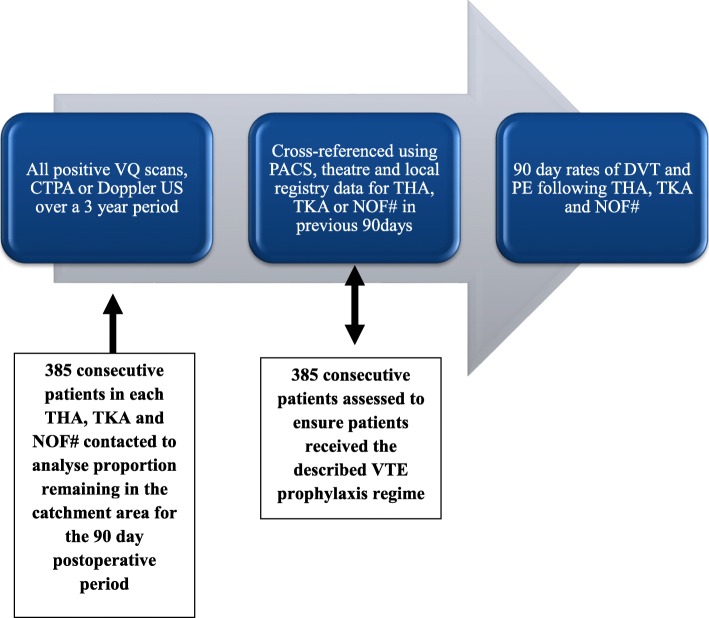
Methods: Over 3 years, all patients investigated for VTE were analysed using Picture Archiving Communications System (PACS). All positive scans were then cross-referenced using PACS and local registry data to see if they had undergone THA, TKA or NOF# in the preceding 90 days. Mortality data were obtained from the national administrative database, Hospital Episode Statistics.
Results: Five thousand seven hundred eighty-eight patients underwent investigation for VTE and there were 29 diagnoses of PE and 24 of DVT. There was a 0.77% rate of symptomatic DVT after THA, 0.05% after TKA and 0.55% after NOF #. The rate of confirmed symptomatic PE for THA was 0.46, 0.27% for TKA and 0.96% for NOF #. Mortality at one-year post-THA was 0.6, 0.6% for TKA and 25.9% after NOF#. All patients contacted either remained within the catchment area for the minimum 90 postoperative days or died within the catchment area.
Conclusions: The 90 day post-operative prevalence of symptomatic VTE of 1.2, 0.3 and 1.5% in THA, TKA and NOF # respectively are similar to other studies using symptomatic and imaging positive VTE as their endpoint. The study uses a method of collecting data which can be utilised in centres where PACS is available.
Keywords: Hip fractures; PACS; THA; TKA; VTE.
Conflict of interest statement
The authors declare that they have no competing interests.
Figures
References
-
- No authors listed. National Institute for Health and Clinical Excellence. Venous Thromboembolism; reducing the risk of venous thromboembolism (deep vein thrombosis and pulmonary embolism) in inpatients admitted to hospital: methods, evidence and guidance. 2010 http://www.nice.org.uk/nicemedia/live/12695/47920/47920.pdf.
-
- Haas SB, Barrack RL, Westrich G, Lachiewicz PF. Venous thromboembolic disease after total hip and knee arthroplasty. J Bone Joint Surg Am. 2008;90(12):2764–2780. - PubMed
MeSH terms
Substances
LinkOut - more resources
Full Text Sources
Medical
