. 2020 Jan 19:2020:2520483.
doi: 10.1155/2020/2520483. eCollection 2020.

Effects of Acupuncture on Hospitalized Patients with Urinary Retention

Affiliations

Effects of Acupuncture on Hospitalized Patients with Urinary Retention

Suhui Chen et al. Evid Based Complement Alternat Med. .

Abstract

Objective: The aim of this study was to investigate the effects of acupuncture on urinary retention and provide treatment suggestions.

Methods: A total of 113 hospitalized patients with urinary retention were included in this study. The GV20, CV6, CV4, CV3, ST28, SP6, and SP9 points were selected as the main acupoints. Acupuncture therapy was conducted for 30 minutes per session. The total number of treatment sessions was determined by the symptoms and the length of hospital stay. Bladder postvoid residual urine volume (PVR) was measured pretreatment and posttreatment by ultrasonic. Efficacy defined as spontaneous urination and a residual urine volume <50 mL was measured.

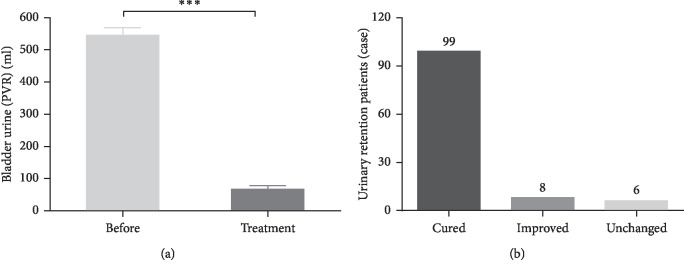
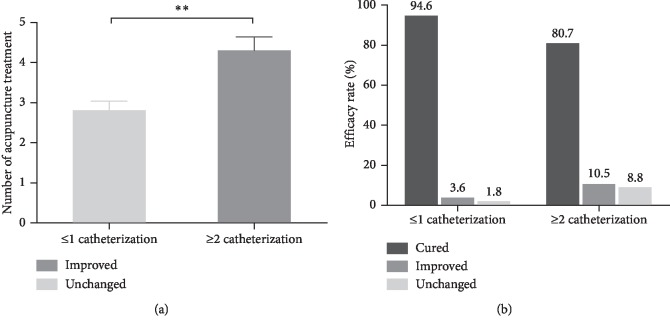
Results: The median number of acupuncture treatment sessions was 3 (range, 1-12 times). Acupuncture treatment significantly reduced the PVR (545.1 ± 23.9 mL vs 67.4 ± 10.7 mL; p < 0.001). Among the 113 patients, 99 (87.6%) patients were cured and 8 (7.1%) patients were improved of their urinary retention. The remaining 6 (5.3%) patients' urinary retention did not improve. The effective rate was 94.7%. There was significant difference in the efficacy rate between patients with one urinary catheterization and with two or more. Acupuncture treatment was not associated with side effects.

Conclusion: Acupuncture is an effective and safe treatment option for urinary retention. Early application of acupuncture treatment should be considered in clinic, and repeated urinary catheter insertion and removal should be avoided. Our study suggests that a randomized controlled study with a large sample size to verify the efficacy of acupuncture for the treatment of urinary retention is warranted.


Conflict of interest statement

The authors declare that they have no conflicts of interest.

Figures
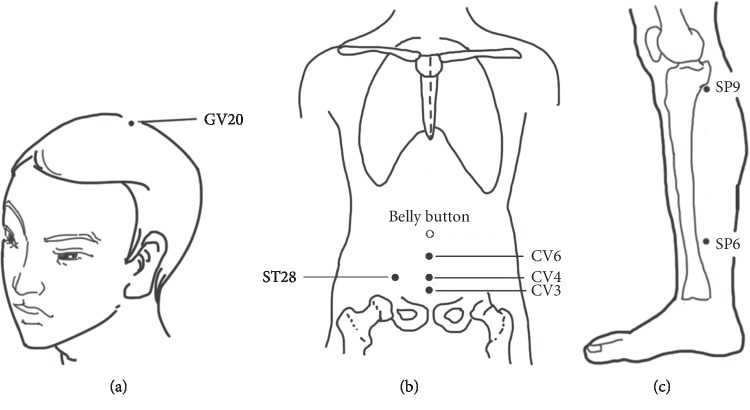
Figure 1
Figure 1
The nomenclature and location of the main acupoints. (a) GV20. (b) CV6, CV4, CV3, and ST28. (c) SP6 and SP9.
Figure 2
Figure 2
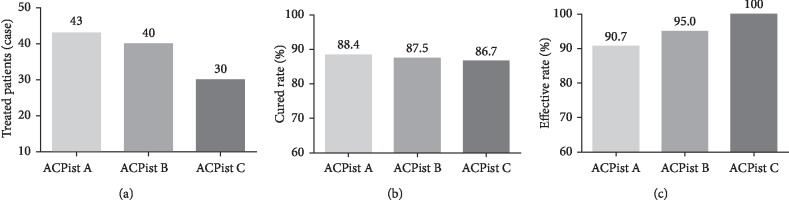
Characteristics of three acupuncturists involved in this study. (a) The treated patients, (b) the cured rate, and (c) the effective rate of three acupuncturists involved in this study. The data shown are the number and percentages (note: ACPist, acupuncturist).
Figure 3
Figure 3
Effects of acupuncture on patients with urinary retention. (a) The changes in bladder postvoid residual urine volume (PVR, ml) after acupuncture treatment. The data shown represent the mean ± SEM, ∗∗∗p < 0.001. (b) The outcome of patients who received acupuncture treatment. The data shown represent the number of cases.
Figure 4
Figure 4
Therapeutic effect between acupunctured patients with one urinary catheterization and with two or more. (a) The number of acupuncture treatment between patients with less than one urinary catheterization and with two or more. The data shown represent the mean ± SEM, ∗∗p < 0.01. (b) Efficacy rate of patients with one urinary catheterization and with two or more. The data shown as percentages.
Figure 5
Figure 5
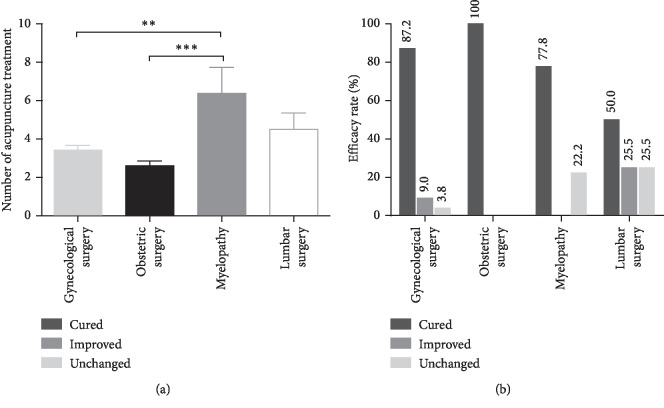
Therapeutic effect among acupunctured patients with gynecological surgery, obstetric surgery, myelopathy, and lumbar surgery. (a) The number of acupuncture treatment among patients with gynecological surgery, obstetric surgery, myelopathy, and lumbar surgery. The data shown represent the mean ± SEM, ∗∗p < 0.01, and ∗∗∗p < 0.001. (b) Efficacy rate of patients with gynecological surgery, obstetric surgery, myelopathy, and lumbar surgery. The data shown as percentages.

References

    1. Baldini G., Bagry H., Aprikian A., Carli F. Postoperative urinary retention: anesthetic and perioperative considerations. Anesthesiology. 2009;110(5):1139–1157. doi: 10.1097/aln.0b013e31819f7aea. - DOI - PubMed
    1. Choi J. H., Yoon S., Lee S. W., et al. Risk factors for postoperative urinary retention among women who underwent laparoscopic cholecystectomy. LUTS: Lower Urinary Tract Symptoms. 2019;11(3):158–162. doi: 10.1111/luts.12255. - DOI - PubMed
    1. Hansen B. S., Søreide E., Warland A. M., Nilsen O. B. Risk factors of post-operative urinary retention in hospitalised patients. Acta Anaesthesiologica Scandinavica. 2011;55(5):545–548. doi: 10.1111/j.1399-6576.2011.02416.x. - DOI - PubMed
    1. Kandadai P., Saini J., Patterson D., O’Dell K., Flynn M. Urinary retention after hysterectomy and postoperative analgesic use. Female Pelvic Medicine & Reconstructive Surgery. 2015;21(5):257–262. doi: 10.1097/spv.0000000000000151. - DOI - PubMed
    1. Geller E. J. Prevention and management of postoperative urinary retention after urogynecologic surgery. International Journal of Women’s Health. 2014;6:829–838. doi: 10.2147/ijwh.s55383. - DOI - PMC - PubMed