


Capturing At-Home Health and Care Information for Children With Medical Complexity Using Voice Interactive Technologies: Multi-Stakeholder Viewpoint
- PMID: 32053114
- PMCID: PMC7055855
- DOI: 10.2196/14202
Capturing At-Home Health and Care Information for Children With Medical Complexity Using Voice Interactive Technologies: Multi-Stakeholder Viewpoint
Abstract
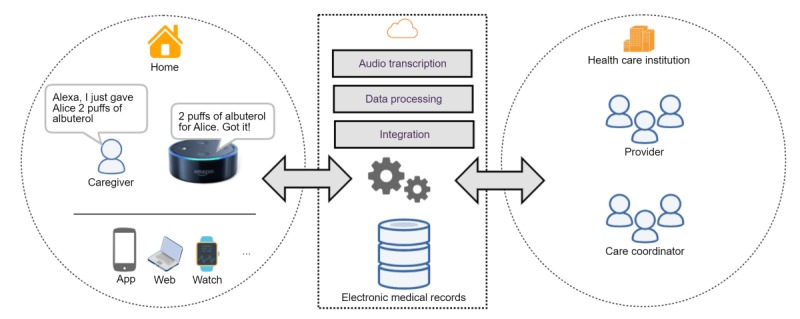
Digital health tools and technologies are transforming health care and making significant impacts on how health and care information are collected, used, and shared to achieve best outcomes. As most of the efforts are still focused on clinical settings, the wealth of health information generated outside of clinical settings is not being fully tapped. This is especially true for children with medical complexity (CMC) and their families, as they frequently spend significant hours providing hands-on medical care within the home setting and coordinating activities among multiple providers and other caregivers. In this paper, a multidisciplinary team of stakeholders discusses the value of health information generated at home, how technology can enhance care coordination, and challenges of technology adoption from a patient-centered perspective. Voice interactive technology has been identified to have the potential to transform care coordination for CMC. This paper shares opinions on the promises, limitations, recommended approaches, and challenges of adopting voice technology in health care, especially for the targeted patient population of CMC.
Keywords: care coordination; children with medical complexity; conversational agents; digital health; self-management; voice assistant; voice technology.
©Emre Sezgin, Garey Noritz, Alexander Elek, Kimberly Conkol, Steve Rust, Matthew Bailey, Robert Strouse, Aarti Chandawarkar, Victoria von Sadovszky, Simon Lin, Yungui Huang. Originally published in the Journal of Medical Internet Research (http://www.jmir.org), 13.02.2020.
Conflict of interest statement
Conflicts of Interest: None declared.
Figures

References
-
- US Department of Health and Human Services. Health Resources and Services Administration. Maternal and Child Health Bureau . Rockville, Maryland: US Department of Health and Human Services; 2013. The National Survey of Children with Special Health Care Needs Chartbook 2009-2010 https://mchb.hrsa.gov/cshcn0910/more/pdf/nscshcn0910.pdf.
-
- Cohen E, Kuo DZ, Agrawal R, Berry JG, Bhagat SK, Simon TD, Srivastava R. Children with medical complexity: an emerging population for clinical and research initiatives. Pediatrics. 2011 Mar;127(3):529–38. doi: 10.1542/peds.2010-0910. http://europepmc.org/abstract/MED/21339266 - DOI - PMC - PubMed
-
- Amir O, Grosz BJ, Gajos KZ, Swenson SM, Sanders LM. From care plans to care coordination: opportunities for computer support of teamwork in complex healthcare. Proceedings of the 33rd Annual ACM Conference on Human Factors in Computing Systems; ACM Conference on Human Factors in Computing Systems; April 18-23, 2015; Seoul, Republic of Korea. 2014. Mar, pp. 101–4. https://dl.acm.org/citation.cfm?id=2702320 - DOI
-
- Council on Children with Disabilities Medical Home Implementation Project Advisory Committee Patient- and family-centered care coordination: a framework for integrating care for children and youth across multiple systems. Pediatrics. 2014 May;133(5):e1451–60. doi: 10.1542/peds.2014-0318. - DOI - PubMed
Publication types
MeSH terms
LinkOut - more resources
Full Text Sources
Medical
Research Materials
