Feasibility of First Injection of Autologous Adipose Tissue-Derived Stromal Vascular Fraction in Human Scarred Vocal Folds: A Nonrandomized Controlled Trial
- PMID: 32053141
- PMCID: PMC7163407
- DOI: 10.1001/jamaoto.2019.4328
Feasibility of First Injection of Autologous Adipose Tissue-Derived Stromal Vascular Fraction in Human Scarred Vocal Folds: A Nonrandomized Controlled Trial
Abstract
Importance: Patients with scarred vocal folds, whether congenitally or after phonosurgery, often exhibit dysphonia that negatively affects daily life and is difficult to treat. The autologous adipose tissue-derived stromal vascular fraction (ADSVF) is a readily accessible source of cells with angiogenic, anti-inflammatory, immunomodulatory, and regenerative properties.
Objective: To evaluate the feasibility and tolerability of local injections of autologous ADSVF in patients with scarred vocal folds.
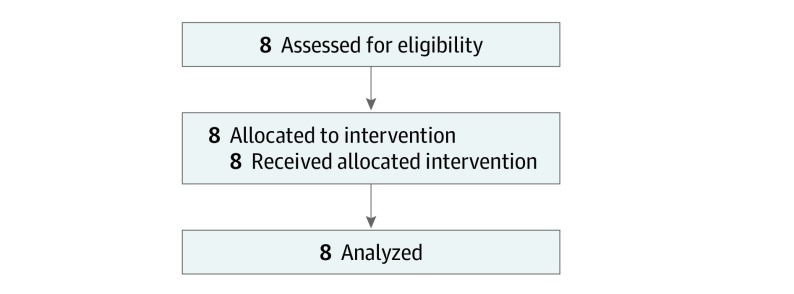
Design, setting, and participants: CELLCORDES (Innovative Treatment for Scarred Vocal Cords by Local Injection of Autologous Stromal Vascular Fraction) is a prospective, open-label, single-arm, single-center, nonrandomized controlled trial with a 12-month follow-up and patient enrollment from April 1, 2016, to June 30, 2017. Eight patients with severe dysphonia attributable to vocal fold scarring associated with a congenital malformation or resulting from microsurgical sequelae (voice handicap index score >60 of 120) completed the study. Data analysis was performed from September 1, 2018, to January 1, 2019.
Interventions: Injection of ADSVF into 1 or 2 vocal folds.
Main outcomes and measures: The primary outcomes were feasibility and the number and severity of adverse events associated with ADSVF-based therapy. The secondary outcomes were changes in vocal assessment, videolaryngostroboscopy, self-evaluation of dysphonia, and quality of life at 1, 6, and 12 months after cell therapy.
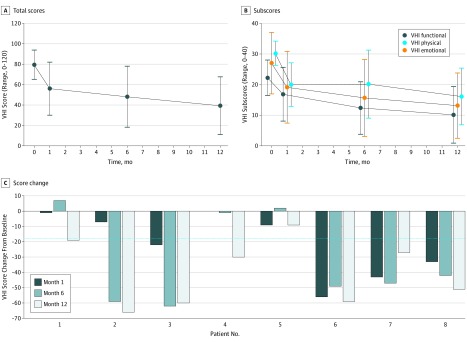
Results: Seven women and 1 man (mean [SD] age, 44.6 [10.4] years) were enrolled in this study. Adverse events associated with liposuction and ADSVF injection occurred; most of them resolved spontaneously. One patient received minor treatment to drain local bruising, and another experienced a minor contour defect at the liposuction site. At 12 months, the voice handicap index score was improved in all patients, with a mean (SD) improvement from baseline of 40.1 (21.5) points. Seven patients (88%) were considered to be responders, defined as improvement by 18 points or more in the voice handicap index score (the minimum clinically important difference).
Conclusions and relevance: The findings suggest that autologous ADSVF injection in scarred vocal folds is feasible and tolerable. The findings require confirmation in a randomized clinical trial with a larger population.
Trial registration: ClinicalTrials.gov Identifier: NCT02622464.
Conflict of interest statement
Figures
References
-
- Friedrich G, Dikkers FG, Arens C, et al. ; European Laryngological Society. Phonosurgery Committee . Vocal fold scars: current concepts and future directions: consensus report of the Phonosurgery Committee of the European Laryngological Society. Eur Arch Otorhinolaryngol. 2013;270(9):2491-2507. doi: 10.1007/s00405-013-2498-9 - DOI - PubMed
-
- Hirano M. Phonosurgery: basic and clinical investigation. Otologia (Fukuoka). 1975;21:239-440.
Publication types
MeSH terms
Associated data
LinkOut - more resources
Full Text Sources
Medical
Miscellaneous