


Impact of delayed treatment in women diagnosed with breast cancer: A population-based study
- PMID: 32053293
- PMCID: PMC7131859
- DOI: 10.1002/cam4.2830
Impact of delayed treatment in women diagnosed with breast cancer: A population-based study
Abstract
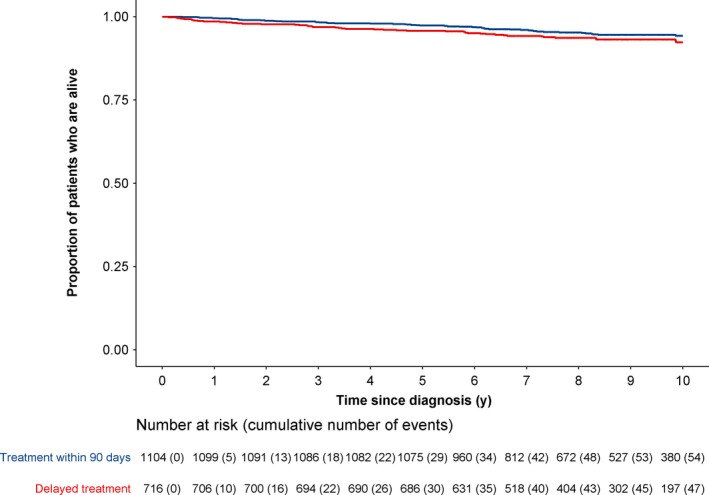
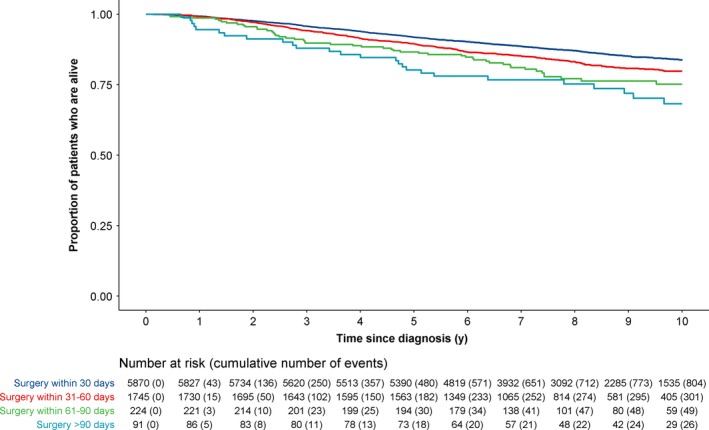
The impact of timely treatment on breast cancer-specific survival may differ by tumor stage. We aim to study the impact of delayed first treatment on overall survival across different tumor stages. In addition, we studied the impact of delayed adjuvant treatments on survival in patients with invasive nonmetastatic breast cancer who had surgery ≤90 days postdiagnosis. This population-based study includes 11 175 breast cancer patients, of whom, 2318 (20.7%) died (median overall survival = 7.9 years). To study the impact of delayed treatment on survival, hazard ratios and corresponding 95% confidence intervals were estimated using Cox proportional-hazards models. The highest proportion of delayed first treatment (>30 days postdiagnosis) was in patients with noninvasive breast cancer (61%), followed by metastatic breast cancer (50%) and invasive nonmetastatic breast cancer (22%). Delayed first treatment (>90 vs ≤30 days postdiagnosis) was associated with worse overall survival in patients with invasive nonmetastatic (HR: 2.25, 95% CI 1.55-3.28) and metastatic (HR: 2.09, 95% CI 1.66-2.64) breast cancer. Delayed adjuvant treatment (>90 vs 31-60 days postsurgery) was associated with worse survival in patients with invasive nonmetastatic (HR: 1.50, 95% CI 1.29-1.74). Results for the Cox proportional-hazards models were similar for breast cancer-specific death. A longer time to first treatment (31-90 days postdiagnosis) may be viable for more extensive diagnostic workup and patient-doctor decision-making process, without compromising survival. However, patients' preference and anxiety status need to be considered.
Keywords: Singapore; breast cancer; population; proportional-hazards models; survival.
© 2020 The Authors. Cancer Medicine published by John Wiley & Sons Ltd.
Conflict of interest statement
The authors declare no potential conflicts of interest.
Figures
References
Publication types
MeSH terms
LinkOut - more resources
Full Text Sources
Medical
