. 2020 Feb 13;15(2):e0228989.
doi: 10.1371/journal.pone.0228989. eCollection 2020.

Urinary chemical fingerprint left behind by repeated NSAID administration: Discovery of putative biomarkers using artificial intelligence

Affiliations

Urinary chemical fingerprint left behind by repeated NSAID administration: Discovery of putative biomarkers using artificial intelligence

Liam E Broughton-Neiswanger et al. PLoS One. .

Abstract

Prediction and early detection of kidney damage induced by nonsteroidal anti-inflammatories (NSAIDs) would provide the best chances of maximizing the anti-inflammatory effects while minimizing the risk of kidney damage. Unfortunately, biomarkers for detecting NSAID-induced kidney damage in cats remain to be discovered. To identify potential urinary biomarkers for monitoring NSAID-based treatments, we applied an untargeted metabolomics approach to urine collected from cats treated repeatedly with meloxicam or saline for up to 17 days. Applying multivariate analysis, this study identified a panel of seven metabolites that discriminate meloxicam treated from saline treated cats. Combining artificial intelligence machine learning algorithms and an independent testing urinary metabolome data set from cats with meloxicam-induced kidney damage, a panel of metabolites was identified and validated. The panel of metabolites including tryptophan, tyrosine, taurine, threonic acid, pseudouridine, xylitol and lyxitol, successfully distinguish meloxicam-treated and saline-treated cats with up to 75-100% sensitivity and specificity. This panel of urinary metabolites may prove a useful and non-invasive diagnostic tool for monitoring potential NSAID induced kidney injury in feline patients and may act as the framework for identifying urine biomarkers of NSAID induced injury in other species.


Conflict of interest statement

The authors have declared that no competing interests exist.

Figures
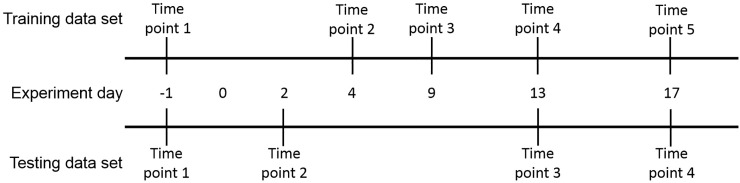
Fig 1
Fig 1. Sampling schedule for metabolite determination in the training and testing groups.
Day -1 represents the pretreatment time point. For both the training and testing data sets, starting on day 0 cats in the treatment groups for each set received 0.3 mg/kg meloxicam every 24h till the end of the study. Cats in the control groups received 0.1 mL/kg body weight of saline every 24h until the studies end.
Fig 2
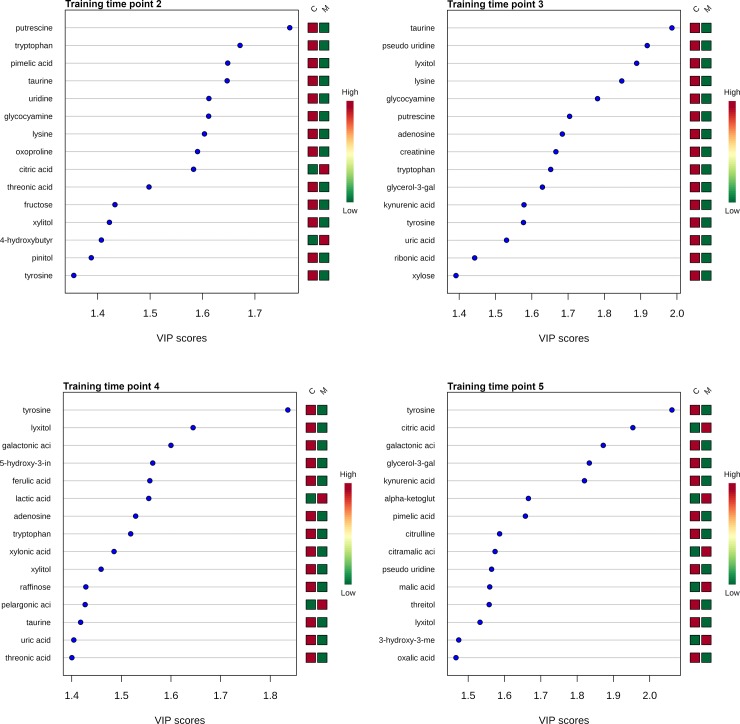
Fig 2. Variable importance in projection (VIP) scores for the top 15 metabolites.
VIP scores of top 15 urine metabolites used to differentiate meloxicam-treated (n = 5) and saline-treated cats (n = 6). VIP scores are derived from PLS-DA analysis performed at each time point, 1–5. VIP scores ≥ 1.0 were considered significant when selecting metabolites for the final model. The column to the right of each figure display variations in metabolite peak intensities.
Fig 3
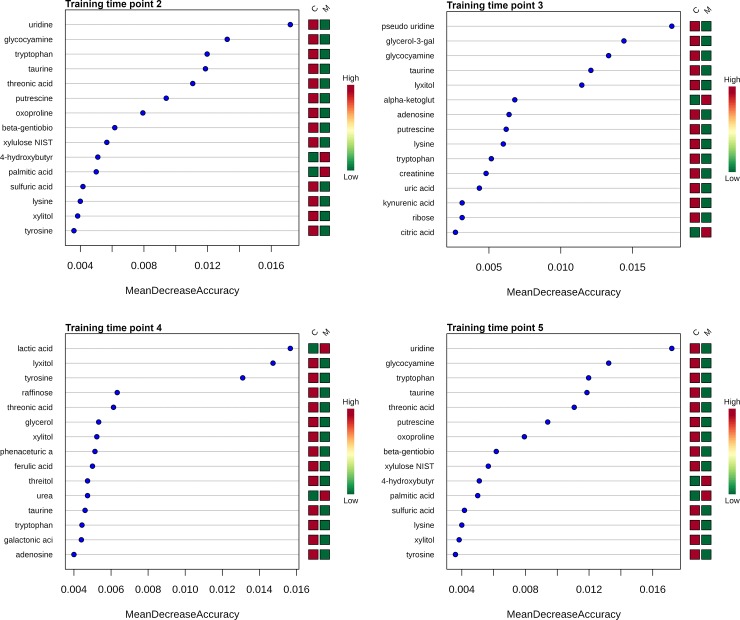
Fig 3. Mean decrease in accuracy (MDA) of top 15 urine metabolites.
MDA of the top 15 urine metabolites for the discrimination of meloxicam-treated (n = 5) and saline-controls (n = 6) for each time points (2–5) after the administration of meloxicam derived from random forest analysis. The higher the MDA value the more important a metabolite is to the performance of the model. Urine metabolites with a mean decrease in accuracy ≥ 0.004 in at least one post-treatment time point (2–5) were considered for inclusion in the predictive model.

References

    1. Laine L. Approaches to nonsteroidal anti-inflammatory drug use in the high-risk patient. Gastroenterology. 2001;120(3):594–606. . - PubMed
    1. Harirforoosh S, Jamali F. Renal adverse effects of nonsteroidal anti-inflammatory drugs. Expert Opin Drug Saf. 2009;8(6):669–81. 10.1517/14740330903311023 . - DOI - PubMed
    1. Hörl WH. Nonsteroidal Anti-Inflammatory Drugs and the Kidney. Pharmaceuticals (Basel). 2010;3(7):2291–321. Epub 2010/07/21. 10.3390/ph3072291 - DOI - PMC - PubMed
    1. Sostres C, Gargallo CJ, Lanas A. Nonsteroidal anti-inflammatory drugs and upper and lower gastrointestinal mucosal damage. Arthritis Res Ther. 2013;15 Suppl 3:S3. Epub 2013/07/24. 10.1186/ar4175 - DOI - PMC - PubMed
    1. Chawla LS, Eggers PW, Star RA, Kimmel PL. Acute kidney injury and chronic kidney disease as interconnected syndromes. N Engl J Med. 2014;371(1):58–66. 10.1056/NEJMra1214243 . - DOI - PMC - PubMed

Publication types