Review
. 2020 Feb 11;21(4):1199.
doi: 10.3390/ijms21041199.

Distinct Roles of mTOR Targets S6K1 and S6K2 in Breast Cancer

Affiliations
Review

Distinct Roles of mTOR Targets S6K1 and S6K2 in Breast Cancer

Savitha Sridharan et al. Int J Mol Sci. .

Abstract

The mechanistic target of rapamycin (mTOR) is a master regulator of protein translation, metabolism, cell growth and proliferation. It forms two complexes, mTOR complex 1 (mTORC1) and 2 (mTORC2). mTORC1 is frequently deregulated in many cancers, including breast cancer, and is an important target for cancer therapy. The immunosuppressant drug rapamycin and its analogs that inhibit mTOR are currently being evaluated for their potential as anti-cancer agents, albeit with limited efficacy. mTORC1 mediates its function via its downstream targets 40S ribosomal S6 kinases (S6K) and eukaryotic translation initiation factor 4E (eIF4E)-binding protein 1 (4E-BP1). There are two homologs of S6K: S6K1 and S6K2. Most of the earlier studies focused on S6K1 rather than S6K2. Because of their high degree of structural homology, it was generally believed that they behave similarly. Recent studies suggest that while they may share some functions, they may also exhibit distinct or even opposite functions. Both homologs have been implicated in breast cancer, although how they contribute to breast cancer may differ. The purpose of this review article is to compare and contrast the expression, structure, regulation and function of these two S6K homologs in breast cancer.

Keywords: RPS6KB1; RPS6KB2; S6K1; S6K2; breast cancer; mTOR.


Conflict of interest statement

The authors declare no conflict of interest.

Figures
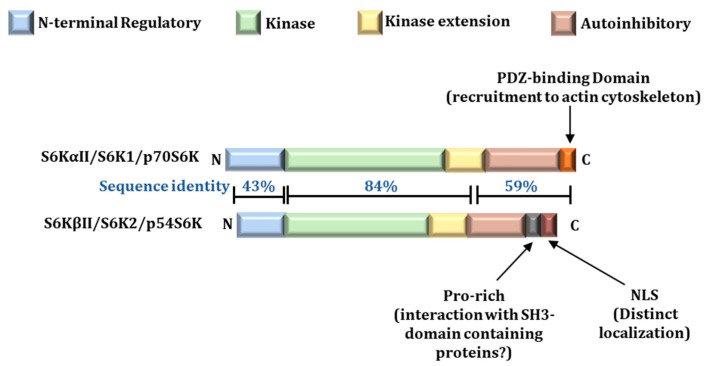
Figure 1
Figure 1
Modular structure of S6Ks. S6K1 and S6K2 share significant homology in their kinase domains. However, the shorter isoforms of both S6K1 and S6K2, which are the predominant forms, exhibit substantial divergence in the extreme N- and C-terminal regions.
Figure 2
Figure 2
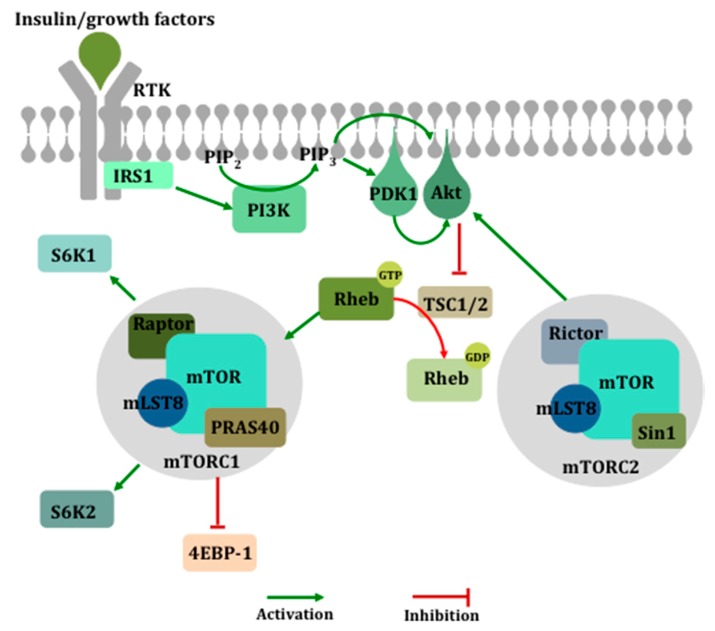
The activation of the mechanistic target of rapamycin (mTOR). Growth factor-mediated activation of the phosphatidylinositol 3-kinase (PI3K) pathway leads to the membrane recruitment and activation of phosphoinositide-dependent kinase 1 (PDK1) and Akt, which then phosphorylates and inactivates the tuberous sclerosis complex (TSC1/2), a negative regulator of ras homolog enriched in brain (Rheb), ultimately resulting in the activation of mTOR within complex 1. mTORC1 mediates its downstream effects primarily via the inhibition of eukaryotic translation initiation factor 4E (eIF4E)-binding protein 1 (4E-BP1) and the activation of S6 kinase (S6K).

References

    1. Dey N., De P., Leyland-Jones B. PI3K-AKT-mTOR inhibitors in breast cancers: From tumor cell signaling to clinical trials. Pharmacol. Ther. 2017;175:91–106. doi: 10.1016/j.pharmthera.2017.02.037. - DOI - PubMed
    1. Guerrero-Zotano A., Mayer I.A., Arteaga C.L. PI3K/AKT/mTOR: Role in breast cancer progression, drug resistance, and treatment. Cancer Metastasis Rev. 2016;35:515–524. doi: 10.1007/s10555-016-9637-x. - DOI - PubMed
    1. Castaneda C.A., Cortes-Funes H., Gomez H.L., Ciruelos E.M. The phosphatidyl inositol 3-kinase/AKT signaling pathway in breast cancer. Cancer Metastasis Rev. 2010;29:751–759. doi: 10.1007/s10555-010-9261-0. - DOI - PubMed
    1. Dillon R.L., Muller W.J. Distinct biological roles for the akt family in mammary tumor progression. Cancer Res. 2010;70:4260–4264. doi: 10.1158/0008-5472.CAN-10-0266. - DOI - PMC - PubMed
    1. Wickenden J.A., Watson C.J. Key signalling nodes in mammary gland development and cancer. Signalling downstream of PI3 kinase in mammary epithelium: A play in 3 Akts. Breast Cancer Res. 2010;12:202. doi: 10.1186/bcr2558. - DOI - PMC - PubMed

MeSH terms

Substances