Comparison of carcass and meat quality traits between lean and fat Pekin ducks
- PMID: 32054185
- PMCID: PMC8255871
- DOI: 10.5713/ajas.19.0612
Comparison of carcass and meat quality traits between lean and fat Pekin ducks
Abstract
Objective: According to market demand, meat duck breeding mainly includes 2 breeding directions: lean Pekin duck (LPD) and fat Pekin duck (FPD). The aim of the present study was to compare carcass and meat quality traits between 2 strains, and to provide basic data for guidelines of processing and meat quality improvement.
Methods: A total of 62 female Pekin ducks (32 LPDs and 30 FPDs) were slaughtered at the age of 42 days. The live body weight and carcass traits were measured and calculated. Physical properties of breast muscle were determined by texture analyzer and muscle fibers were measured by paraffin sections. The content of inosine monophosphate (IMP), intramuscular fat (IMF) and fatty acids composition were measured by high-performance liquid chromatography, Soxhlet extraction method and automated gas chromatography respectively.
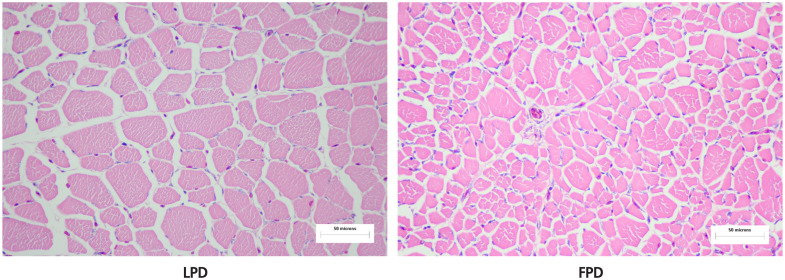
Results: The results showed that the bodyweight of LPDs was higher than that of FPDs. FPDs were significantly higher than LPDs in subcutaneous fat thickness, subcutaneous fat weight, subcutaneous fat percentage, abdominal fat percentage and abdominal fat shear force (p<0.01). LPDs were significantly higher than FPDs in breast muscle thickness, breast muscle weight, breast muscle rate and breast muscle shear force (p<0.01). The muscle fiber average area and fiber diameter of LPDs were significantly higher than those of FPDs (p<0.01). The muscle fiber density of LPDs was significantly lower than that of FPDs (p<0.01). The IMF of LPDs in the breast muscle was significantly higher than that in the FPDs (p<0.01). There was no significant difference between the 2 strains in IMP content (p>0.05). The polyunsaturated fatty acid content of LPDs was significantly higher than that of FPDs (p<0.01), and FPDs had higher saturated fatty acid and monounsaturated fatty acid levels (p<0.05).
Conclusion: Long-term breeding work resulted in vast differences between the two strains Pekin ducks. This study provides a reference for differences between LPD and FPD that manifest as a result of long-term selection.
Keywords: Carcass Traits; Fatty Acids; Intramuscular Fat; Meat Quality; Pekin Duck.
Conflict of interest statement
We certify that there is no conflict of interest with any financial organization regarding the material discussed in the manuscript. Hao JP, Yang FX are employees of Beijing Golden Star Duck Center.
Figures
References
Grants and funding
LinkOut - more resources
Full Text Sources