


Association between periodontitis and anti-citrullinated protein antibodies in rheumatoid arthritis patients: a cross-sectional study
- PMID: 32054521
- PMCID: PMC7020577
- DOI: 10.1186/s13075-020-2121-6
Association between periodontitis and anti-citrullinated protein antibodies in rheumatoid arthritis patients: a cross-sectional study
Abstract
Aim: The aim of this study was to evaluate the association between periodontal parameters related with the periodontal disease severity and the presence and levels of anti-citrullinated protein antibodies (ACPAs) in rheumatoid arthritis (RA) patients.
Materials and methods: This cross-sectional study included 164 RA patients. Socio-demographics and RA disease characteristics, including ELISA-detected ACPA (anti-CCP-2), were recorded. Exposure was assessed by periodontal parameters: plaque index (PI), bleeding on probing (BoP), probing pocket depth, and clinical attachment levels (CAL). Presence and levels of ACPAs (outcome) and exposure variables were compared by both parametric and non-parametric tests and associations were evaluated by adjusted odds ratio (OR).
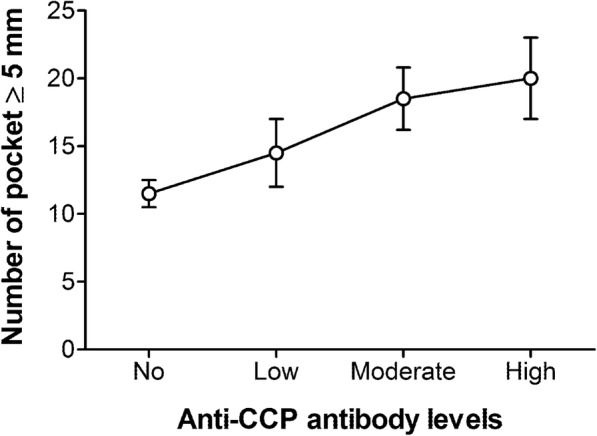
Results: A significant association was observed between the presence of anti-CCP antibodies and severity of periodontal outcomes such as the mean CAL (OR 1.483, p = 0.036), mean PI (OR 1.029, p = 0.012), and the number of pockets ≥ 5 mm (OR 1.021, p = 0.08). High anti-CCP antibodies levels were associated with mean CAL, mean PI, and number of pockets ≥ 5 mm with an OR of 1.593 (p = 0.043), 1.060 (p < 0.001), and 1.031 (p = 0.031), respectively. Furthermore, a significant increase of 4.45 U/mL in anti-CCP antibodies levels (p = 0.002) in RA patients was found for each pocket ≥ 5 mm after adjusting for age, gender, smoking, time of disease evolution, and RA activity.
Conclusions: In RA patients, the severity of periodontal conditions such as mean CAL, mean PI, and the number of pockets ≥ 5 mm were linearly associated with both the presence and levels of anti-CCP antibodies.
Keywords: ACPA; Rheumatoid arthritis; Rheumatoid factor; Severe periodontitis.
Conflict of interest statement
The authors declare that they have no competing interests.
Figures
References
-
- Rakieh C, Rakieh C, Nam JL, Nam JL, Hunt L, Hunt L, et al. Predicting the development of clinical arthritis in anti-CCP positive individuals with non-specific musculoskeletal symptoms: a prospective observational cohort study. Ann Rheum Dis. 2015;74:1659–1666. doi: 10.1136/annrheumdis-2014-205227. - DOI - PubMed
Publication types
MeSH terms
Substances
LinkOut - more resources
Full Text Sources
Medical
Research Materials
Miscellaneous
