Review
. 2018;55(2):79-93.
doi: 10.2141/jpsa.0170132. Epub 2017 Dec 25.

Selenium in Poultry Nutrition: from Sodium Selenite to Organic Selenium Sources

Affiliations
Review

Selenium in Poultry Nutrition: from Sodium Selenite to Organic Selenium Sources

Peter F Surai et al. J Poult Sci. 2018.

Abstract

Selenium (Se) is an essential element in poultry nutrition and its bio-efficacy depends on its chemical form. A growing body of research proves that organic forms of Se, mainly selenomethionine (SeMet), in poultry diets have a range of important advantages over traditional sodium selenite. In fact, the organic Se concept considers SeMet as a storage form of Se in the chicken body. As chickens are not able to synthesize SeMet, its provision through diet is a key strategy to fight commercially relevant stresses. Indeed, in stress conditions, when increased selenoprotein expression requires additional Se, while its provision via feed usually decreases due to a reduction in feed consumption, Se reserves in the body (mainly in the muscles) could help maintain an effective antioxidant defense and prevent detrimental consequences of stresses. The poultry industry is looking for the most effective sources of organic Se for commercial use. In this review, advantages and disadvantages of main organic Se sources for poultry (Se-yeast, SeMet, and OH-SeMet) are analyzed, and future directions for the development of new Se sources are identified.

Keywords: OH-SeMet; Se-yeast; SeMet; chicken; poultry; selenium.


Figures

Fig. 1.
Fig. 1.
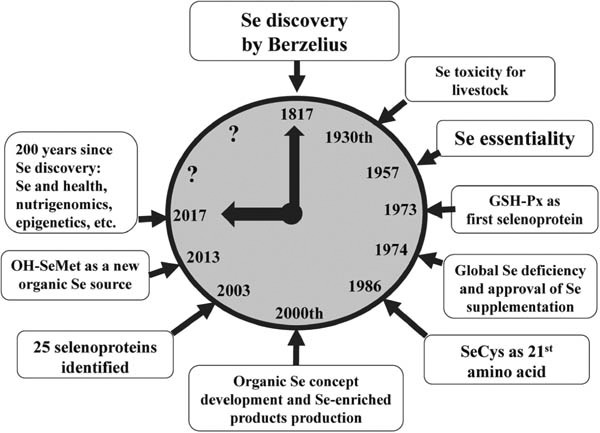
History of Se research and usage. Selenium was discovered by the Swedish chemist Berzelius in 1817. In 1930, Se toxicity for livestock was described (Surai, 2006). In 1957, Se essentiality was discovered by Schwarz and Foltz (1957, 1958). The first selenoprotein, GSH-Px was described by Rotruck et al. (1973). In 1970, a global Se deficiency in livestock was admitted and the FDA approved Se supplements for poultry and swine in 1974 in the form of selenite or selenate. In 1986, SeCys was identified as the 21st amino acid encoded by the stop codon TGA (Chambers et al., 1986). The organic Se concept was developed in 2000 and a range of Se-enriched products appeared on the market (Surai, 2006). In 2003, mammalian proteomes were characterised and 25 selenoproteins were identified (Kryukov et al., 2003). Later, 26 genes encoding different selenoproteins were identified (Lei, 2017; Zhao et al., 2017). Organic selenium sources found their way into animal/poultry nutrition, and a new effective source of organic Se (OH-SeMet) combining major advantages of Se-yeast and pure SeMet was successfully tested and found its way to poultry/animal industry (Briens et al., 2013, 2014; Jlali et al., 2013). Two hundred years have passed since the discovery of Se, and interest in the chemistry, biochemistry, and practical application of this element in poultry/animal industry increases steadily.
Fig. 2.
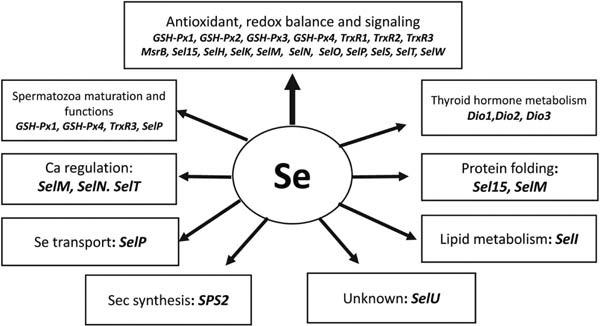
Fig. 2.. Established and suggested selenoprotein functions.
Fig. 3.
Fig. 3.
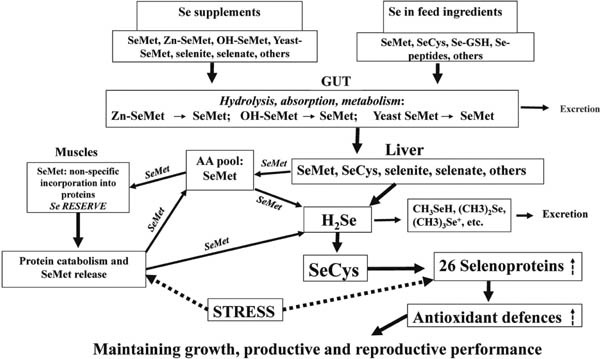
Organic Se in action. A range of Se-containing compounds, including selenite, selenate, SeMet, Zn-SeMet, OH-SeMet, Se-yeast, SeCys, Se-GSH, and Se-peptides, can be included into premixes. All those Se forms come to the intestine where initial hydrolysis (Se-Met will be released from Se-yeast or Zn-SeMet; OH-SeMet will be converted into SeMet) and some metabolic changes will take place. This includes excretion of Se metabolites via bile, feces, and urine. Further, selenite, selenate, SeMet and some other Se forms will be delivered to the liver for metabolization and distribution. In parallel, a fraction of SeMet will go to the free amino acid pool and be used for building Se reserves mainly in muscles. The next step of Se assimilation and metabolism includes the conversion of all major forms of Se into H2Se, from which SeCys will be synthesized and incorporated into 26 newly synthesized selenoproteins that are integral part of the antioxidant system of the body. Under stress conditions, protein catabolism will take place, which will release some SeMet incorporated into those proteins, and this SeMet will be converted into H2Se and further into newly synthesized SeCys and 26 selenoproteins. Additional sources of Se will be responsible for the upregulation of selenoprotein genes and additional synthesis of selenoproteins, which will upregulate antioxidant defenses and will aid the body to adapt to and overcome the stress with minimal negative consequences. When only selenite is present in the diet, Se reserves in the muscles will not be built and therefore, the ability of the body to adapt to stress will be restricted.
Fig. 4.
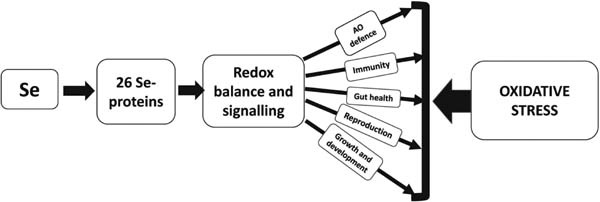
Fig. 4.. Protective effects of Se in poultry.

References

    1. Ahmed HH, Khalil WK and, Hamza AH. Molecular mechanisms of nano-selenium in mitigating hepatocellular carcinoma induced by N-nitrosodiethylamine (NDEA) in rats. Toxicology Mechanisms and Methods, 24: 593-602. 2014. - PubMed
    1. Alfthan G, Xu GL, Tan WH, Aro A, Wu J, Yang YX, Liang WS, Xue WL and Kong LH. Selenium supplementation of children in a selenium-deficient area in China: blood selenium levels and glutathione peroxidase activities. Biological Trace Element Research, 73: 113-125. 2000. - PubMed
    1. Amoako PO, Uden PC and Tyson JF. Speciation of selenium dietary supplements; formation of S-(methylseleno)cysteine and other selenium compounds. Analytica Chimica Acta, 652: 315-323. 2009. - PubMed
    1. Anan Y, Mikami T, Tsuji Y, Ogra Y. Distribution and metabolism of selenohomolanthionine labeled with a stable isotope. Analytical Bioanalitical Chemistry, 399: 1765-1772. 2011. - PubMed
    1. Anan Y and Ogra Y. Toxicological and pharmacological analysis of selenohomolanthionine in mice. Toxicology Research, 2: 115-122. 2013.