


Evolutionary genomics can improve prediction of species' responses to climate change
- PMID: 32055407
- PMCID: PMC7006467
- DOI: 10.1002/evl3.154
Evolutionary genomics can improve prediction of species' responses to climate change
Abstract
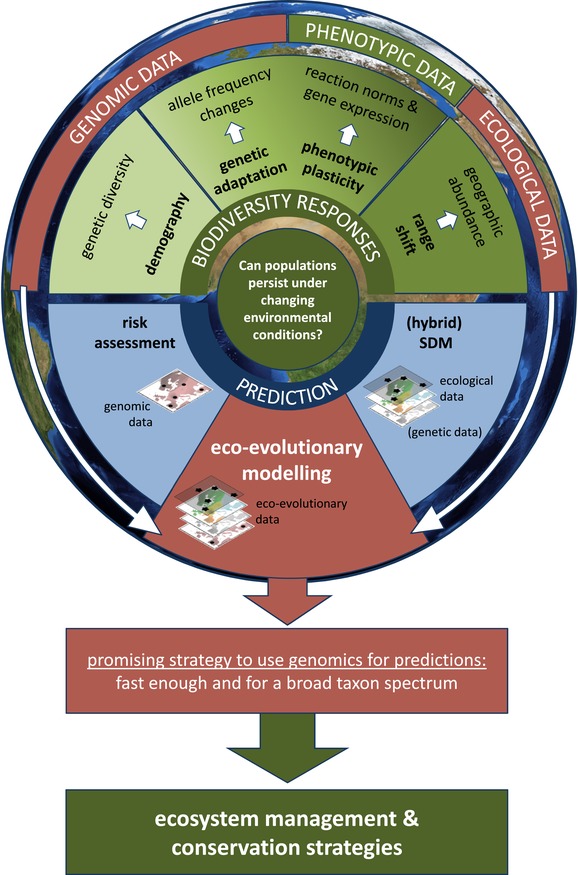
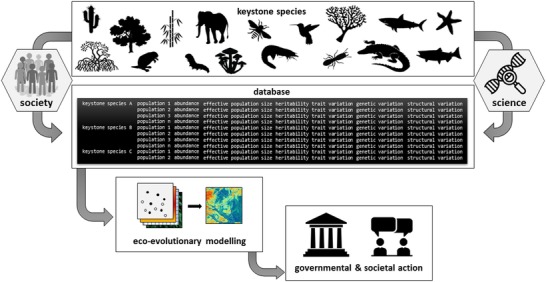
Global climate change (GCC) increasingly threatens biodiversity through the loss of species, and the transformation of entire ecosystems. Many species are challenged by the pace of GCC because they might not be able to respond fast enough to changing biotic and abiotic conditions. Species can respond either by shifting their range, or by persisting in their local habitat. If populations persist, they can tolerate climatic changes through phenotypic plasticity, or genetically adapt to changing conditions depending on their genetic variability and census population size to allow for de novo mutations. Otherwise, populations will experience demographic collapses and species may go extinct. Current approaches to predicting species responses to GCC begin to combine ecological and evolutionary information for species distribution modelling. Including an evolutionary dimension will substantially improve species distribution projections which have not accounted for key processes such as dispersal, adaptive genetic change, demography, or species interactions. However, eco-evolutionary models require new data and methods for the estimation of a species' adaptive potential, which have so far only been available for a small number of model species. To represent global biodiversity, we need to devise large-scale data collection strategies to define the ecology and evolutionary potential of a broad range of species, especially of keystone species of ecosystems. We also need standardized and replicable modelling approaches that integrate these new data to account for eco-evolutionary processes when predicting the impact of GCC on species' survival. Here, we discuss different genomic approaches that can be used to investigate and predict species responses to GCC. This can serve as guidance for researchers looking for the appropriate experimental setup for their particular system. We furthermore highlight future directions for moving forward in the field and allocating available resources more effectively, to implement mitigation measures before species go extinct and ecosystems lose important functions.
Keywords: Biodiversity loss; eco‐evolutionary dynamics; genomic quantitative genetics; models.
© 2019 The Authors. Evolution Letters published by Wiley Periodicals, Inc. on behalf of Society for the Study of Evolution (SSE) and European Society for Evolutionary Biology (ESEB).
Figures
References
-
- Ahrens, C. W. , Byrne M., and Rymer P. D.. 2019. Standing genomic variation within coding and regulatory regions contributes to the adaptive capacity to climate in a foundation tree species. Mol. Ecol. 28:2502–2516. - PubMed
-
- Andrew, N. R. , Hart R. A., Jung M. P., Hemmings Z., and Terblanche J. S.. 2013. Can temperate insects take the heat? A case study of the physiological and behavioural responses in a common ant, Iridomyrmex purpureus (Formicidae), with potential climate change. J. Insect Physiol. 59:870–880. - PubMed
