Clinical features and genetic characteristics of hereditary diffuse leukoencephalopathy with spheroids due to CSF1R mutation: a case report and literature review
- PMID: 32055602
- PMCID: PMC6995741
- DOI: 10.21037/atm.2019.12.17
Clinical features and genetic characteristics of hereditary diffuse leukoencephalopathy with spheroids due to CSF1R mutation: a case report and literature review
Abstract
Background: Hereditary diffuse leukoencephalopathy with spheroid (HDLS) is an autosomal dominant white matter disease characterized by adult-onset cognitive impairment, behavioral or emotional changes, paresis, Parkinsonism, and seizures. Mutations in the gene encoding colony-stimulating factor 1 receptor (CSF1R) have been identified as the cause of HDLS.
Methods: Detail medical history, clinical features and brain imaging of a patient with adult-onset leukoencephalopathy, cognitive impairment and motor dysfunction was reviewed and next generation sequencing was performed. An extensive literature research was then performed to identify all patients with HDLS previously reported. The clinical characteristics, brain imaging and genetic features of patients with HDLS were reviewed.
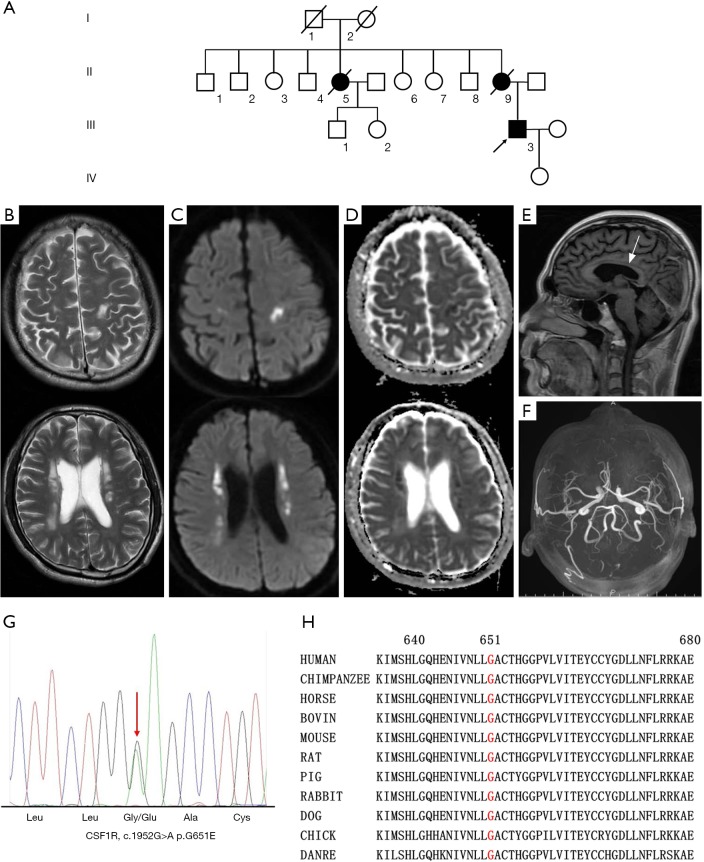
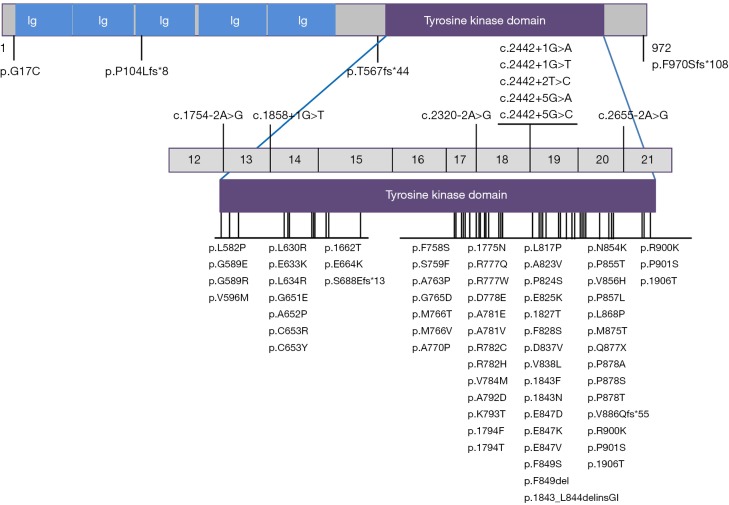
Results: A novel CSF1R mutation, c.1952G>A p.G651E was identified in the patient. Extensive review showed that HDLS typically presents with broad phenotypic variability. The most common symptoms of HDLS were cognitive impairment, followed by psychiatric symptoms, Parkinsonism, gait disorder, and dysphagia. The most common brain imaging findings of HDLS were bilateral white matter lesion, mostly around the ventricles, frontal lobe, and parietal lobe. Calcifications in white matter on CT, cerebral atrophy and thinning of corpus callosum were also common features. Although HDLS demonstrates an autosomal dominant pattern, sporadic cases are not uncommon.
Conclusions: Early recognition of clinical and neuroradiographical characteristics of HDLS is key for the correct diagnosis of the disease.
Keywords: Colony-stimulating factor 1 receptor (CSF1R); clinical features; genetics; hereditary diffuse leukoencephalopathy with spheroid (HDLS).
2020 Annals of Translational Medicine. All rights reserved.
Conflict of interest statement
Conflicts of Interest: The authors have no conflicts of interest to declare.
Figures
References
-
- Sundal C, Wszolek ZK. CSF1R-Related Adult-Onset Leukoencephalopathy with Axonal Spheroids and Pigmented Glia. In: Adam MP, Ardinger HH, Pagon RA, et al. editors. GeneReviews((R)). Seattle (WA): University of Washington, Seattle University of Washington, Seattle. GeneReviews is a registered trademark of the University of Washington, Seattle.; 1993. - PubMed
-
- Axelsson R, Roytta M, Sourander P, et al. Hereditary diffuse leucoencephalopathy with spheroids. Acta Psychiatr Scand Suppl 1984;314:1-65. - PubMed
LinkOut - more resources
Full Text Sources
Other Literature Sources
Research Materials
Miscellaneous