Potential for diagnosis of infectious disease from the 100,000 Genomes Project Metagenomic Dataset: Recommendations for reporting results
- PMID: 32055707
- PMCID: PMC6993825
- DOI: 10.12688/wellcomeopenres.15499.1
Potential for diagnosis of infectious disease from the 100,000 Genomes Project Metagenomic Dataset: Recommendations for reporting results
Abstract
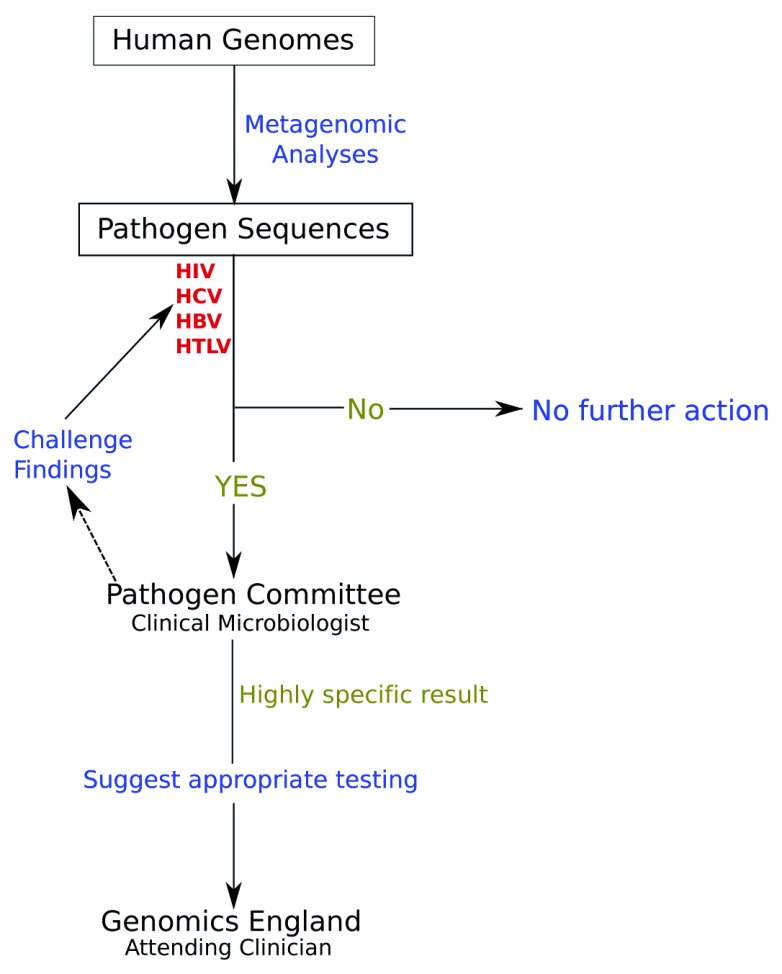
The identification of microbiological infection is usually a diagnostic investigation, a complex process that is firstly initiated by clinical suspicion. With the emergence of high-throughput sequencing (HTS) technologies, metagenomic analysis has unveiled the power to identify microbial DNA/RNA from a diverse range of clinical samples (1). Metagenomic analysis of whole human genomes at the clinical/research interface bypasses the steps of clinical scrutiny and targeted testing and has the potential to generate unexpected findings relating to infectious and sometimes transmissible disease. There is no doubt that microbial findings that may have a significant impact on a patient's treatment and their close contacts should be reported to those with clinical responsibility for the sample-donating patient. There are no clear recommendations on how such findings that are incidental, or outside the original investigation, should be handled. Here we aim to provide an informed protocol for the management of incidental microbial findings as part of the 100,000 Genomes Project which may have broader application in this emerging field. As with any other clinical information, we aim to prioritise the reporting of data that are most likely to be of benefit to the patient and their close contacts. We also set out to minimize risks, costs and potential anxiety associated with the reporting of results that are unlikely to be of clinical significance. Our recommendations aim to support the practice of microbial metagenomics by providing a simplified pathway that can be applied to reporting the identification of potential pathogens from metagenomic datasets. Given that the ambition for UK sequenced human genomes over the next 5 years has been set to reach 5 million and the field of metagenomics is rapidly evolving, the guidance will be regularly reviewed and will likely adapt over time as experience develops.
Keywords: full-genome sequencing; incidental findings; metagenomics; pathogens.
Copyright: © 2019 Magiorkinis G et al.
Conflict of interest statement
No competing interests were disclosed.
Figures
References
-
- Matt Hancock announces ambition to map 5 million genomes. [press release].2018. Reference Source
-
- Framework on the feedback of health-related findings in research. Medical Reserach Council Wellcome Trust. 2014 Reference Source
Grants and funding
LinkOut - more resources
Full Text Sources
Research Materials