. 2021 Jan;99(1):190-199.
doi: 10.1002/jnr.24595. Epub 2020 Feb 13.

Cognitive function and its relationship with brain structure in myotonic dystrophy type 1

Affiliations

Cognitive function and its relationship with brain structure in myotonic dystrophy type 1

Kathleen E Langbehn et al. J Neurosci Res. 2021 Jan.

Abstract

Studies have shown relationships between white matter abnormalities and cognitive dysfunction in myotonic dystrophy type 1 (DM1), but comprehensive analysis of potential structure-function relationships are lacking. Fifty adult-onset DM1 individuals (33 female) and 68 unaffected adults (45 female) completed the Wechsler Adult Intelligence Scale-IV (WAIS-IV) to determine the levels and patterns of intellectual functioning. Neuroimages were acquired with a 3T scanner and were processed with BrainsTools. Regional brain volumes (regions of interest, ROIs) were adjusted for inter-scanner variation and intracranial volume. Linear regression models were conducted to assess if group by ROI interaction terms significantly predicted WAIS-IV composite scores. Models were adjusted for age and sex. The DM1 group had lower Perceptual Reasoning Index (PRI), Working Memory Index (WMI), and Processing Speed Index (PSI) scores than the unaffected group (PRI t(113) = -3.28, p = 0.0014; WMI t(114) = -3.49, p = 0.0007; PSI t(114) = -2.98, p = 0.0035). The group by hippocampus interaction term was significant for both PRI and PSI (PRI (t(111) = -2.82, p = 0.0057; PSI (t(112) = -2.87, p = 0.0049)). There was an inverse association between hippocampal volume and both PRI and PSI in the DM1 group (the higher the volume, the lower the intelligence quotient scores), but no such association was observed in the unaffected group. Enlarged hippocampal volume may underlie some aspects of cognitive dysfunction in adult-onset DM1, suggesting that increased volume of the hippocampus may be pathological.

Keywords: DM1; WAIS-IV; cognitive impairments; hippocampus; magnetic resonance imaging; neuroanatomy.


Conflict of interest statement

Conflict of Interest Statement

No authors have any conflicts of interest to declare.

Disclosure of Conflicts of Interest: None of the authors has any conflict of interest to disclose.

Figures
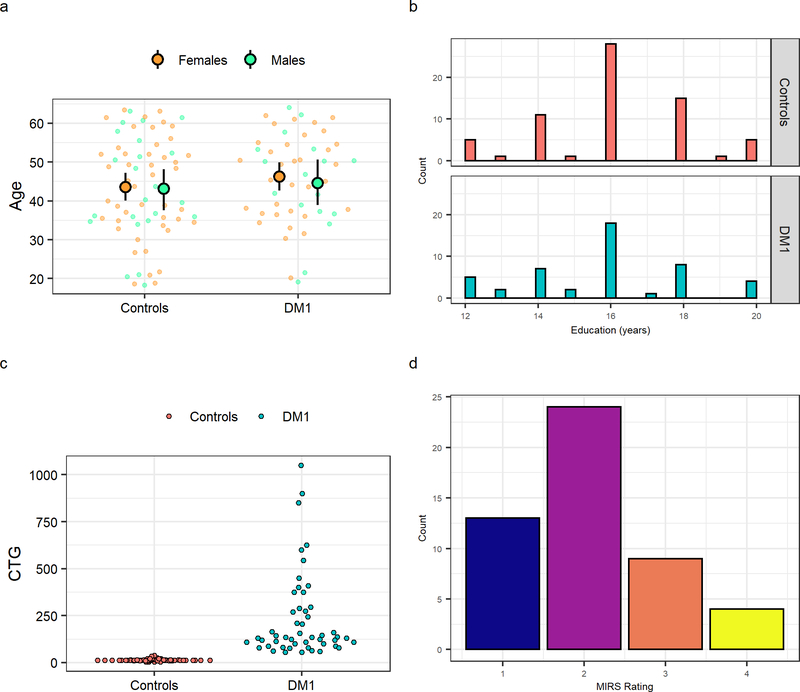
Figure 1:
Figure 1:
Sample characteristics. Panel a shows the age distributions of unaffected individuals and DM1- affected adults, separated by sex. Large circles represent the means with 95% confidence limits and the small circles represent individual observations Sex distribution was not different between groups (X2 (1, N = 118) = 6.63 e−31, p = 1). Panel b illustrates the distribution of years of education distribution for unaffected individuals (top panel) and DM1-affected adults (lower panel). Education distribution (binned as less than 4-year college degree [< 16 years] and completed 4-year college degree or higher [≥ 16 years]) was not different between groups (X2 (1, N = 114) = 0.38, p = 0.54). Panel c depicts CTG trinucleotide repeat expansion for each unaffected adult and DM1-affected individual in the sample. Panel d shows Muscle Impairment Rating Scale (MIRS) distribution of DM1-affected adults. Scores of MIRS ≤ 2 indicate none to mild impairment and scores of MIRS ≥ 3 indicate moderate to severe muscle impairment.
Figure 2:
Figure 2:
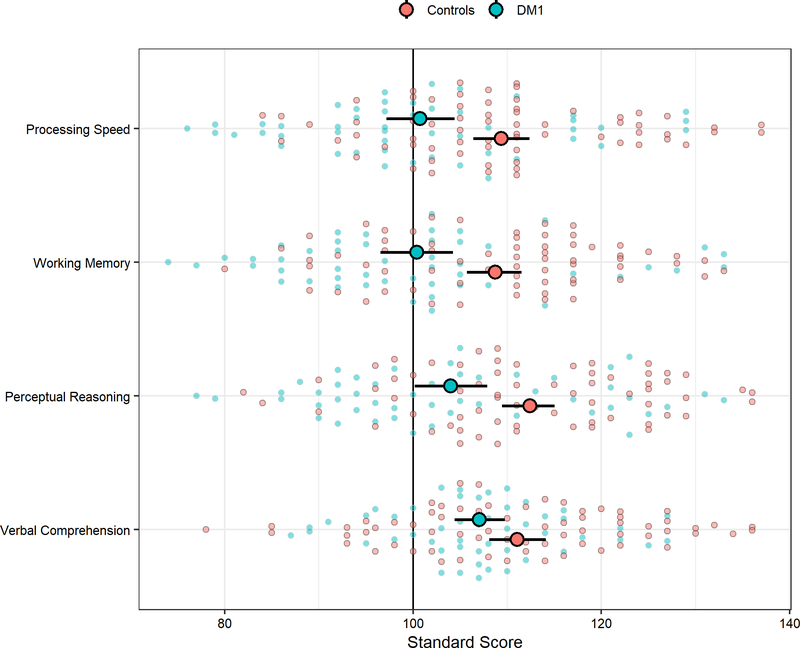
Cognitive performance group differences between unaffected adults and DM1-affected adults. The vertical, black line marks the normed mean of 100. The larger circles represent the means and 95% confidence limits. Small, transparent circles represent individual observations. Scores > 2.5 SDs above the mean were removed for analysis.
Figure 3:
Figure 3:
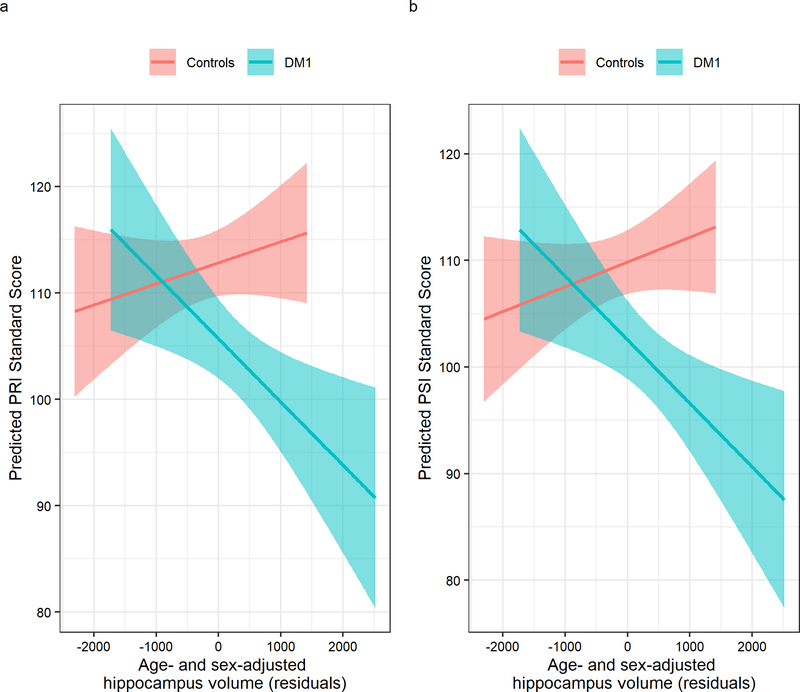
Associations between cognitive functions and hippocampus volume. Panel a illustrates the group by hippocampus (x-axis) interaction effect predicting Perceptual Reasoning (y-axis). Hippocampus volumes are expressed as age- and sex-adjusted residuals. Panel b shows the interaction between group and hippocampus volume predicting Processing Speed.
Figure 4:
Figure 4:
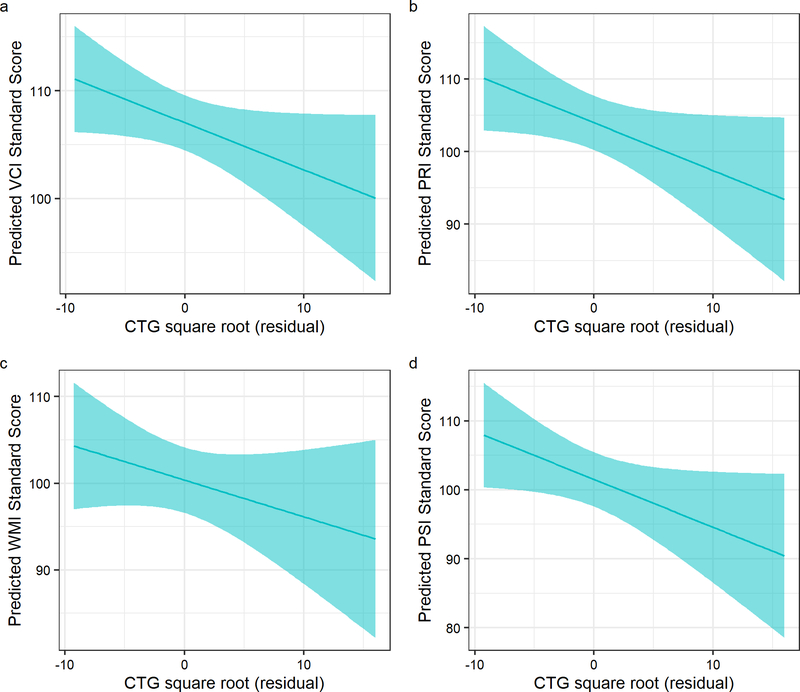
Associations between cognitive functions and CTG repeat expansion in DM1-affected adults. To account for the skewed distribution, we took the square root of CTG repeat length in DM1-affected adults. The x-axes on the plots show age- and sex adjusted CTG residuals. Panel a shows the association with Verbal Comprehension, Panel b shows the association with Perceptual Reasoning, Panel c shows the association with Working Memory, and Panel d shows the association with Processing Speed.

References

    1. Amaral DG, Li D, Libero L, Solomon M, Van de Water J, Mastergeorge A, … Wu Nordahl C (2017). In pursuit of neurophenotypes: The consequences of having autism and a big brain. Autism Research, 10(5), 711–722. 10.1002/aur.1755 - DOI - PMC - PubMed
    1. Baldanzi S, Cecchi P, Fabbri S, Pesaresi I, Simoncini C, Angelini C, … Siciliano G (2016). Relationship between neuropsychological impairment and grey and white matter changes in adult-onset myotonic dystrophy type 1. NeuroImage: Clinical, 12, 190–197. 10.1016/j.nicl.2016.06.011 - DOI - PMC - PubMed
    1. Callus E, Bertoldo EG, Beretta M, Boveri S, Cardani R, Fossati B, … Meola G (2018). Neuropsychological and psychological functioning aspects in myotonic dystrophy type 1 patients in Italy. Frontiers in Neurology, 9(SEP), 1–17. 10.3389/fneur.2018.00751 - DOI - PMC - PubMed
    1. Caso F, Agosta F, Peric S, Rakočević-Stojanović V, Copetti M, Kostic VS, & Filippi M (2014). Cognitive impairment in myotonic dystrophy type 1 is associated with white matter damage. PLoS ONE, 9(8), 1–8. 10.1371/journal.pone.0104697 - DOI - PMC - PubMed
    1. Censori B, Danni M, Del Pesce M, & Provinciali L (1990). Neuropsychological profile in myotonic dystrophy. J Neurol, 237(4), 251–256. Retrieved from http://www.ncbi.nlm.nih.gov/entrez/query.fcgi?cmd=Retrieve&db=PubMed&dop... - PubMed

Publication types