


Somatic mutations and copy number variations in breast cancers with heterogeneous HER2 amplification
- PMID: 32058674
- PMCID: PMC7138394
- DOI: 10.1002/1878-0261.12650
Somatic mutations and copy number variations in breast cancers with heterogeneous HER2 amplification
Abstract
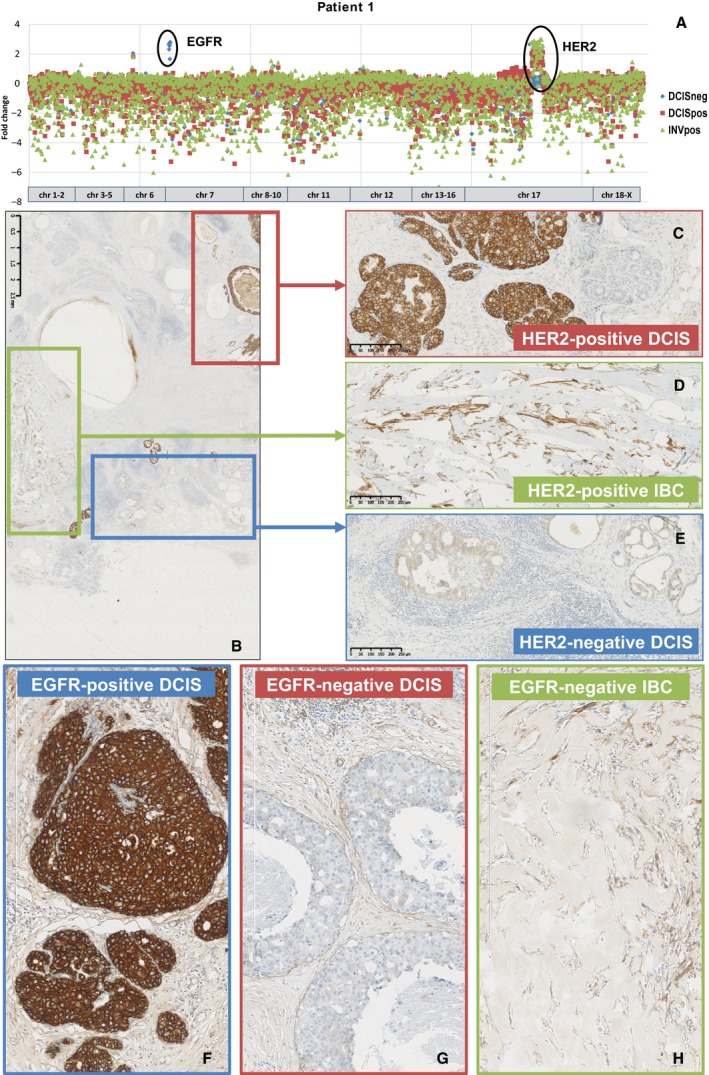
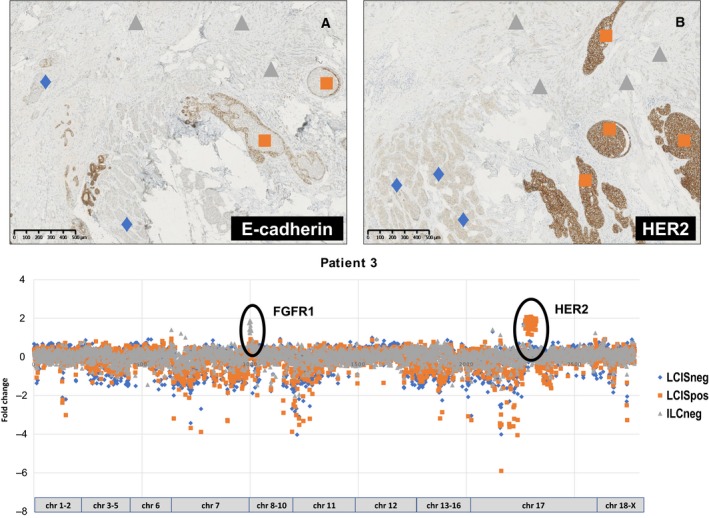
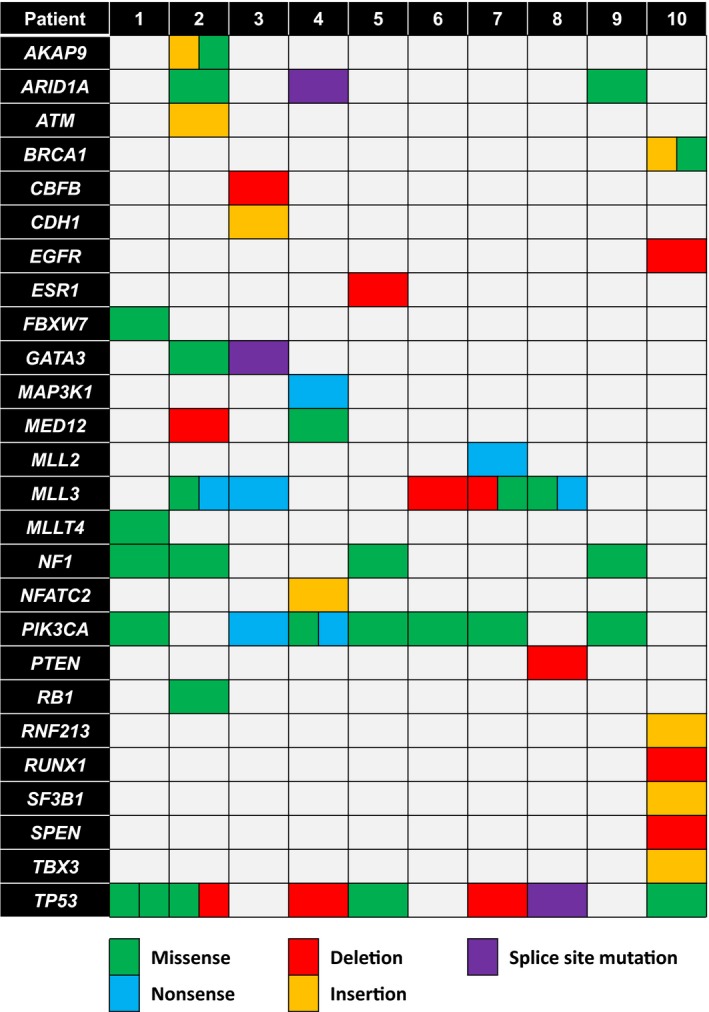
Intratumour heterogeneity fuels carcinogenesis and allows circumventing specific targeted therapies. HER2 gene amplification is associated with poor outcome in invasive breast cancer. Heterogeneous HER2 amplification has been described in 5-41% of breast cancers. Here, we investigated the genetic differences between HER2-positive and HER2-negative admixed breast cancer components. We performed an in-depth analysis to explore the potential heterogeneity in the somatic mutational landscape of each individual tumour component. Formalin-fixed, paraffin-embedded breast cancer tissue of ten patients with at least one HER2-negative and at least one HER2-positive component was microdissected. Targeted next-generation sequencing was performed using a customized 53-gene panel. Somatic mutations and copy number variations were analysed. Overall, the tumours showed a heterogeneous distribution of 12 deletions, 9 insertions, 32 missense variants and 7 nonsense variants in 26 different genes, which are (likely) pathogenic. Three splice site alterations were identified. One patient had an EGFR copy number gain restricted to a HER2-negative in situ component, resulting in EGFR protein overexpression. Two patients had FGFR1 copy number gains in at least one tumour component. Two patients had an 8q24 gain in at least one tumour component, resulting in a copy number increase in MYC and PVT1. One patient had a CCND1 copy number gain restricted to a HER2-negative tumour component. No common alternative drivers were identified in the HER2-negative tumour components. This series of 10 breast cancers with heterogeneous HER2 gene amplification illustrates that HER2 positivity is not an unconditional prerequisite for the maintenance of tumour growth. Many other molecular aberrations are likely to act as alternative or collaborative drivers. This study demonstrates that breast carcinogenesis is a dynamically evolving process characterized by a versatile somatic mutational profile, of which some genetic aberrations will be crucial for cancer progression, and others will be mere 'passenger' molecular anomalies.
Keywords: HER2 amplification; breast cancer; copy number variations; intratumour heterogeneity; next-generation sequencing; somatic mutation.
© 2020 The Authors. Published by FEBS Press and John Wiley & Sons Ltd.
Conflict of interest statement
MRVB is supported by the Mathilde Horlait‐Dapsens Foundation (Brussels, Belgium) and the non‐for‐profit organization Foundation Against Cancer (Grant 2019‐089, Brussels, Belgium). The other authors report that they have no conflicts of interest to disclose.
Figures
References
-
- Agahozo MC, Sieuwerts AM, Doebar SC, Verhoef EI, Beaufort CM, Ruigrok‐Ritstier K, de Weerd V, Sleddens HFBM, Dinjens WNM, Martens JWM et al (2019) PIK3CA mutations in ductal carcinoma in situ and adjacent invasive breast cancer. Endocr Relat Cancer 26, 471–482. - PubMed
-
- Assenov Y, Brocks D and Gerhäuser C (2018) Intratumor heterogeneity in epigenetic patterns. Semin Cancer Biol 51, 12–21. - PubMed
-
- Barros FFT, Powe DG, Ellis IO and Green AR (2010) Understanding the HER family in breast cancer: interaction with ligands, dimerization and treatments. Histopathology 56, 560–572. - PubMed
-
- Bartlett AI, Starcyznski J, Robson T, Maclellan A, Campbell FM, van de Velde CJ, Hasenburg A, Markopoulos C, Seynaeve C, Rea D et al (2011) Heterogeneous HER2 gene amplification: Impact on patient outcome and a clinically relevant definition. Am J Clin Pathol 136, 266–274. - PubMed
-
- Burkhardt L, Grob TJ, Hermann I, Burandt E, Choschzick M, Jänicke F, Müller V, Bokemeyer C, Simon R, Sauter G et al (2010) Gene amplification in ductal carcinoma in situ of the breast. Breast Cancer Res Treat 123, 757–765. - PubMed
Publication types
MeSH terms
Substances
Associated data
- Actions
- Actions
- Actions
- Actions
- Actions
LinkOut - more resources
Full Text Sources
Medical
Research Materials
Miscellaneous
