


Salivary Redox Biomarkers in Selected Neurodegenerative Diseases
- PMID: 32059422
- PMCID: PMC7074092
- DOI: 10.3390/jcm9020497
Salivary Redox Biomarkers in Selected Neurodegenerative Diseases
Abstract
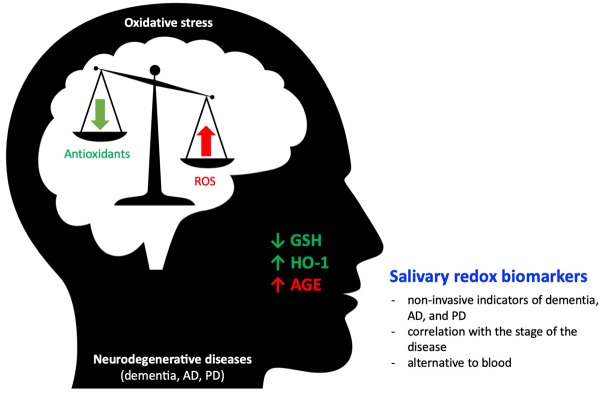
Neurodegenerative diseases (NDDs), such as Alzheimer's disease, Parkinson's disease, and Huntington's disease, are disorders, which cause irreversible and progressive deterioration of the central nervous system. The pathophysiology of NDDs is still not fully explained; nevertheless, oxidative stress is considered as a critical mediator of cerebral degeneration, brain inflammation, as well as neuronal apoptosis. Therefore, it is not surprising that redox biomarkers are increasingly used in the diagnosis of neurodegenerative diseases. As saliva is a very easy to obtain bioliquid, it seems promising to use this biomaterial in the diagnosis of NDDs. Saliva collection is easy, cheap, stress-free, and non-infectious, and it does not require the help of a specialised medical personnel. Additionally, the concentrations of many salivary redox biomarkers correlate with their content in blood serum as well as the degree of disease progression, which makes them non-invasive indicators of NDDs. This paper reviews the latest knowledge concerning the use of salivary redox biomarkers in the diagnosis and prognosis of selected neurodegenerative diseases.
Keywords: neurodegenerative diseases (NDDs); oxidative stress; saliva; salivary biomarkers.
Conflict of interest statement
The authors declare no conflict of interest.
Figures
References
Publication types
LinkOut - more resources
Full Text Sources
