


In Vitro Propagation and Variation of Antioxidant Properties in Micropropagated Vaccinium Berry Plants-A Review
- PMID: 32059466
- PMCID: PMC7070298
- DOI: 10.3390/molecules25040788
In Vitro Propagation and Variation of Antioxidant Properties in Micropropagated Vaccinium Berry Plants-A Review
Abstract
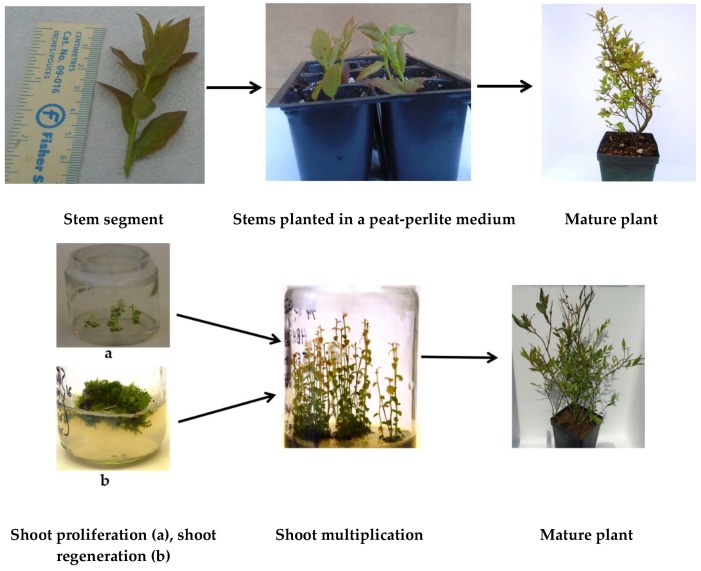
The berry crops in genus Vacciniun L. are the richest sources of antioxidant metabolites which have high potential to reduce the incidence of several degenerative diseases. In vitro propagation or micropropagation has been attractive to researchers for its incredible potential for mass production of a selected genotype in a short time, all year round. Propagation techniques affect the antioxidant activity in fruits and leaves. Total antioxidant activity was higher in the fruit of in vitro propagated plants compare to the plants grown ex vivo. This review provides critical information for better understanding the micropropagation and conventional propagation methods, and their effects on antioxidant properties and morphological differentiation in Vaccinium species, and fills an existing gap in the literature.
Keywords: antioxidant activity; blueberry propagation; phenolic content; stem cutting; tissue culture.
Conflict of interest statement
The authors declare no conflicts of interest.
Figures
References
-
- Song G.-Q. Blueberry (Vaccinium corymbosum L.) In: Wang K., editor. Agrobacterium Protocols. Volume 2. Springer; New York, NY, USA: 2015. pp. 121–131.
-
- Hancock J.F., Luby J.J., Beaudry R. Fruits of temperate climates/Fruits of the Ericaceae. In: Trugo L., Finglas P.M., Caballero B., editors. Encyclopedia of Food Science, Food Technology and Nutrition. 2nd ed. Academic Press; London, UK: 2003. pp. 2762–2768.
-
- Debnath S., Sion M. Genetic diversity, antioxidant activities, and anthocyanin contents in lingonberry. Int. J. Fruit Sci. 2009;9:185–199. doi: 10.1080/15538360903005061. - DOI
Publication types
MeSH terms
Substances
LinkOut - more resources
Full Text Sources
Medical
Miscellaneous
