. 2020 Feb 12;10(2):288.
doi: 10.3390/biom10020288.

Exploration and Characterization of Novel Glycoside Hydrolases from the Whole Genome of Lactobacillus ginsenosidimutans and Enriched Production of Minor Ginsenoside Rg3(S) by a Recombinant Enzymatic Process

Affiliations

Exploration and Characterization of Novel Glycoside Hydrolases from the Whole Genome of Lactobacillus ginsenosidimutans and Enriched Production of Minor Ginsenoside Rg3(S) by a Recombinant Enzymatic Process

Muhammad Zubair Siddiqi et al. Biomolecules. .

Abstract

Background: Several studies have reported that ginsenoside Rg3(S) is effective in treating metastatic diseases, obesity, and various cancers, however, its presence in white ginseng cannot be estimated, and only a limited amount is present in red ginseng. Therefore, the use of recombinant glycosidases from a Generally Recognized As Safe (GRAS) host strain is a promising approach to enhance production of Rg3(S), which may improve nutritional activity, human health, and quality of life.

Method: Lactobacillus ginsenosidimutans EMML 3041T, which was isolated from Korean fermented pickle (kimchi), presents ginsenoside-converting abilities. The strain was used to enrich the production of Rg3(S) by fermenting protopanaxadiol (PPD)-mix-type major ginsenosides (Rb1, Rb2, Rc, and Rd) in four different types of food-grade media (1, MRS; 2, Basel Food-Grade medium; 3, Basel Food-Grade medium-I, and 4, Basel Food-Grade medium-II). Due to its tendency to produce Rg3(S), the presence of glycoside hydrolase in Lactobacillus ginsenosidimutans was proposed, the whole genome was sequenced, and the probable glycoside hydrolase gene for ginsenoside conversion was cloned.

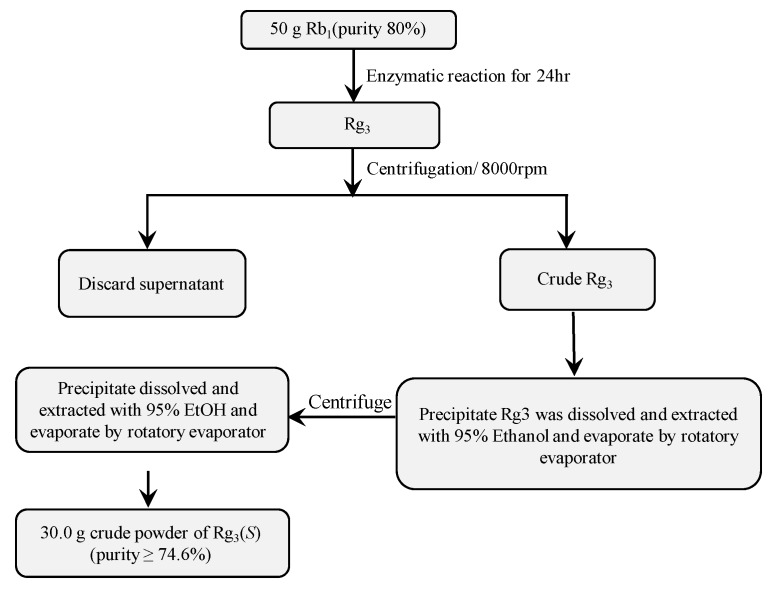
Results: The L. ginsenosidimutans EMML 3041T strain was whole genome sequenced to identify the target genes. After genome sequencing, 12 sets of glycoside hydrolases were identified, of which seven sets (α,β-glucosidase and α,β-galactosidase) were cloned in Escherichia coli BL21 (DE3) using the pGEX4T-1 vector system. Among the sets of clones, only one clone (BglL.gin-952) showed ginsenoside-transforming abilities. The recombinant BglL.gin-952 comprised 952 amino acid residues and belonged to glycoside hydrolase family 3. The enzyme exhibited optimal activity at 55 °C and a pH of 7.5 and showed a promising conversion ability of major ginsenoside Rb1→Rd→Rg3(S). The recombinant enzyme (GST-BglL.gin-952) was used to mass produce Rg3(S) from major ginsenoside Rb1. Scale-up of production using 50 g of Rb1 resulted in 30 g of Rg3(S) with 74.3% chromatography purity.

Conclusion: Our preliminary data demonstrated that this enzyme would be beneficial in the preparation of pharmacologically active minor ginsenoside Rg3(S) in the functional food and pharmaceutical industries.

Keywords: Lactobacillus ginsenosidimutans; bioconversion; complete genome sequence; ginsenoside Rg3(S); gram unit production; novel glycoside hydrolases; recombinant enzyme.


Conflict of interest statement

The authors declare no conflict of interest.

Figures

Figure 1
Figure 1
Conversion of protopanaxadiol (PPD)-mix-type ginsenosides by seven different glycoside hydrolases. 1, Ginsenoside standard; 2, AglL.gin-556; 3, BglL.gin-484; 4, BglL.gin-952; 5, BglL.gin-902; 6, AgalL.gin-556; 7, AgalL.gin-319; 8, ginsenoside standard.
Figure 2
Figure 2
(A) Thin-layer chromatography (TLC) analysis showed the conversion of the PPD-mix extracts by Lactobacillus ginsenosidimutans EMML 3041T from Korean ginseng, American leaf saponins, and Chinese ginseng. Std, ginsenosides standards; 1. Korean ginseng extract (KGE) control; 2, American leaf extract (ALE) control; 3, Chinese ginseng extract (CGE) control; 4–6, conversion of KGE, ALE, and CGE in MRS broth; 7–9, conversion of KGE, ALE, and CGE in Basel Food-Grade broth. (B) The effect of two different media (MRS and BFG) on the bioconversion of PPD-mix-type ginsenosides. Std, ginsenoside standard; cont, control of PPD-mix ginsenosides (Rb1, Rc, and Rd).
Figure 3
Figure 3
Phylogenetic tree analysis showing the position of the novel BglL.gin-952 in the glycoside hydrolases of family 3 (GH3). The tree was constructed using the maximum-likelihood algorithm alongside a Poisson model and pairwise deletion. Bootstrap values expressed as percentages of 1000 replications greater than 50% are shown at the branch points. The bar represents 10 amino acid residue substitutions per 100 amino acid residues.
Figure 4
Figure 4
(A,B). SDS-PAGE analysis of recombinant glycoside hydrolase genes of L. ginsenosidimutans. Lanes 1 and 10, protein marker (50–240 kDa); Lanes 2 and 3, soluble and precipitate enzyme of AglL.gin-556 (87 kDa), respectively; Lanes 4 and 5, soluble and precipitated enzymes of BglL.gin-484 (79 kDa), respectively; Lanes 6 and 7, soluble and precipitated enzymes of BglL.gin-952; Lanes 8 and 9, soluble and precipitated enzymes of AgalL.gin-319, respectively.
Figure 5
Figure 5
Conversion pathway of ginsenosides Rb1 and Rd to Rg3(S) by recombinant BglL.gin-952.
Figure 6
Figure 6
(A). Effect of pH on enzyme activity. Enzyme activity was measured under standard assay conditions. Enzyme solutions containing 2.0 mM pNPGlc were incubated with various buffers at pH 2.0–10.0 for 12 h at 4 °C. To assess the stability of BglAg-762, the enzymes were incubated for 30 min at 50 °C in various buffers at pH 2.0–10.0, and the residual activities were measured. (B) The effect of temperature on the stability and activity of recombinant BglAg-762 was measured under standard assay conditions. The thermodependence of BglAg-762 was assayed using 50 mM potassium phosphate buffer (pH 7.5) at varying temperatures ranging from 4–60 °C. Thermostability was tested by incubating aliquots of the enzyme in 50 mM potassium phosphate buffer (pH 7.5) for different periods of time at various temperatures. After cooling the sample, the residual activity was determined.
Figure 7
Figure 7
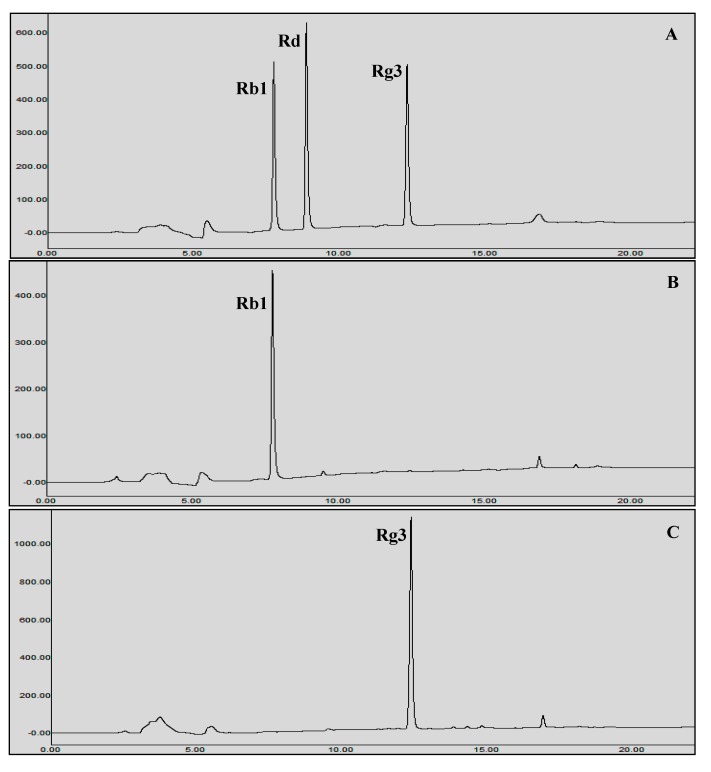
HPLC analysis of the transformation of Rb1 to Rg3(S) by recombinant BglL.gin-952. A, Ginsenoside standard; B, Rb1 as a starting substrate; C, Rg3(S) production after 24 h of reaction.
Figure 8
Figure 8
Gram unit production of ginsenoside Rg3(S) from ginsenoside Rb1.

References

    1. Jia L., Zhao Y. Current evaluation of the millennium phytomedicine-ginseng (I): Etymology, pharmacognosy, phytochemistry, market and regulations. Curr. Med. Chem. 2009;16:2475–2484. doi: 10.2174/092986709788682146. - DOI - PMC - PubMed
    1. Li W., Zhang M., Gu J., Meng Z.-J., Zhao L.-C., Zheng Y.-N., Chen L., Yang G.-L. Hypoglycemic effect of protopanaxadiol-type ginsenosides and compound K on Type 2 Diabetes mice induced by High-Fat Diet combining with Streptozotocin via suppression of hepatic gluconeogenesis. Fitoterapia. 2012;83:192–198. doi: 10.1016/j.fitote.2011.10.011. - DOI - PubMed
    1. Siddiqi M.H., Siddiqi M.Z., Ahn S., Kim Y.-J., Yang D.C. Ginsenoside Rh1 induces mouse osteoblast growth and differentiation through the bone morphogenetic protein 2/runt-related gene 2 signalling pathway. J. Pharm. Pharmacol. 2014;66:1763–1773. doi: 10.1111/jphp.12306. - DOI - PubMed
    1. Siddiqi M.Z., Siddiqi M.H., Kim Y.-J., Jin Y., Huq A., Yang D.-C. Effect of Fermented Red Ginseng Extract Enriched in Ginsenoside Rg3 on the Differentiation and Mineralization of Preosteoblastic MC3T3-E1 Cells. J. Med. Food. 2015;18:542–548. doi: 10.1089/jmf.2014.3251. - DOI - PMC - PubMed
    1. Wong A.S.T., Che C.-M., Leung K.-W. Recent advances in ginseng as cancer therapeutics: A functional and mechanistic overview. Nat. Prod. Rep. 2015;32:256–272. doi: 10.1039/C4NP00080C. - DOI - PubMed

Publication types

MeSH terms

Supplementary concepts

LinkOut - more resources