


Associations of Caregiver-Oncologist Discordance in Prognostic Understanding With Caregiver-Reported Therapeutic Alliance and Anxiety
- PMID: 32061833
- PMCID: PMC7311277
- DOI: 10.1016/j.jpainsymman.2020.02.005
Associations of Caregiver-Oncologist Discordance in Prognostic Understanding With Caregiver-Reported Therapeutic Alliance and Anxiety
Abstract
Context: Discordance in prognostic understanding between caregivers of adults with advanced cancer and the oncologist may shape caregivers' views of the oncologist and bereavement outcomes.
Objectives: We examined prospective associations of caregiver-oncologist discordance with caregiver-oncologist therapeutic alliance and caregiver anxiety after patient death.
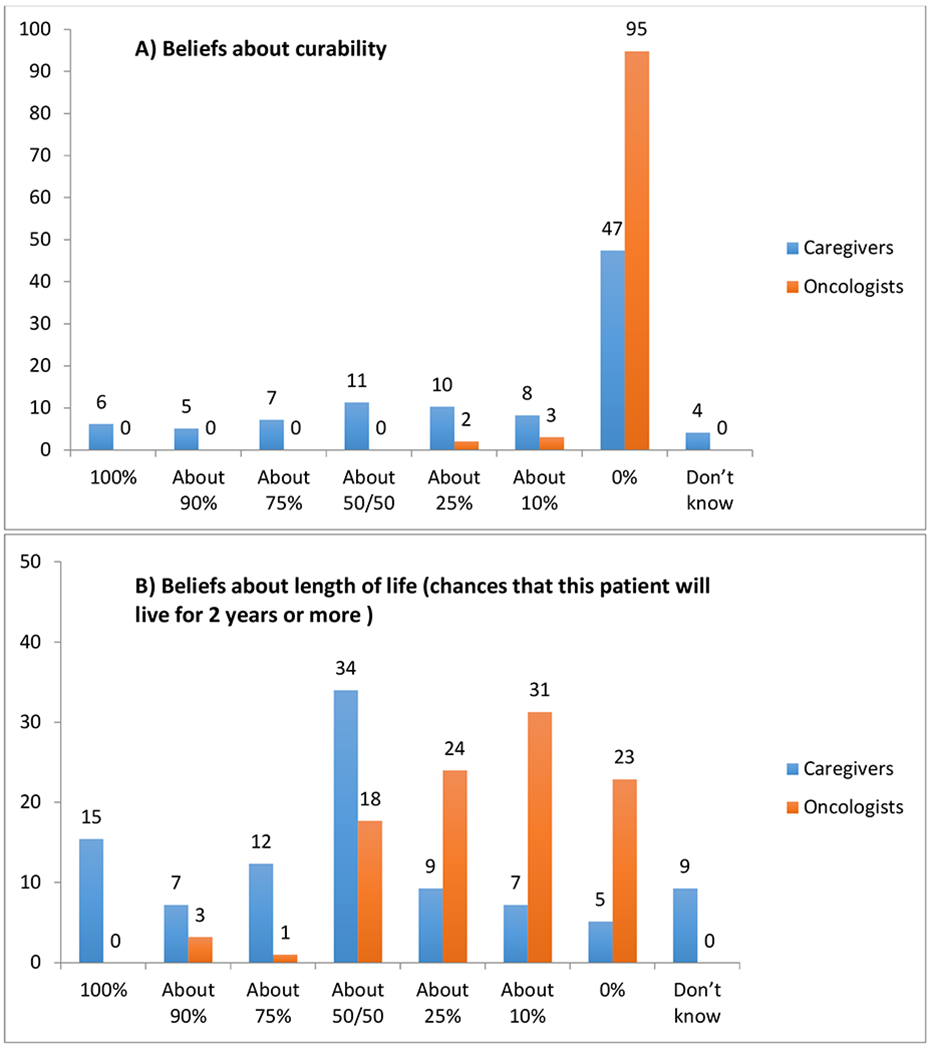
Methods: We conducted a secondary analysis of data collected in a cluster randomized controlled trial from August 2012 to June 2014 in Western New York and California. At enrollment, caregivers and oncologists used a seven-point scale to rate their beliefs about the patient's curability and living two years or more: 100%, about 90%, about 75%, about 50 of 50, about 25%, about 10%, and 0%. Discordance was defined as a difference of two points or more. Outcomes at seven months after patient death included caregiver-oncologist therapeutic alliance (The Human Connection scale, modified into five items) and caregiver anxiety (Generalized Anxiety Disorder-7). We conducted multivariable linear regression models to assess the independent associations of discordance with alliance and anxiety.
Results: We included 97 caregivers (mean age 63) and 38 oncologists; 41% of caregiver-oncologist dyads had discordant beliefs about the patient's curability, and 63% of caregiver-oncologist dyads had discordant beliefs about living two years or more. On multivariate analysis, discordance in beliefs about curability was associated with lower anxiety (β = -2.20; SE 0.77; P = 0.005). Discordance in beliefs about length of life was associated with a weaker alliance (β = -5.87; SE = 2.56; P = 0.02).
Conclusion: A better understanding of how caregivers understand and come to terms with poor prognoses will guide interventions to improve cancer care delivery and outcomes of cancer treatment.
Keywords: Discordance; anxiety; beliefs about curability; beliefs about length of life; therapeutic alliance.
Copyright © 2020 American Academy of Hospice and Palliative Medicine. Published by Elsevier Inc. All rights reserved.
Conflict of interest statement
Figures
References
-
- Shin DW, Cho J, Kim SY, et al. Patients’ and family caregivers’ understanding of the cancer stage, treatment goal, and chance of cure: A study with patient-caregiver-physician triad. Psychooncology. 2018;27(1):106–113. - PubMed
-
- Mack JW, Weeks JC, Wright AA, Block SD, Prigerson HG. End-of-life discussions, goal attainment, and distress at the end of life: predictors and outcomes of receipt of care consistent with preferences. Journal of clinical oncology : official journal of the American Society of Clinical Oncology. 2010;28(7):1203–1208. - PMC - PubMed
-
- Tang ST, Liu TW, Chow JM, et al. Associations between accurate prognostic understanding and end-of-life care preferences and its correlates among Taiwanese terminally ill cancer patients surveyed in 2011–2012. Psycho-oncology. 2014;23(7):780–787. - PubMed
-
- Enzinger AC, Zhang B, Schrag D, Prigerson HG. Outcomes of Prognostic Disclosure: Associations With Prognostic Understanding, Distress, and Relationship With Physician Among Patients With Advanced Cancer. Journal of clinical oncology: official journal of the American Society of Clinical Oncology. 2015;33(32):3809–3816. - PMC - PubMed
Publication types
MeSH terms
Grants and funding
LinkOut - more resources
Full Text Sources
