


Cardiovascular Health Among Pregnant Women, Aged 20 to 44 Years, in the United States
- PMID: 32063122
- PMCID: PMC7070227
- DOI: 10.1161/JAHA.119.015123
Cardiovascular Health Among Pregnant Women, Aged 20 to 44 Years, in the United States
Abstract
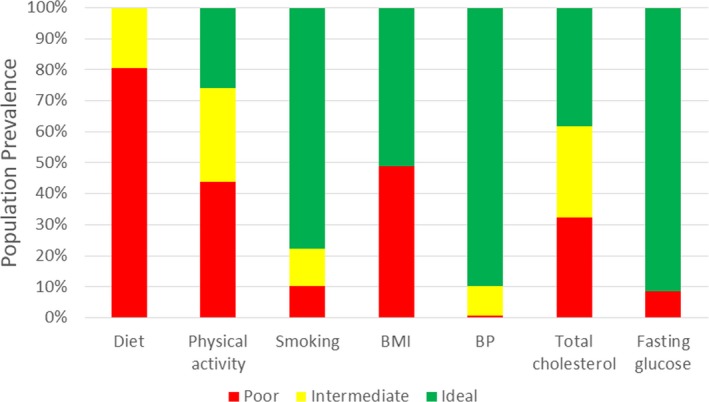
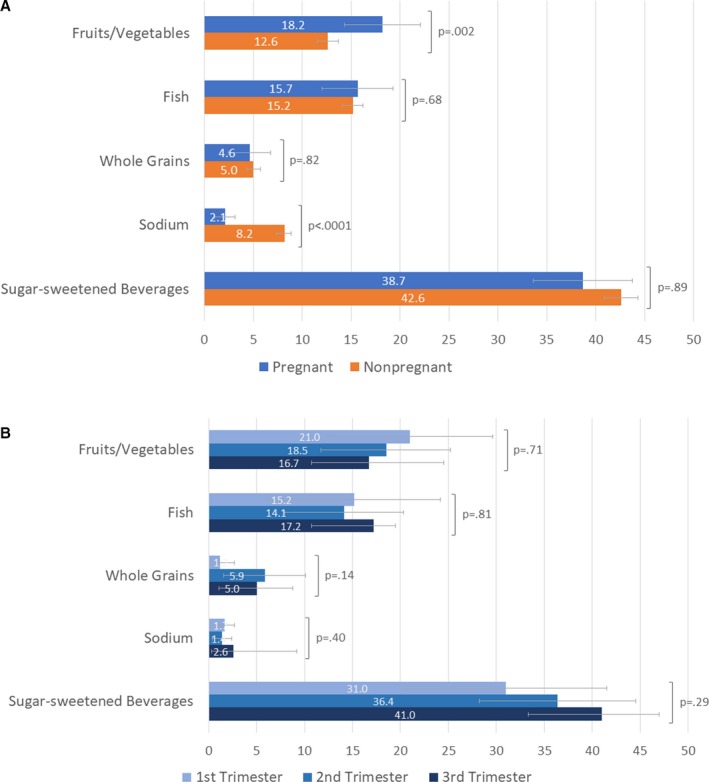
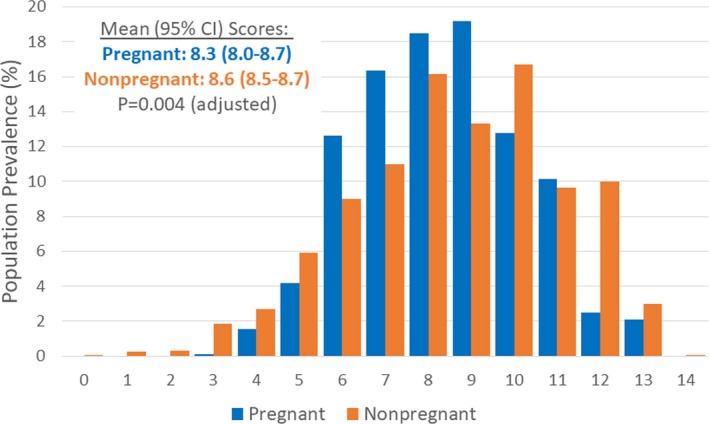
Background Pregnancy is a cardiometabolic stressor and thus a critical period to address women's lifetime cardiovascular health (CVH). However, CVH among US pregnant women has not been characterized. Methods and Results We analyzed cross-sectional data from National Health and Nutrition Examination Surveys 1999 to 2014 for 1117 pregnant and 8200 nonpregnant women, aged 20 to 44 years. We assessed 7 CVH metrics using American Heart Association definitions modified for pregnancy; categorized metrics as ideal, intermediate, or poor; assigned these categories 2, 1, or 0 points, respectively; and summed across the 7 metrics for a total score of 0 to 14 points. Total scores 12 to 14 indicated high CVH; 8 to 11, moderate CVH; and 0 to 7, low CVH. We applied survey weights to generate US population-level estimates of CVH levels and compared pregnant and nonpregnant women using demographic-adjusted polytomous logistic and linear regression. Among pregnant women, the prevalences (95% CIs) of ideal levels of CVH metrics were 0.1% (0%-0.3%) for diet, 27.3% (22.2%-32.3%) for physical activity, 38.9% (33.7%-44.0%) for total cholesterol, 51.1% (46.0%-56.2%) for body mass index, 77.7% (73.3%-82.2%) for smoking, 90.4% (87.5%-93.3%) for blood pressure, and 91.6% (88.3%-94.9%) for fasting glucose. The mean total CVH score was 8.3 (95% CI, 8.0-8.7) of 14, with high CVH in 4.6% (95% CI, 0.5%-8.8%), moderate CVH in 60.6% (95% CI, 52.3%-68.9%), and low CVH in 34.8% (95% CI, 26.4%-43.2%). CVH levels were significantly lower among pregnant versus nonpregnant women; for example, 13.0% (95% CI, 11.0%-15.0%) of nonpregnant women had high CVH (adjusted, comparison P=0.01). Conclusions From 1999 to 2014, <1 in 10 US pregnant women, aged 20 to 44 years, had high CVH.
Keywords: Life's Simple 7; cardiovascular health; pregnancy.
Figures
Comment in
-
Where are the Recommendations on Healthy Lifestyle and Cardiovascular Disease Prevention for Pregnant Women?J Am Heart Assoc. 2020 Feb 18;9(4):e016052. doi: 10.1161/JAHA.120.016052. Epub 2020 Feb 17. J Am Heart Assoc. 2020. PMID: 32063112 Free PMC article. No abstract available.
References
-
- Brown HL, Warner JJ, Gianos E, Gulati M, Hill AJ, Hollier LM, Rosen SE, Rosser ML, Wenger NK; American Heart Association, the American College of Obstetricians and Gynecologists . Promoting risk identification and reduction of cardiovascular disease in women through collaboration with obstetricians and gynecologists: a presidential advisory from the American Heart Association and the American College of Obstetricians and Gynecologists. Circulation. 2018;137:e843–e852. - PubMed
-
- McSweeney JC, Rosenfeld AG, Abel WM, Braun LT, Burke LE, Daugherty SL, Fletcher GF, Gulati M, Mehta LS, Pettey C, Reckelhoff JF. Preventing and experiencing ischemic heart disease as a woman: state of the science—a scientific statement from the American Heart Association. Circulation. 2016;133:1302–1331. - PMC - PubMed
-
- Mosca L, Benjamin EJ, Berra K, Bezanson JL, Dolor RJ, Lloyd‐Jones DM, Newby LK, Pina IL, Roger VL, Shaw LJ, Zhao D, Beckie TM, Bushnell C, D'Armiento J, Kris‐Etherton PM, Fang J, Ganiats TG, Gomes AS, Gracia CR, Haan CK, Jackson EA, Judelson DR, Kelepouris E, Lavie CJ, Moore A, Nussmeier NA, Ofili E, Oparil S, Ouyang P, Pinn VW, Sherif K, Smith SC Jr, Sopko G, Chandra‐Strobos N, Urbina EM, Vaccarino V, Wenger NK. Effectiveness‐based guidelines for the prevention of cardiovascular disease in women—2011 update: a guideline from the American Heart Association. Circulation. 2011;123:1243–1262. - PMC - PubMed
-
- Grundy SM, Stone NJ, Bailey AL, Beam C, Birtcher KK, Blumenthal RS, Braun LT, de Ferranti S, Faiella‐Tommasino J, Forman DE, Goldberg R, Heidenreich PA, Hlatky MA, Jones DW, Lloyd‐Jones D, Lopez‐Pajares N, Ndumele CE, Orringer CE, Peralta CA, Saseen JJ, Smith SC Jr, Sperling L, Virani SS, Yeboah J. 2018 AHA/ACC/AACVPR/AAPA/ABC/ACPM/ADA/AGS/APhA/ASPC/NLA/PCNA guideline on the management of blood cholesterol: a report of the American College of Cardiology/American Heart Association Task Force on Clinical Practice Guidelines. Circulation. 2019;139:e1082–e1143. - PMC - PubMed
-
- Barker DJ. The developmental origins of chronic adult disease. Acta Paediatr Suppl. 2004;93:26–33. - PubMed
Publication types
MeSH terms
Substances
Grants and funding
LinkOut - more resources
Full Text Sources
