. 2020 Feb 10:17:5.
doi: 10.1186/s12950-020-0238-7. eCollection 2020.

Different signaling pathways involved in the anti-inflammatory effects of unfractionated heparin on lipopolysaccharide-stimulated human endothelial cells

Affiliations

Different signaling pathways involved in the anti-inflammatory effects of unfractionated heparin on lipopolysaccharide-stimulated human endothelial cells

Xu Li et al. J Inflamm (Lond). .

Abstract

Background: There is a complex interplay between inflammatory response and coagulation in sepsis. Heparin is used as a recognized anticoagulant and possesses multiple biological properties that possibly affect sepsis. This study aimed to determine the possible signaling pathways involved in the anti-inflammatory effects of unfractionated heparin (UFH) on lipopolysaccharide (LPS)-stimulated human pulmonary microvascular endothelial cells (HPMECs).

Methods: HPMECs were transfected with siRNA targeting IκB-α. Cells were treated with UFH (0.01 U/ml~ 10 U/ml) 15 min before adding LPS (10 μg/ml). We detected the markers of systemic inflammatory response. Release of interleukin (IL)-6, IL-8 were evaluated at 3 h by ELISA and at 1 h by qRT-PCR. After 1 h, nuclear factor-κB (NF-κB) as well as phosphorylated inhibitor κB-α (IκB-α), signal transducer and activator of transcription-3 (STAT3) and ERK1/2, JNK, p38 mitogen-activated protein kinase (MAPK) expressions were evaluated by Western blot. DNA binding was conducted to further prove the activation of NF-κB pathway.

Results: In HPMECs, UFH obviously inhibited LPS-stimulated production of IL-6 and IL-8, especially in 10 U/ml. UFH inhibited LPS-induced phosphorylation of IκB-α, ERK1/2, JNK, p38 MAPK and STAT3. UFH also suppressed LPS-stimulated nuclear translocation of NF-κB. Importantly, transfection with siRNA targeting IκB-α induced more obvious inflammatory response. UFH suppressed cytokines production and phosphorylation of different signaling pathways in IκB-α silencing cells.

Conclusion: These results demonstrate that UFH exerts the anti-inflammatory effects on LPS-stimulated HPMECs by different signaling pathways.

Keywords: Endothelial cells; Nuclear factor-κB; Sepsis; Signaling pathway; Unfractionated heparin.


Conflict of interest statement

Competing interestsThe authors declare that they have no competing interests.

Figures
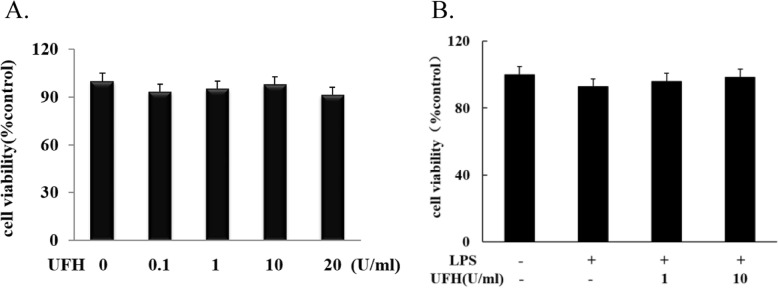
Fig. 1
Fig. 1
Effect of UFH on cell viability measured by MTT asssay. a Cells were treated with 0.1% DMSO or UFH for 24 h. b Cells were pre-treated with UFH (1 and 10 U/ml) for 15 min and then exposed to 10 μg/ml of LPS for 24 h. Values are means ± SD of three independent experiments
Fig. 2
Fig. 2
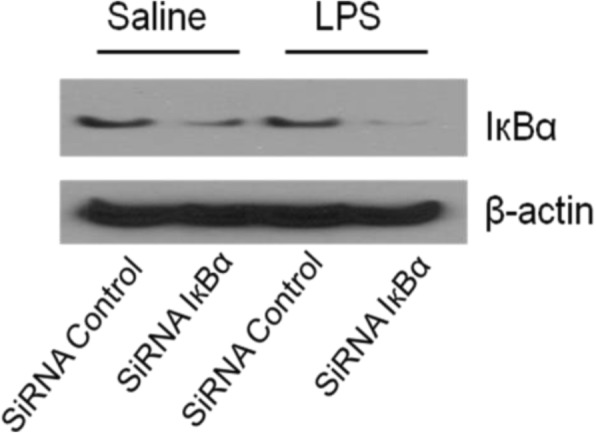
Western blot to prove successful transfection. The results are representative of three independent experiments
Fig. 3
Fig. 3
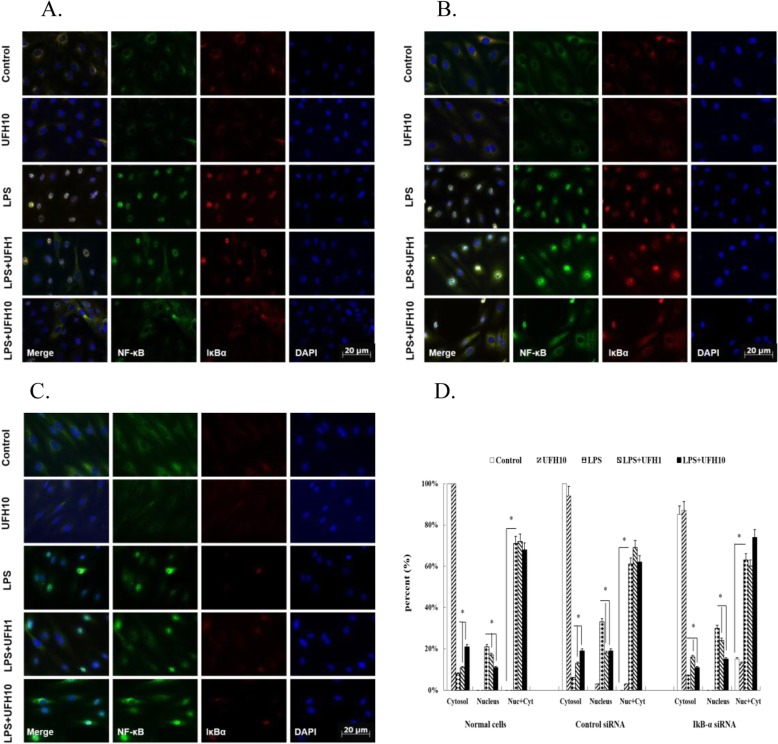
Effects of UFH on nuclear translocation of LPS-stimulated NF-κB p65 by immunofluorescence. Cells were treated with the indicated concentrations of UFH for 15 min, followed by exposure to 10 μg/ml LPS for 1 h. The results are representative of three independent experiments. a Untreated cells. b Control siRNA cells. c IκB-α siRNA cells. d Quantification of the movement of fluorescent label for NF-κB. *P<0.05, compared to the vehicle-treated control group. **P<0.01, compared to the vehicle-treated control group. #P<0.05, compared to the LPS-treated group. ##P<0.01, compared to the LPS-treated group
Fig. 4
Fig. 4
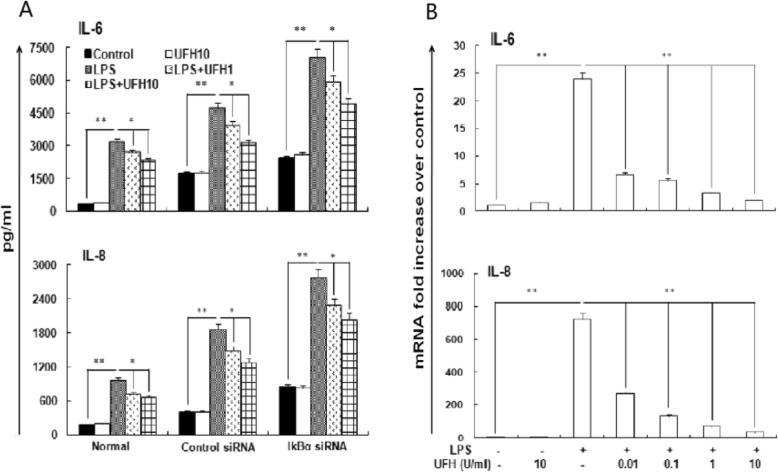
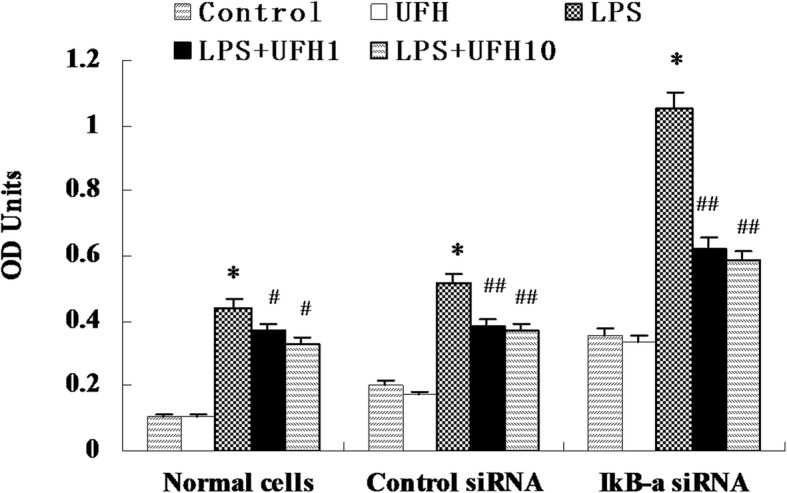
Effects of UFH on the production of IL-6 and IL-8 stimulated by LPS. Supernatants and cells for evaluation of IL-6 and IL-8 were collected at indicated time. UFH suppressed the increasing effects of LPS both on protein (Fig. 4a) and mRNA levels (Fig. 4b). The results represent mean ± SD of three replicates.*P<0.05, compared to the vehicle-treated control group. **P<0.01, compared to the vehicle-treated control group. #P<0.05, compared to the LPS-treated group. ##P<0.01, compared to the LPS-treated group
Fig. 5
Fig. 5
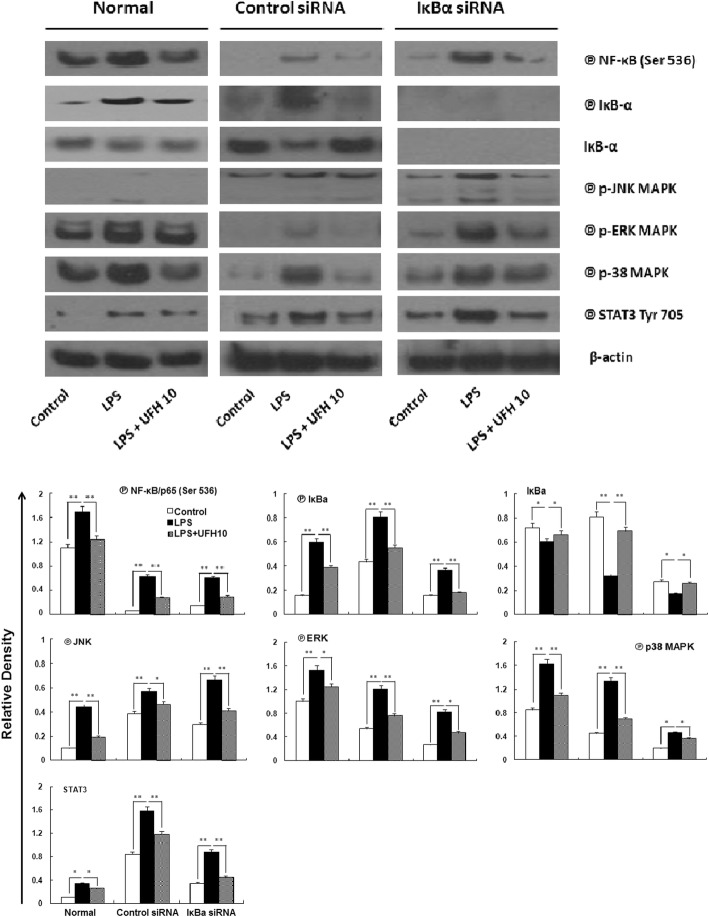
Effects of UFH on LPS-stimulated activation of different signaling pathways. Cells were treated with 10 U/ml of UFH for 15 min, followed by exposure to 10 μg/ml LPS for 1 h. The intensity of the band was corrected with that of β-actin. Graph shows mean ± SD fold change over control from 3 experiments. *P<0.05, compared to the vehicle-treated control group. **P<0.01, compared to the vehicle-treated control group. #P<0.05, compared to the LPS-treated group. ##P<0.01, compared to the LPS-treated group
Fig. 6
Fig. 6
Effects of UFH on LPS-induced NF-κB DNA binding. Cells were pretreated with 10 U/ml of UFH for 15 min, followed by exposure to 10 μg/ml LPS for 1 h. The results are representative of three independent experiments. *P<0.05, compared to the vehicle-treated control group. **P<0.01, compared to the vehicle-treated control group. #P<0.05, compared to the LPS-treated group. ##P<0.01, compared to the LPS-treated group

References

    1. Iba T, Levy JH. Inflammation and thrombosis: roles of neutrophils, platelets and endothelial cells and their interactions in thrombus formation during sepsis. J Thromb Haemost. 2018;16(2):231–241. doi: 10.1111/jth.13911. - DOI - PubMed
    1. Opal SM, van der Poll T. Endothelial barrier dysfunction in septic shock. J Intern Med. 2015;277(3):277–293. doi: 10.1111/joim.12331. - DOI - PubMed
    1. Levi M, Van der Poll T, Büller HR. Bidirectional relation between inflammation and coagulation. Circulation. 2004;109:2698–2704. doi: 10.1161/01.CIR.0000131660.51520.9A. - DOI - PubMed
    1. Onishi A, St Ange K, Dordick JS, Linhardt RJ. Heparin and anticoagulation. Front Biosci (Landmark Ed) 2016;21:1372–1392. doi: 10.2741/4462. - DOI - PubMed
    1. Ludwig RJ. Therapeutic use of heparin beyond anticoagulation. Curr Drug Discov Technol. 2009;6:281–289. doi: 10.2174/157016309789869001. - DOI - PubMed