. 2020 Jan 29:11:48.
doi: 10.3389/fpsyg.2020.00048. eCollection 2020.

Novelty Improves the Formation and Persistence of Memory in a Naturalistic School Scenario

Affiliations

Novelty Improves the Formation and Persistence of Memory in a Naturalistic School Scenario

D Ramirez Butavand et al. Front Psychol. .

Abstract

One of the top challenges in education and neuroscience consists in translating laboratory results into strategies to improve learning and memory in teaching environments. In that sense, during the last two decades, researchers have discovered specific temporal windows around learning, during which the intervention with some experiences induces modulatory effects on the formation and/or persistence of memory. Based on these results, the aim of the present study was to design a specific strategy to improve the memory of students in a high-school scenario, by assessing the effect of a novel situation experienced close to learning. We found that the long-term memory about a geometrical figure was more precise in the group of students that faced a novel situation 1 h before or after learning the figure than the control group of students who did not face the novelty. This enhancement was probably triggered by processes acting on memory formation mechanisms that remained evident 45 days after learning, indicating that the improvement was sustained over time. In addition, our results showed that novelty no longer improved the memory if it was experienced 4 h before or after learning. However, far beyond this window of efficacy, when it was faced around 10 h after learning, the novel experience improved the memory persistence tested 7 days later. In summary, our findings characterized different temporal windows of the effectiveness of novelty acting on memory processing, providing a simple and inexpensive strategy that could be used to improve memory formation and persistence in high-school students.

Keywords: high-school students; long-term memory; memory formation; memory persistence; novel class.


Figures

Figure 1
Figure 1
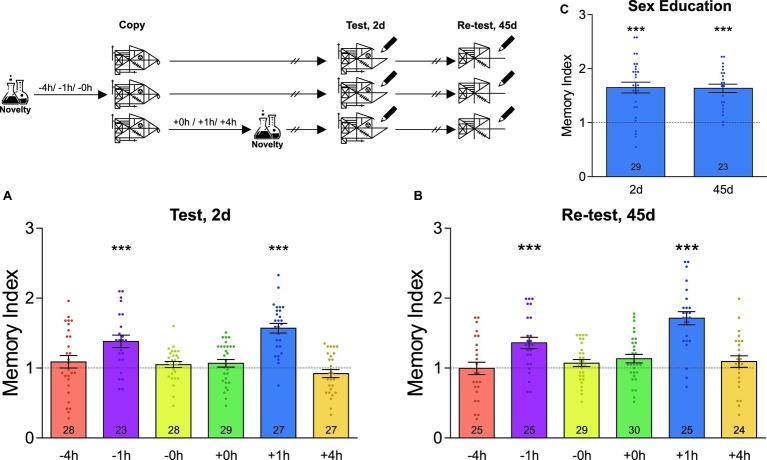
Novel experiences around learning improve the formation of an unrelated graphical memory. A schematic representation of the experimental protocol is presented on the top left of the figure: students were asked to copy Rey-Osterrieth’s figure and had or not (Control) a novel experience (Attentional Blindness class) before or after it. The time at which the students copied the figure was time zero and the time condition described for the novelty was relative to it and is expressed in hours. The Memory Index was calculated by normalizing the score obtained by each participant in the test session with its corresponding control group mean. It is shown as the mean ± SEM for students who have had the novel experience at different times around the time at which they copied the figure. The dotted line represents the Control group. (A) The LTM of this figure was tested 2 days after training. (B) The LTM of this figure was re-tested 45 days after training in the same students as those of figure (A). (C) Students experienced a novel sex education lesson 1 h after training and tested 2 days after learning and re-tested 45 days later. One-sample t-test against theoretical value 1, ***p < 0.001. The number of students in the different experimental groups is detailed inside each bar. The number of students in all control groups ranged from 29 to 35.
Figure 2
Figure 2
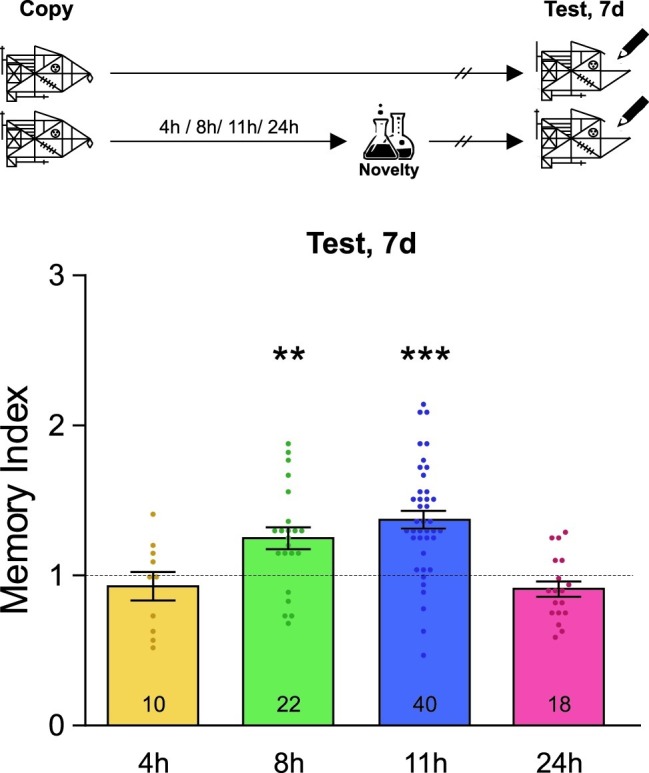
Novel experiences late after training improve memory persistence. A schematic representation of the experimental protocol is presented on the top panel: students were asked to copy Rey-Osterrieth’s figure and they had or not (Control) a novel experience (Attentional Blindness class) after it. The time at which the students copied the figure was time zero and the time condition described for the novelty was relative to it and is expressed in hours. The Memory Index was calculated by normalizing the score obtained by each participant in the test session with each corresponding control group mean. It is shown as mean ± SEM for students who have had the novel experience at different times after learning (4–24 h). The dotted line represents the Control group. The LTM shown in this figure was tested 7 days after training. One-sample t-test against theoretical value 1, **p < 0.01, ***p < 0.001. The number of students in the different experimental groups is detailed inside each bar. The number of students in all control groups ranged from 30 to 37.

References

    1. Abdou K., Shehata M., Choko K., Nishizono H., Matsuo M., Muramatsu S., et al. (2018). Synapse-specific representation of the identity of overlapping memory engrams. Science 360, 1227–1231. 10.1126/science.aat3810 - DOI - PubMed
    1. Adcock R. A., Thangavel A., Whitfield-Gabrieli S., Knutson B., Gabrieli J. D. E. (2006). Reward-motivated learning: mesolimbic activation precedes memory formation. Neuron 50, 507–517. 10.1016/j.neuron.2006.03.036, PMID: - DOI - PubMed
    1. Ballarini F., Moncada D., Martinez M. C., Alen N., Viola H. (2009). Behavioral tagging is a general mechanism of long-term memory formation. Proc. Natl. Acad. Sci. USA 106, 14599–14604. 10.1073/pnas.0907078106 - DOI - PMC - PubMed
    1. Ballarini F., Martínez M. C., Díaz Perez M., Moncada D., Viola H. (2013). Memory in elementary school children is improved by an unrelated novel experience. PLOS One 8:e66875. 10.1371/journal.pone.0066875 - DOI - PMC - PubMed
    1. Bekinschtein P., Cammarota M., Igaz L. M., Bevilaqua L. R., Izquierdo I., Medina J. H. (2007). Persistence of long-term memory storage requires a late protein synthesis- and BDNF- dependent phase in the hippocampus. Neuron 53, 261–277. 10.1016/j.neuron.2006.11.025, PMID: - DOI - PubMed

LinkOut - more resources