Incidence and prevalence of intravenous medication errors in the UK: a systematic review
- PMID: 32064081
- PMCID: PMC6992970
- DOI: 10.1136/ejhpharm-2018-001624
Incidence and prevalence of intravenous medication errors in the UK: a systematic review
Abstract
Objectives: Medication error is the most common type of medical error, and intravenous medicines are at a higher risk as they are complex to prepare and administer. The WHO advocates a 50% reduction of harmful medication errors by 2022, but there is a lack of data in the UK that accurately estimates the true rate of intravenous medication errors. This study aimed to estimate the number of intravenous medication errors per 1000 administrations in the UK National Health Service and their associated economic costs. The rate of errors in prescribing, preparation and administration, and rate of different types of errors were also extracted.
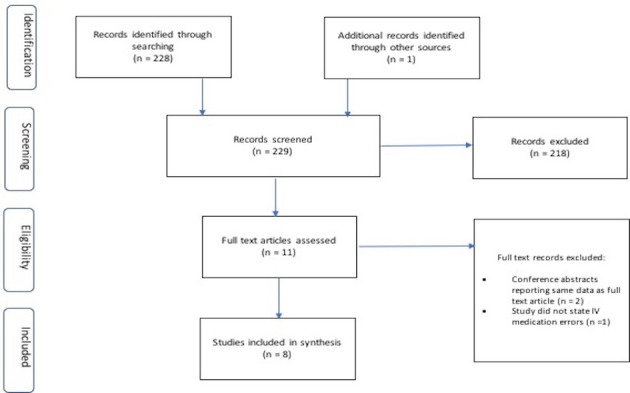
Methods: MEDLINE, Embase, Cochrane central register of clinical trials, Database of Abstracts of Reviews of Effectiveness, National Health Service Economic Evaluation Database and the Health Technology Appraisals Database were searched from inception to July 2017. Epidemiological studies to determine the incidence of intravenous medication errors set wholly or in part in the UK were included. 228 studies were identified, and after screening, eight papers were included, presenting 2576 infusions. Data were reviewed and extracted by a team of five reviewers with discrepancies in data extraction agreed by consensus.
Results: Five of eight studies used a comparable denominator, and these data were pooled to determine a weighted mean incidence of 101 intravenous medication errors per 1000 administrations (95% CI 84 to 121). Three studies presented prevalence data but these were based on spontaneous reports only; therefore it did not support a true estimate. 32.1% (95% CI 30.6% to 33.7%) of intravenous medication errors were administration errors and 'wrong rate' errors accounted for 57.9% (95% CI 54.7% to 61.1%) of these.
Conclusion: Intravenous medication errors in the UK are common, with half these of errors related to medication administration. National strategies are aimed at mitigating errors in prescribing and preparation. It is now time to focus on reducing administration error, particularly wrong rate errors.
Keywords: clinical pharmacy; information technology; intravenous infusions; medication errors; public hospitals.
© European Association of Hospital Pharmacists 2020. Re-use permitted under CC BY-NC. No commercial re-use. Published by BMJ.
Conflict of interest statement
Competing interests: AS reports personal fees and non-financial support from Becton Dickinson UK Ltd. during the conduct of the study. JC, MR, TS and EW all report personal fees from Becton Dickinson UK Ltd. during the conduct of the study.
Figures
References
-
- Department of Health. The Report of the Short Life Working Group on reducing medication-related harm. London 2018. https://www.gov.uk/government/publications/medication-errors-short-life-... (accessed 15 Mar 2018).
-
- World Health Organisation. Medication Without Harm - Global Patient Safety Challenge on Medication Safety. Geneva, 2017.
-
- Maddox RR, Danello S, Williams CK, et al. Agency for Healthcare Research and Quality, 2008. Intravenous infusion safety initiative: collaboration, evidence-based best practices, and “smart” technology help avert high-risk adverse drug events and improve patient outcomes http://www.ncbi.nlm.nih.gov/pubmed/21249948 (accessed 18 Mar 2018). - PubMed
-
- ECRI Institute. Top 10 health technology hazards for 2017 named. OR Manager 2017;33:24–7. - PubMed
Publication types
MeSH terms
Substances
LinkOut - more resources
Full Text Sources
Medical