


Retooling Asymmetric Conjugate Additions for Sterically Demanding Substrates with an Iterative Data-Driven Approach
- PMID: 32064147
- PMCID: PMC7011729
- DOI: 10.1021/acscatal.9b01814
Retooling Asymmetric Conjugate Additions for Sterically Demanding Substrates with an Iterative Data-Driven Approach
Abstract
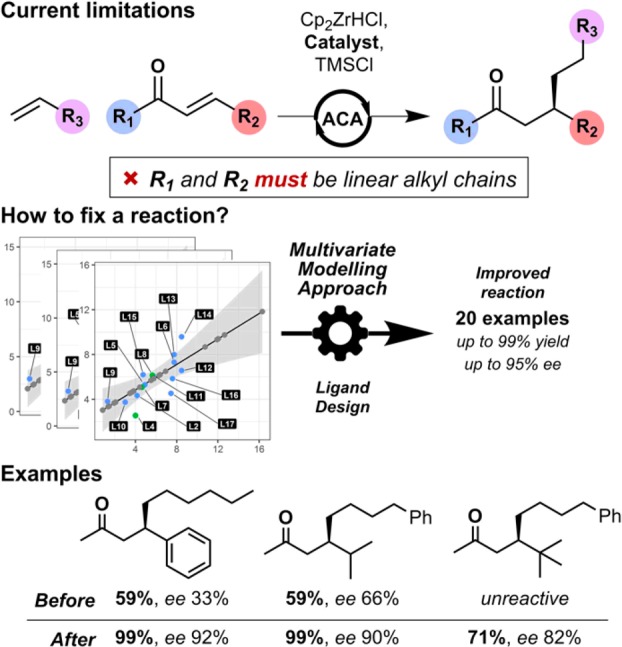
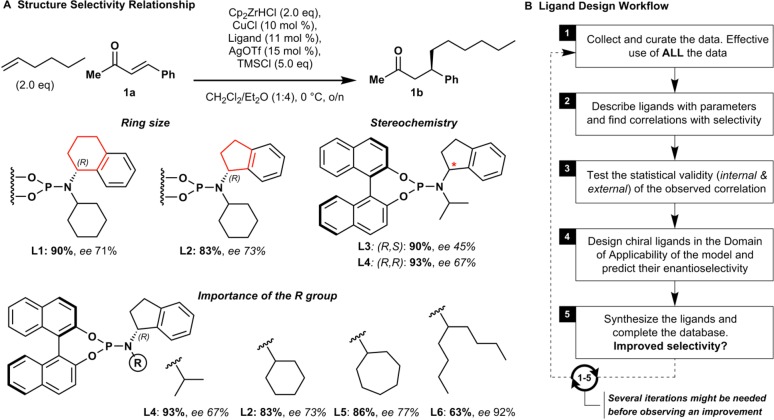
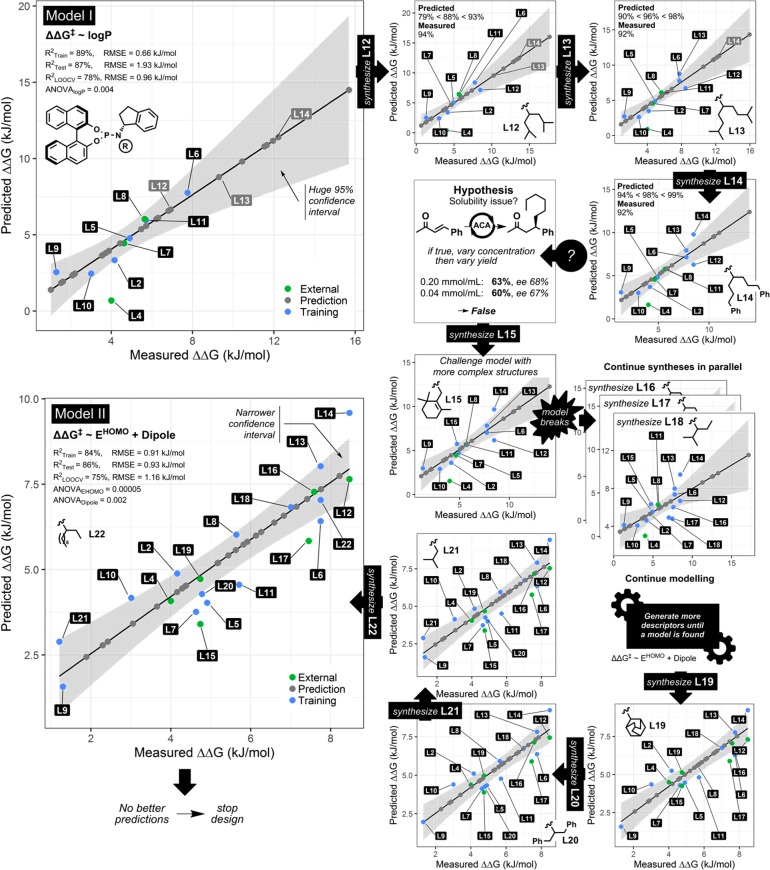
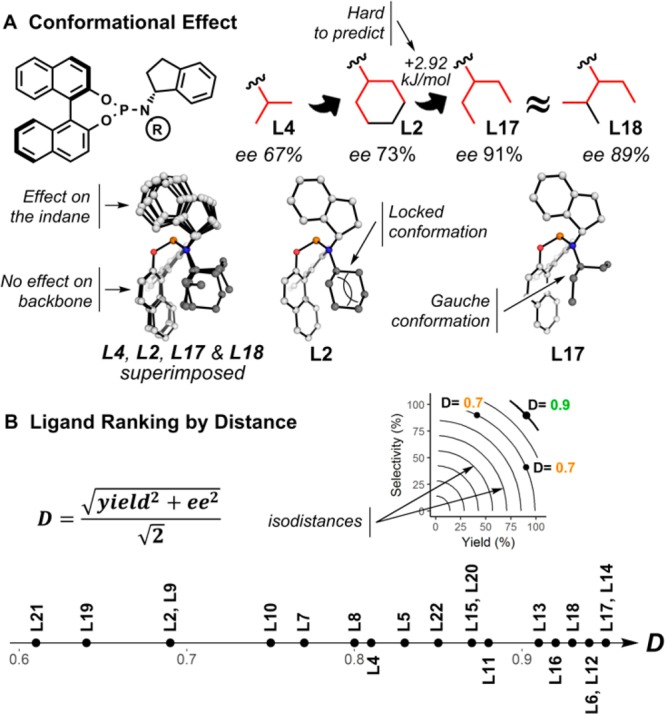
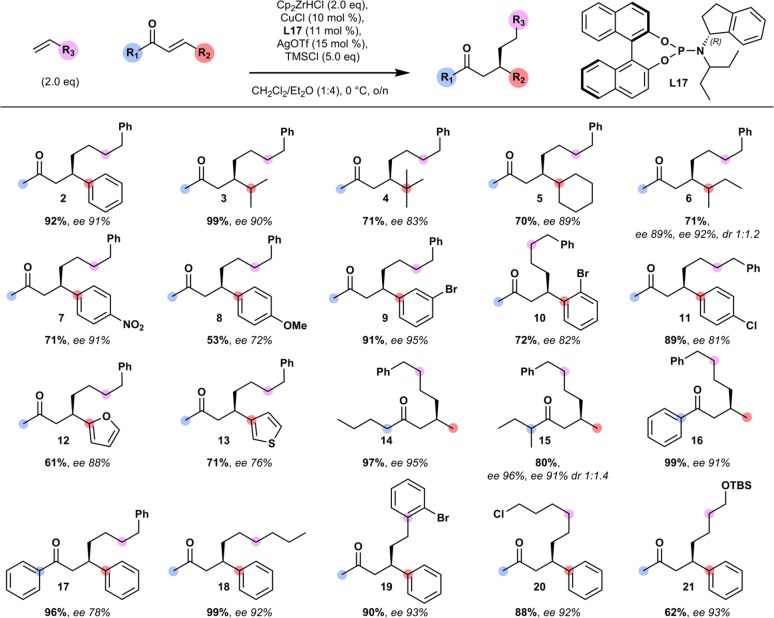
The development of catalytic enantioselective methods is routinely carried out using easily accessible and prototypical substrates. This approach to reaction development often yields asymmetric methods that perform poorly using substrates that are sterically or electronically dissimilar to those used during the reaction optimization campaign. Consequently, expanding the scope of previously optimized catalytic asymmetric reactions to include more challenging substrates is decidedly nontrivial. Here, we address this challenge through the development of a systematic workflow to broaden the applicability and reliability of asymmetric conjugate additions to substrates conventionally regarded as sterically and electronically demanding. The copper-catalyzed asymmetric conjugate addition of alkylzirconium nucleophiles to form tertiary centers, although successful for linear alkyl chains, fails for more sterically demanding linear α,β-unsaturated ketones. Key to adapting this method to obtain high enantioselectivity was the synthesis of modified phosphoramidite ligands, designed using quantitative structure-selectivity relationships (QSSRs). Iterative rounds of model construction and ligand synthesis were executed in parallel to evaluate the performance of 20 chiral ligands. The copper-catalyzed asymmetric addition is now more broadly applicable, even tolerating linear enones bearing tert-butyl β-substituents. The presence of common functional groups is tolerated in both nucleophiles and electrophiles, giving up to 99% yield and 95% ee across 20 examples.
Copyright © 2019 American Chemical Society.
Conflict of interest statement
The authors declare no competing financial interest.
Figures
References
-
- Pinheiro D. L. J.; de Castro P. P.; Amarante G. W. Recent Developments and Synthetic Applications of Nucleophilic Zirconocene Complexes from Schwartz’s Reagent. Eur. J. Org. Chem. 2018, 2018, 4828–4844. 10.1002/ejoc.201800852. - DOI
-
- P. Sibi M.; Manyem S. Enantioselective Conjugate Additions. Tetrahedron 2000, 56, 8033–8061. 10.1016/S0040-4020(00)00618-9. - DOI
LinkOut - more resources
Full Text Sources