


Advancements in Hydrogel-Functionalized Immunosensing Platforms
- PMID: 32064366
- PMCID: PMC7016926
- DOI: 10.1021/acsomega.9b03816
Advancements in Hydrogel-Functionalized Immunosensing Platforms
Abstract
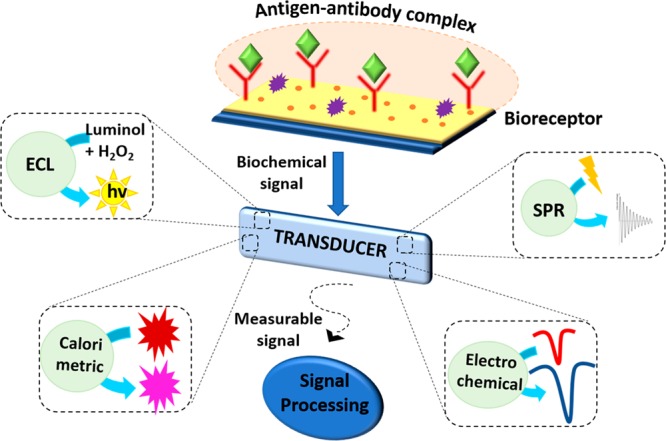
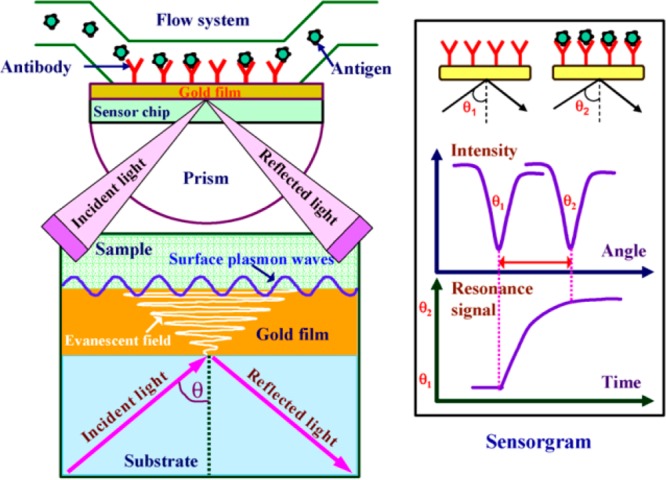
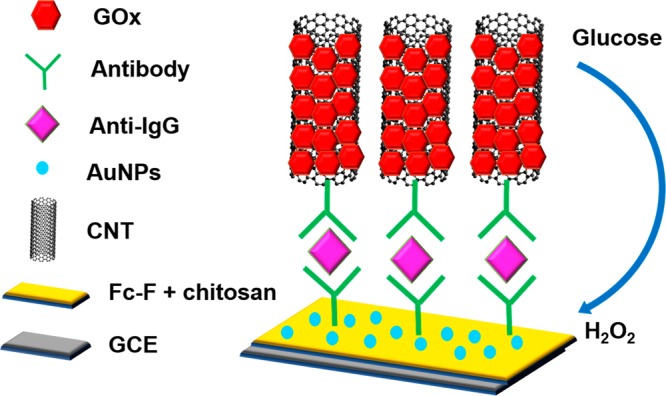
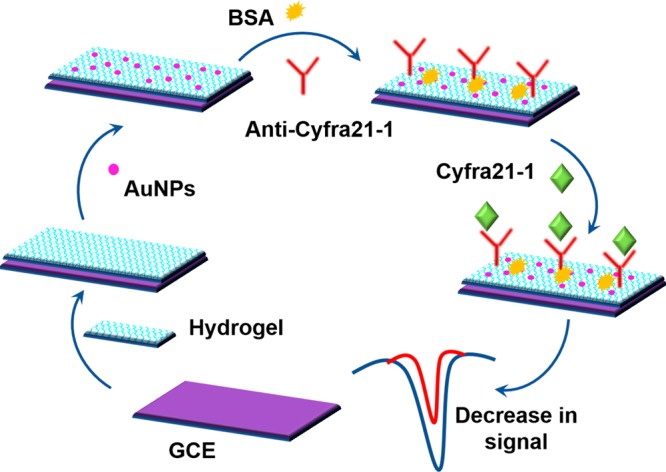
Explicit antigen-antibody binding has accelerated the development of immunosensors for the detection of various analytes in biomedical and environmental domains. Being a subclass of biosensors, immunosensors have been a significant area of research in attaining high sensitivity and an ultralow sensing limit to detect biological analytes present in trace levels. The highly porous structure, large surface area, and excellent biocompatibility of hydrogels enabling the retainability of the activity and innate framework of the attached biomolecules make them a suitable candidate for immunosensor fabrication. Hydrogels based on polycarboxylate, cellulose, polyaniline, polypyrrole, sodium alginate, chitosan, and agarose are exploited in conjunction with other nanomaterials such as AuNPs, GO, and MWCNTs to augment the electron transfer during the immunosensing mechanism. Surface plasmon resonance, electrochemiluminescence, colorimetric, and electrochemical assays are different strategies utilized for the signal transduction in hydrogel-based immunosensors during the formation of the antigen-antibody complex. These hydrogel-based immunosensors exhibit rapid response, excellent stability, reproducibility, high selectivity and high sensitivity, a broad range of detection, an ultralow limit of detection, and display results similar to those for the ELISA test. This review propounds different hydrogel-functionalized immunosensing platforms classified on the basis of their signal transduction for the detection of disparate cancer biomarkers (tumor necrosis factor, α-fetoprotein, prostate-specific antigen, carbohydrate antigen 24-2, carcinoembryonic antigen, neuron-specific enolase, and cytokeratin antigen 21-1), hormones (cortisol, cortisone, and human chorionic gonadotropin), human IgG, and ractopamine in animal feeds.
Copyright © 2020 American Chemical Society.
Conflict of interest statement
The authors declare no competing financial interest.
Figures
References
-
- Huang Y.; Ding Y.; Li T.; Yang M. Redox Hydrogel Based Immunosensing Platform for the Label-Free Detection of a Cancer Biomarker. Anal. Methods 2015, 7 (2), 411–415. 10.1039/C4AY02640C. - DOI
Publication types
LinkOut - more resources
Full Text Sources