. 2020 Feb 17;20(1):79.
doi: 10.1186/s12870-019-2185-0.

Metatranscriptomic dynamics after Verticillium dahliae infection and root damage in Olea europaea

Affiliations

Metatranscriptomic dynamics after Verticillium dahliae infection and root damage in Olea europaea

Jose Manuel Martí et al. BMC Plant Biol. .

Abstract

Background: The olive tree is of particular economic interest in the Mediterranean basin. Researchers have conducted several studies on one of the most devastating disorders affecting this tree, the Verticillium wilt, which causes substantial economic losses in numerous areas. We analyzed metatranscriptomic samples taken from a previous study conducted on leaves and roots of Olea europaea that were infected with Verticillium dahliae. In addition, we also analyzed mechanically damaged roots. The aim of our approach is to describe the dynamics of the root microbiome after severe perturbations.

Results: Our results not only describe the dynamics of the microbial community associated with the disturbance, but also show the high complexity of these systems and explain how this can lead to a conflicting assignment of the various types of parasitism observed in a specific organism.

Conclusions: Our findings indicate that this infection, although led by Verticillium, is driven not by a single species, but by a polymicrobial consortium that also includes natural endophytes of the olive tree. This community contains both biotrophic and necrotrophic organisms that alternate and live together during the infection. In addition, opportunistic organisms appear that take profit not from plant tissues, but from new emerging populations of microorganisms. Therefore, this system can be described as a complex biological system composed of different interacting communities. Notably, our work has important considerations when it comes to classifying the type of parasitism of a given species.

Keywords: Biotroph; Endophytes; Hemibiotroph; Necrotroph; Olea europaea; Polymicrobial infection; Rank dynamics; Root damage; Temporal metatranscriptomics; Verticillium dahliae; Verticillium wilt of olive.


Conflict of interest statement

The authors declare that they have no competing interests.

Figures
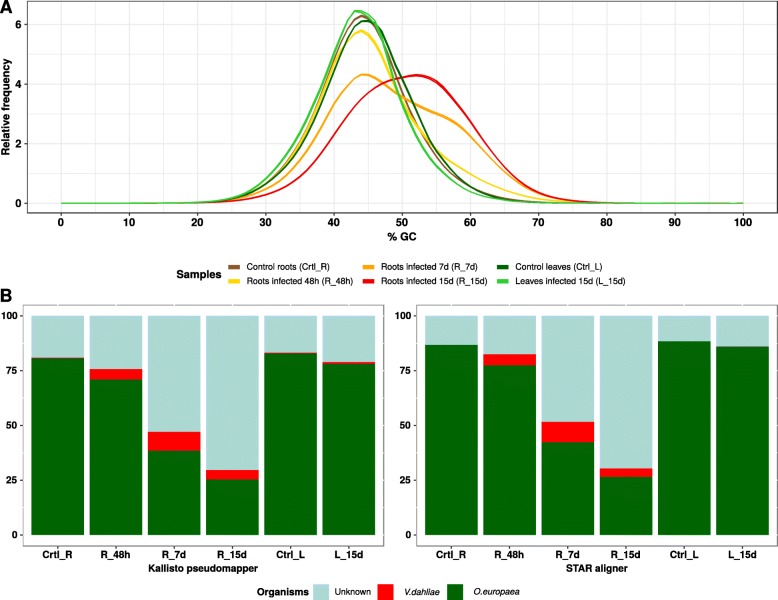
Fig. 1
Fig. 1
(A): The average per base GC content of the reads. The GC content of the olive genome is roughly 43%. (B): Percentage of reads mapped to the olive (green) and V.dahliae (red) genomes, obtained through Kallisto pseudomaper and STAR aligner, respectively. The cyan color corresponds to the proportion of unmapped reads of initially unknown origin
Fig. 2
Fig. 2
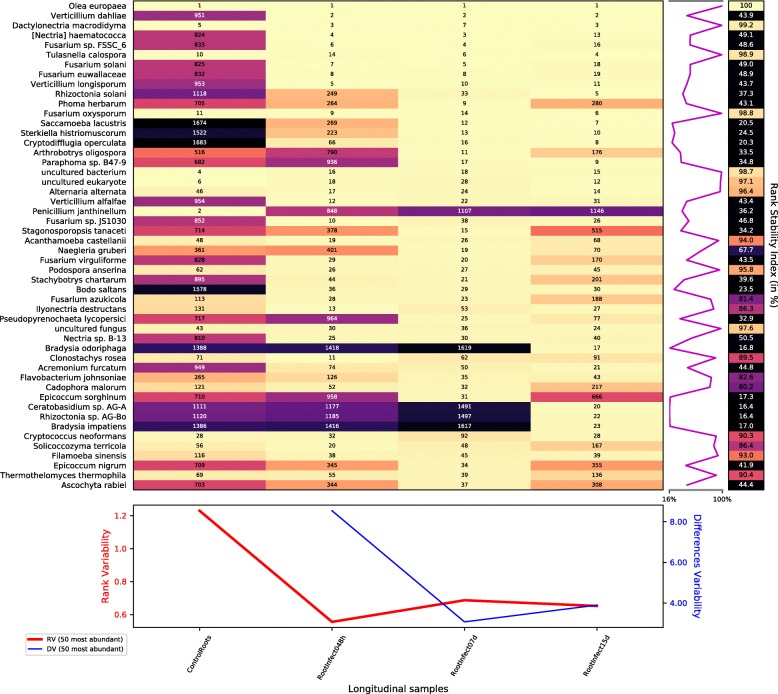
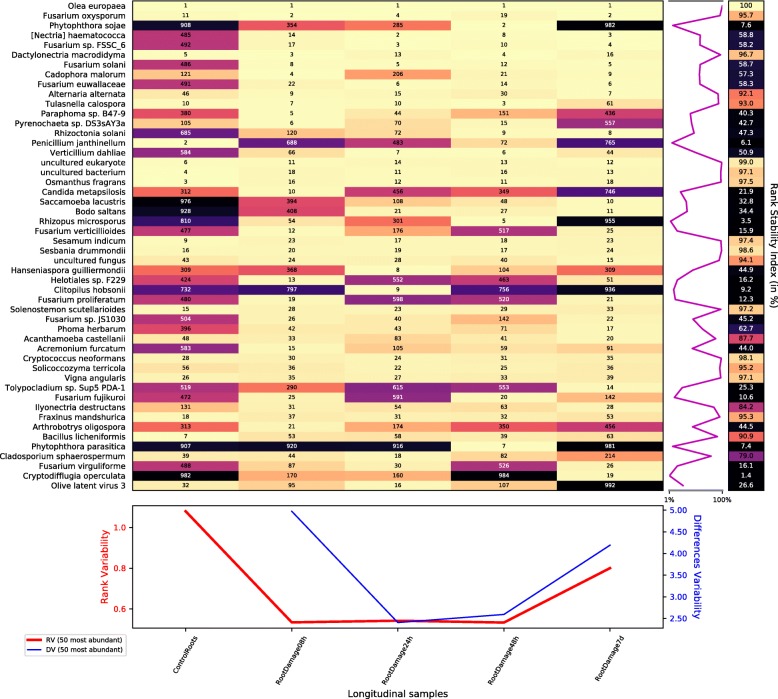
Rank dynamics and stability plot for mapped reads classified at species level during the process of infection with V. dahliae. The dynamics of the rank during the process shows the profound impact in the rhizosphere of the olive tree caused by the inoculation with V. dahliae. Numbers and colours (using perceptually uniform colormap for easier visualization) show the ranking by the accumulated species abundance in each column. Different rank variability and stability measurements [13] are given. The right panel shows the rank stability throughout species ordered by their overall abundance. The lower panel contains plots of the rank variability (RV) and differences variability (DV) over time
Fig. 3
Fig. 3
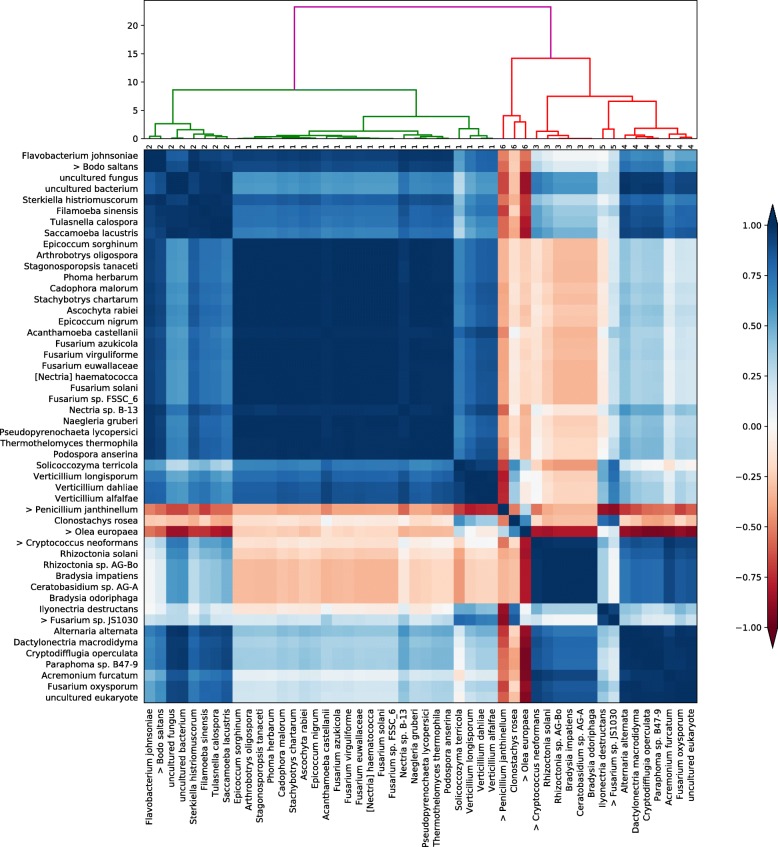
Clustered correlation and dendrogram plot for species during the process of infection with V. dahliae. We show the 50 most abundant species ordered by clustering based on the Pearson time correlation matrix (darker shades of blue indicate higher magnitudes of positive correlation, while darker shades of red indicate higher anti-correlation values). With this analysis, six different clusters can be identified (cluster number assignment shown under the dendrogram)
Fig. 4
Fig. 4
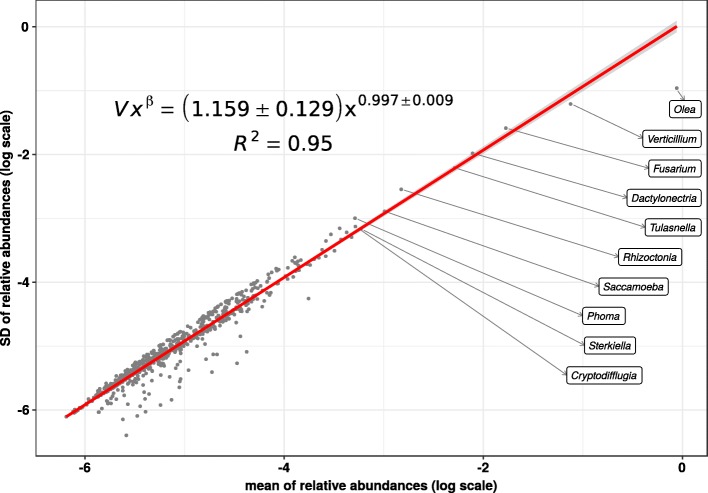
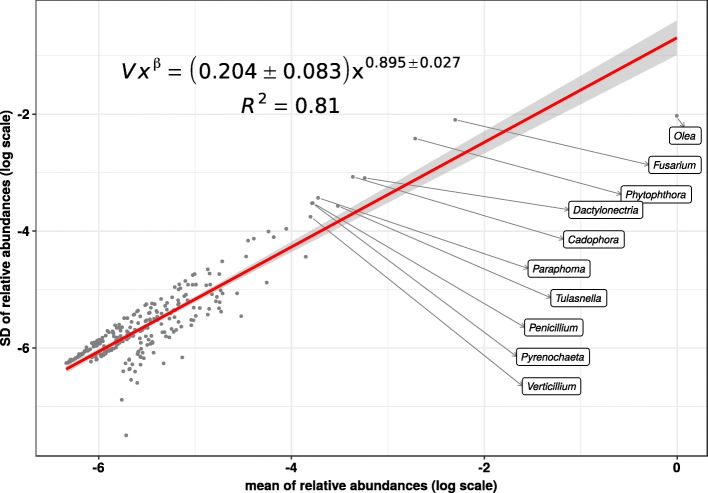
Taylor’s law of the biological system consisting in the metatranscriptome at genus level along the root infectious process. We see that Taylor’s power law spans six orders of magnitude, therefore, it is ubiquitous
Fig. 5
Fig. 5
Recentrifuge plots of the evolution of fungal MTS classified reads at species level during the V. dahliae infection. The top pie refers to the root control sample, whereas the others apply to the infected roots after 48 h, 7 days, and 15 days, respectively, of the Verticilium inoculation. An interactive and dynamic collection of Recentrifuge [24] plots can be accessed via the official project’s webpage at https://www.uv.es/martijm/olea
Fig. 6
Fig. 6
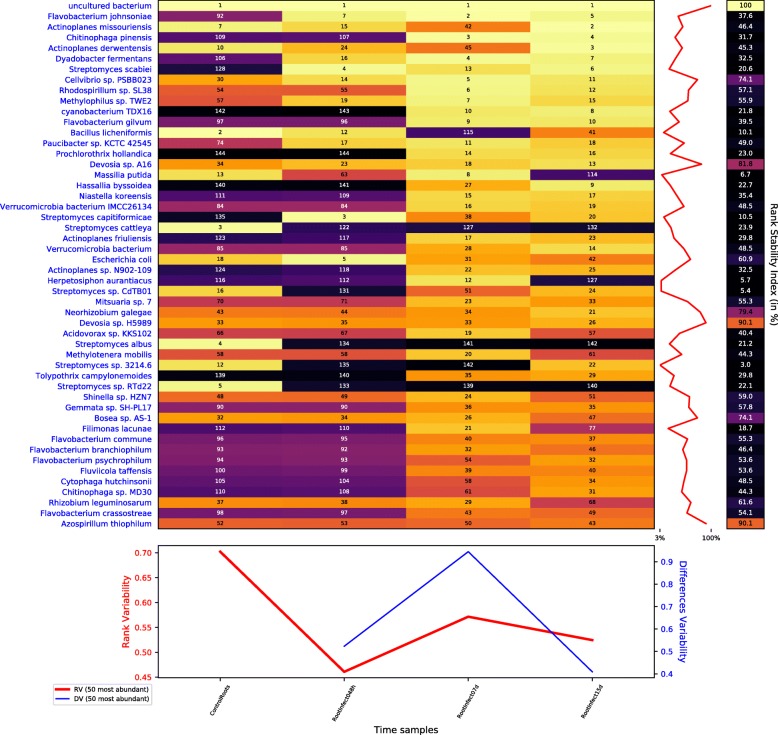
Rank dynamics and stability plot for bacterial species during the process of infection with V. dahliae. Numbers and colours (using perceptually uniform colormap for easier visualization) show the ranking by the accumulated species abundance in each column. Different rank variability and stability measurements [13] are given. The right panel shows the rank stability throughout species ordered by their overall abundance. The lower panel contains plots of the rank variability over time
Fig. 7
Fig. 7
Rank dynamics and stability plot for species during the process after root damage. The dynamics of the rank during the process shows a significative impact in the rhizosphere of the olive. Numbers and colours (using perceptually uniform colormap for easier visualization) show the ranking by the accumulated species abundance in each column. Different rank variability and stability measurements [13] are given. The right panel shows the rank stability throughout species ordered by their overall abundance. The lower panel contains plots of the rank variability over time
Fig. 8
Fig. 8
Taylor’s law of the biological system consisting in the metatranscriptome at genus level throughout the root damage process. We see that Taylor’s power law seems to be ubiquitous, spanning in this case more than six orders of magnitude
Fig. 9
Fig. 9
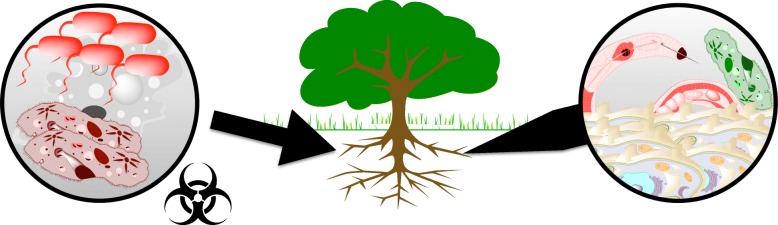
Systems approach to the Verticillium wilt of olive: a complex interaction between complex systems. Polymicrobial community attacks a host community (a host and its symbionts). Our results suggest the relevance of a systems perspective as a generalization of the approach to an infectious process. The tree illustration appearing in this Figure is a public-domain, vectorial image obtained from http://openclipart.org

References

    1. Terral J-F, Arnold-Simard G. Beginnings of olive cultivation in eastern spain in relation to holocene bioclimatic changes. Quat Res. 1996;46(2):176–85. doi: 10.1006/qres.1996.0057. - DOI
    1. López-Escudero FJ, Mercado-Blanco J. Verticillium wilt of olive: a case study to implement an integrated strategy to control a soil-borne pathogen. Plant Soil. 2011;344(1):1–50. doi: 10.1007/s11104-010-0629-2. - DOI
    1. Jiménez-Ruiz Jaime, Leyva-Pérez María de la O, Schilirò Elisabetta, Barroso Juan Bautista, Bombarely Aureliano, Mueller Lukas, Mercado-Blanco Jesús, Luque Francisco. Transcriptomic Analysis of Olea europaea L. Roots during the Verticillium dahliae Early Infection Process. The Plant Genome. 2017;10(1):plantgenome2016.07.0060. doi: 10.3835/plantgenome2016.07.0060. - DOI - PubMed
    1. Cuadros-Orellana S, Rabelo Leite L, Dutra Medeiros J, Badotti F, Fonseca PL, Vaz AB, Oliveira G, Göes-Neto A. Assessment of fungal diversity in the environment using metagenomics: a decade in review. Fungal Genomics Biol. 2013;3(2):110–22.
    1. Scholz SS, Schmidt-Heck W, Guthke R, Furch ACU, Reichelt M, Gershenzon J, Oelmüller R. Verticillium dahliae-arabidopsis interaction causes changes in gene expression profiles and jasmonate levels on different time scales. Front Microbiol. 2018;9:217. doi: 10.3389/fmicb.2018.00217. - DOI - PMC - PubMed