


Consensus protocols for the diagnosis and management of the hereditary autoinflammatory syndromes CAPS, TRAPS and MKD/HIDS: a German PRO-KIND initiative
- PMID: 32066461
- PMCID: PMC7027082
- DOI: 10.1186/s12969-020-0409-3
Consensus protocols for the diagnosis and management of the hereditary autoinflammatory syndromes CAPS, TRAPS and MKD/HIDS: a German PRO-KIND initiative
Abstract
Background: Rare autoinflammatory diseases (AIDs) including Cryopyrin-Associated Periodic Syndrome (CAPS), Tumor Necrosis Receptor-Associated Periodic Syndrome (TRAPS) and Mevalonate Kinase Deficiency Syndrome (MKD)/ Hyper-IgD Syndrome (HIDS) are genetically defined and characterized by recurrent fever episodes and inflammatory organ manifestations. Early diagnosis and early start of effective therapies control the inflammation and prevent organ damage. The PRO-KIND initiative of the German Society of Pediatric Rheumatology (GKJR) aims to harmonize the diagnosis and management of children with rheumatic diseases nationally. The task of the PRO-KIND CAPS/TRAPS/MKD/HIDS working group was to develop evidence-based, consensus diagnosis and management protocols including the first AID treat-to-target strategies.
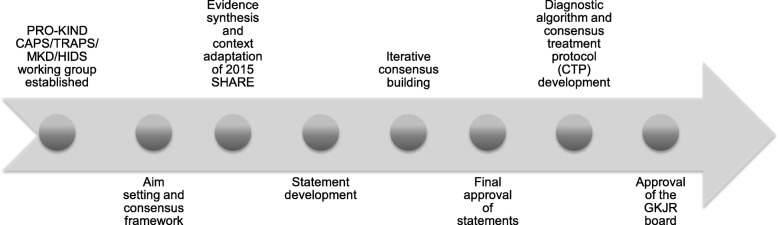
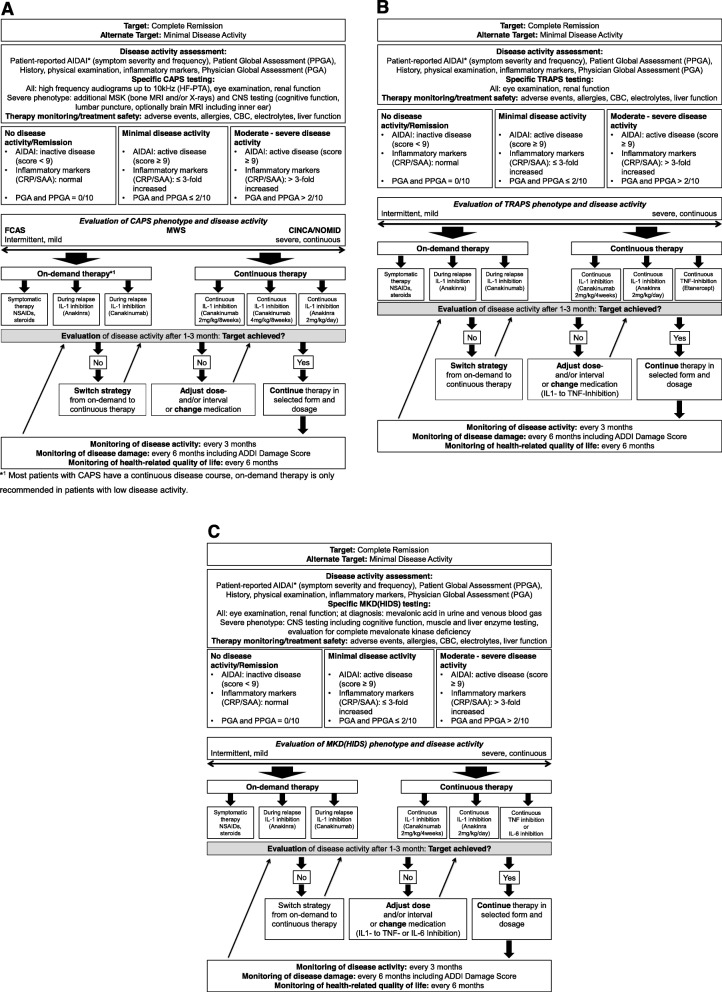
Methods: The national CAPS/TRAPS/MKD/HIDS expert working group was established, defined its aims and conducted a comprehensive literature review synthesising the recent (2013 to 2018) published evidence including all available recommendations for diagnosis and management. General and disease-specific statements were anchored in the 2015 SHARE recommendations. An iterative expert review process discussed, adapted and refined these statements. Ultimately the GKJR membership vetted the proposed consensus statements, agreement of 80% was mandatory for inclusion. The approved statements were integrated into three disease specific consensus treatment plans (CTPs). These were developed to enable the implementation of evidence-based, standardized care into clinical practice.
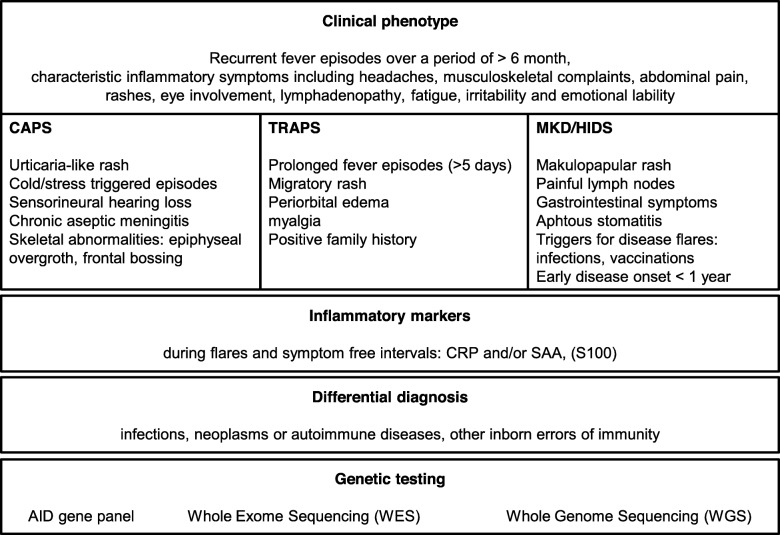
Results: The CAPS/TRAPS/MKD/HIDS expert working group of 12 German and Austrian paediatric rheumatologists completed the evidence synthesis and modified a total of 38 statements based on the SHARE recommendation framework. In iterative reviews 36 reached the mandatory agreement threshold of 80% in the final GKJR member survey. These included 9 overarching principles and 27 disease-specific statements (7 for CAPS, 11 TRAPS, 9 MKD/HIDS). A diagnostic algorithm was established based on the synthesized evidence. Statements were integrated into diagnosis- and disease activity specific treat-to-target CTPs for CAPS, TRAPS and MKD/HIDS.
Conclusions: The PRO-KIND CAPS/TRAPS/MKD/HIDS working group established the first evidence-based, actionable treat-to-target consensus treatment plans for three rare hereditary autoinflammatory diseases. These provide a path to a rapid evaluation, effective control of disease activity and tailored adjustment of therapies. Their implementation will decrease variation in care and optimize health outcomes for children with AID.
Keywords: Autoinflammatory diseases; Comparative effectiveness; Consensus treatment plans; Management; Treat-to-target.
Conflict of interest statement
S.H. received honoraria from Novartis Pharma for Advisory Board attendance.
E.L. received speaker honoraria from Novartis and SOBI and funding for the AID-registry by the Federal Ministry of Education and Research (BMBF: 01GM08104, 01GM1112D, 01GM1512D).
G.H. received speaker honoraria from Novartis, MSD, Bayer, Bristol-Myers, Sobi, Boehringer and Chugai and received research grants from AbbVie, Chugai, Novartis, Pfizer, Roche and MSD.
D.H. received speaker honoraria from Novartis Pharma.
N.R. received research grants, travel grants for Advisory Board attendance and speaker honoraria from Novartis.
A.J. has no financial disclosures.
A.R.-W. received research grants, travel grants for Advisory Board attendance and speaker honoraria from Novartis.
G.E. was partially funded through the Margarete Mueller-Bull Stiftung and a research grant of Novartis Pharma. G.E. also received speaker honoraria from Novartis Pharma.
M.P. received speaking honoraria from Novartis, MSD, Pfizer, SOBI and Chugai and received research grants from Novartis, SOBI, Pfizer and Chugai.
J.B. received speaker’s bureaus or consulting fees from AbbVie, Novartis, and Pfizer.
S.B. received speaker honoraria from Novartis and SOBI.
J.B.K.-D. performed clinical studies with and received educational, research and centre grants and honoraria from Novartis, AbbVie and SOBI.
Figures
References
Publication types
MeSH terms
Substances
LinkOut - more resources
Full Text Sources
Miscellaneous
