. 2020 Feb 17;13(1):81.
doi: 10.1186/s13071-020-3926-5.

The complete mitochondrial genome of a parasite at the animal-fungal boundary

Affiliations

The complete mitochondrial genome of a parasite at the animal-fungal boundary

Salma Sana et al. Parasit Vectors. .

Abstract

Background: Sphaerothecum destruens is an obligate intracellular fish parasite which has been identified as a serious threat to freshwater fishes. Taxonomically, S. destruens belongs to the order Dermocystida within the class Ichthyosporea (formerly referred to as Mesomycetozoea), which sits at the animal-fungal boundary. Mitochondrial DNA (mtDNA) sequences can be valuable genetic markers for species detection and are increasingly used in environmental DNA (eDNA) based species detection. Furthermore, mtDNA sequences can be used in epidemiological studies by informing detection, strain identification and geographical spread.

Methods: We amplified the entire mitochondrial (mt) genome of S. destruens in two overlapping long fragments using primers designed based on the cox1, cob and nad5 partial sequences. The mt-genome architecture of S. destruens was then compared to close relatives to gain insights into its evolution.

Results: The complete mt-genome of Sphaerothecum destruens is 23,939 bp in length and consists of 47 genes including 21 protein-coding genes, 2 rRNA, 22 tRNA and two unidentified open reading frames. The mitochondrial genome of S. destruens is intronless and compact with a few intergenic regions and includes genes that are often missing from animal and fungal mt-genomes, such as, the four ribosomal proteins (small subunit rps13 and 14; large subunit rpl2 and 16), tatC (twin-arginine translocase component C), and ccmC and ccmF (cytochrome c maturation protein ccmC and heme lyase).

Conclusions: We present the first mt-genome of S. destruens which also represents the first mt-genome for the order Dermocystida. The availability of the mt-genome can assist the detection of S. destruens and closely related parasites in eukaryotic diversity surveys using eDNA and assist epidemiological studies by improving molecular detection and tracking the parasite's spread. Furthermore, as the only representative of the order Dermocystida, its mt-genome can be used in the study of mitochondrial evolution of the unicellular relatives of animals.

Keywords: Animal-fungal boundary; Dermocystida; Invasive; Mesomycetozoea; Mitochondrial DNA; Parasite; Pseudorasbora parva; Sphaerothecum destruens; Topmouth gudgeon.


Conflict of interest statement

The authors declare that they have no competing interests.

Figures

Fig. 1
Fig. 1
A schematic representation of the phylogenetic position of Sphaerothecum destruens (reconstructed from [19, 20]). Sphaerothecum destruens belongs to the order Dermocystida which belongs to the class Ichthyosporea. Its taxonomic position is between fungi and animals (Metazoa). Due to the lack of mitochondrial genomes in close relatives, the mitochondrial genome of S. destruens was compared to Amoebidium parasiticum (Ichthyophonida), Ministeria vibrans (Filasterea), Capsaspora owczarzaki (Filasterea), Monosiga brevicollis (Choanoflagellatea) and Oscarella carmela (Demospongiae, Metazoa)
Fig. 2
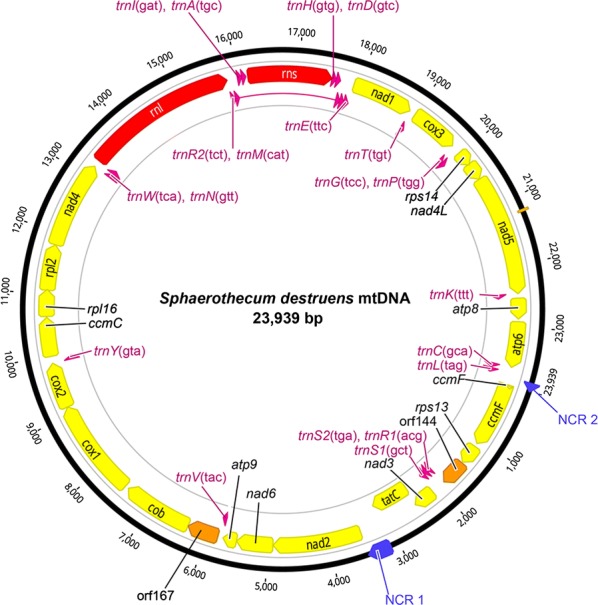
Fig. 2
The complete mitochondrial genome for Sphaerothecum destruens. All genes are encoded in the same transcriptional orientation. 22 tRNA genes (pink), 2 rRNA genes (red), 19 protein coding genes (yellow), 2 open reading frames (ORFs) (orange)) and 2 non-coding regions (NCR) (blue) are labelled. Twenty-two transfer RNA genes are designated with single-letter amino acid code: A, alanine; C, cysteine; D, aspartic acid; E, glutamic acid; G, glycine; H, histidine; I, isoleucine, K, lysine; L, leucine; M, methionine; N, asparagine; P, proline; R, arginine; S, serine; T, threonine; V, valine; W, tryptophan; Y, tyrosine. Three methionine (M) and two serine (S) and arginine (R) tRNA genes are labelled along with their anticodon sequence
Fig. 3
Fig. 3
The predicted secondary structures of 22 tRNAs of Sphaerothecum destruens mitochondrial DNA generated in MITOS [25] The tRNA stands for trnA (transfer RNA alanine), trnL (transfer RNA leucine), trnM1-3 (transfer RNA methionine), trnC (transfer RNA cysteine), trnD (transfer RNA aspartic acid), trnE (transfer RNA glutamic acid), trnG (transfer RNA glycine), trnH (transfer RNA histidine), trnI (transfer RNA isoleucine), trnK (transfer RNA lysine), trnP (transfer RNA proline), trnR1-2 (transfer RNA arginine), trnS1-2 (transfer RNA serine), trnV (transfer RNA valine), trnW (transfer RNA tryptophan), trnY (transfer RNA tyrosine), trnN (transfer RNA asparagine) and trnT (transfer RNA threonine)
Fig. 4
Fig. 4
Neighbour-joining treed based on pairwise distances among tRNA genes from S. phaerothecum destruens (SD) and Amoebidium parasiticum (AP, AF538045; AF*, AF538046) Nucleotides for anticodons and the variable loops were excluded from the analysis. Portions of the tree discussed in the text are indicated by the black and white arrows. Only bootstrap values above 50 are shown

References

    1. Andreou D, Gozlan RE. Associated disease risk from the introduced generalist pathogen Sphaerothecum destruens: management and policy implications. Parasitology. 2016;143:1204–1210. doi: 10.1017/S003118201600072X. - DOI - PMC - PubMed
    1. Fisher MC, Henk DA, Briggs CJ, Brownstein JS, Madoff LC, McCraw SL, et al. Emerging fungal threats to animal, plant and ecosystem health. Nature. 2012;484:186–194. doi: 10.1038/nature10947. - DOI - PMC - PubMed
    1. Andreou D, Arkush KD, Guégan JF, Gozlan RE. Introduced pathogens and native freshwater biodiversity: a case study of Sphaerothecum destruens. PLoS ONE. 2012;7:e36998. doi: 10.1371/journal.pone.0036998. - DOI - PMC - PubMed
    1. Paley R, Andreou D, Bateman K, Feist S. Isolation and culture of Sphaerothecum destruens from Sunbleak (Leucaspius delineatus) in the UK and pathogenicity experiments in Atlantic salmon (Salmo salar) Parasitology. 2012;139:904–914. doi: 10.1017/S0031182012000030. - DOI - PubMed
    1. Arkush KD, Frasca S, Hedrick RP. Pathology associated with the rosette agent, a systemic protist infecting salmonid fishes. J Aquat Anim Health. 1998;10:1–11. doi: 10.1577/1548-8667(1998)010<0001:PAWTRA>2.0.CO;2. - DOI

LinkOut - more resources