Review
. 2020 Mar;7(3):e209-e214.
doi: 10.1016/S2352-3018(19)30407-2. Epub 2020 Feb 14.

HIV transmission and source-sink dynamics in sub-Saharan Africa

Affiliations
Review

HIV transmission and source-sink dynamics in sub-Saharan Africa

Justin T Okano et al. Lancet HIV. 2020 Mar.

Abstract

Multiple phylogenetic studies of HIV in sub-Saharan Africa have shown that mobility-driven transmission frequently occurs: many communities export and import strains. Mobility-driven transmission can result in source-sink dynamics: one community can sustain a micro-epidemic in another community in which transmission is too low to be self-sustaining. In epidemiology, the basic reproduction number (R0) is used to specify the sustainability threshold. R0 represents the average number of secondary infections generated by one infected individual in a community in which everyone is susceptible. If R0 is greater than 1, transmission is high enough to sustain an epidemic; if R0 is less than 1, it is not. Here, we discuss the conditions that are needed (in terms of R0) for source-sink transmission dynamics to occur in generalised HIV epidemics in sub-Saharan Africa, present an example of where these conditions could occur (ie, Namibia), and discuss the necessity of considering mobility-driven transmission when designing control strategies. Additionally, we discuss the need for a new generation of HIV transmission models that are more realistic than the current models. The new models should reflect not only geographical variation in epidemiology and demography, but also the spatial-temporal complexity of population-level movement patterns.


Conflict of interest statement

Declaration of interests

The authors declare that they have no conflicts of interest.

Figures
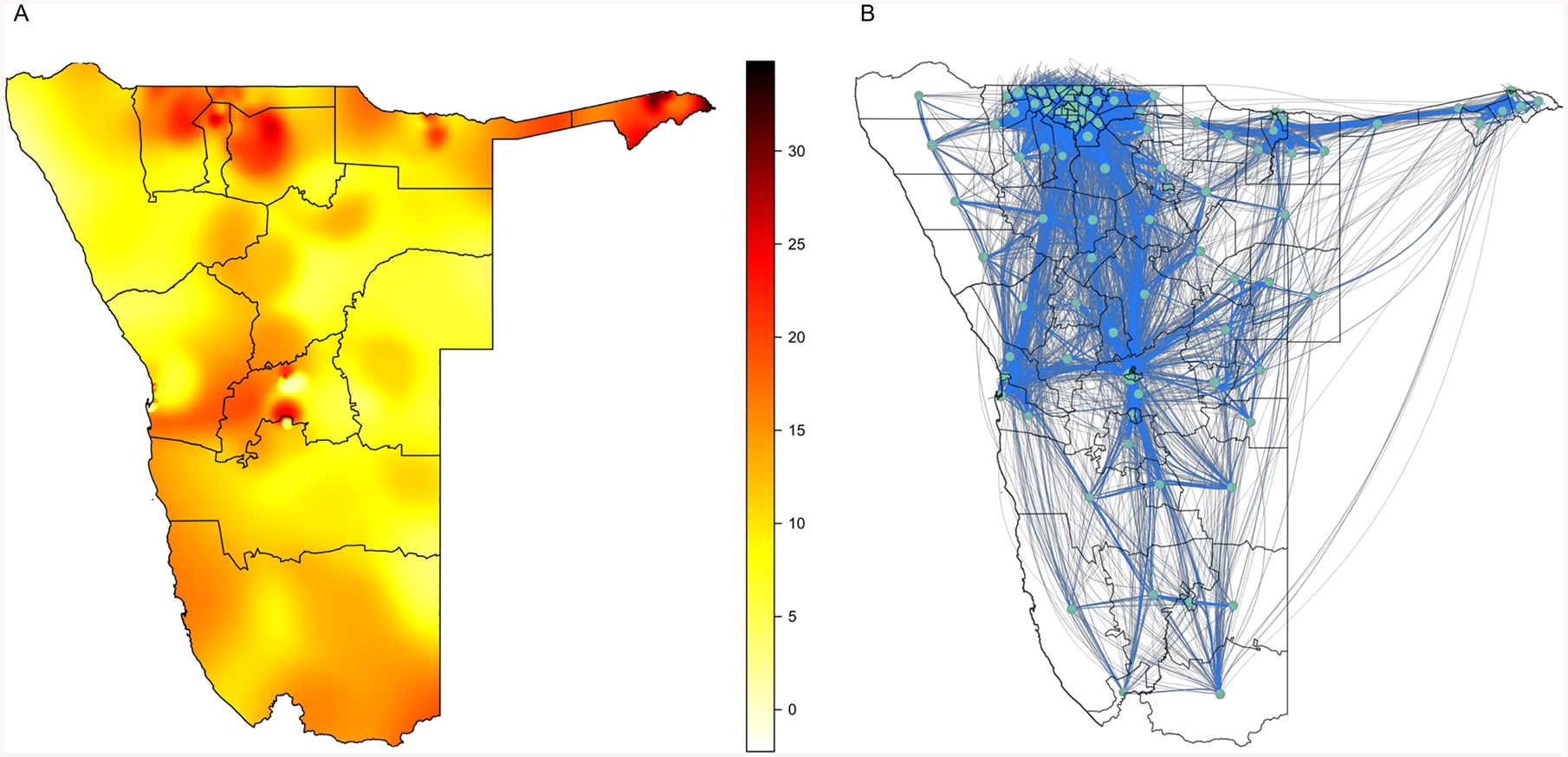
Figure 1:
Figure 1:. HIV prevalence map and mobility network for Namibia.
(A) ESP map, the color scale indicates HIV prevalence (%) in 15—64 year olds. The map was constructed by using an adaptive bandwidth kernel density estimation method to smooth and spatially interpolate the HIV-testing data from the NDHS; the R programming package prevR was used for implementation. (B) Network constructed from the CDR dataset.
Figure 2:
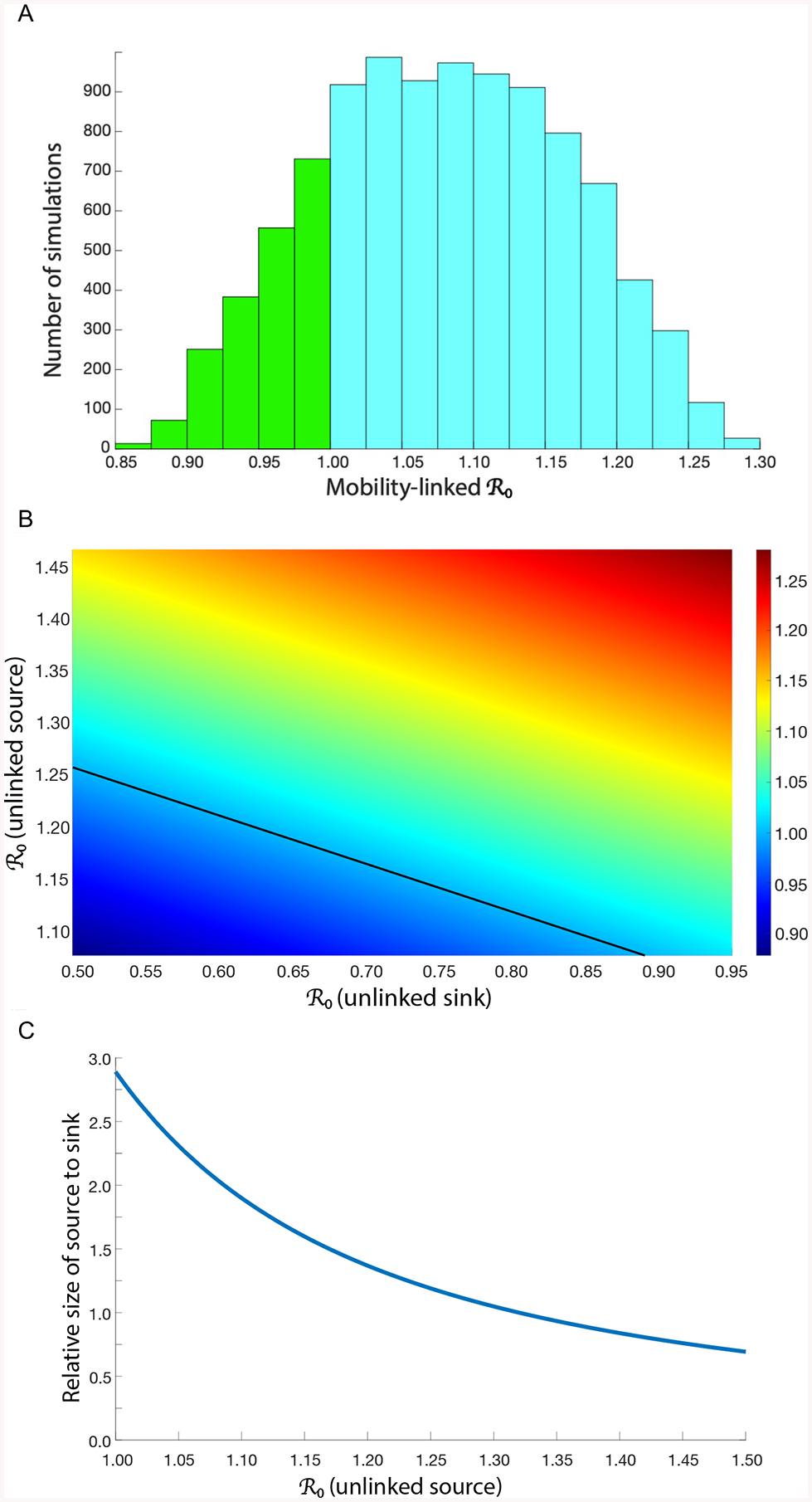
Figure 2:. Source-sink transmission dynamics in Namibia.
(A) Results from the uncertainty analysis, frequency distribution of 10,000 values of the mobility-linked R0 (B) Response hypersurface showing the outcome of linking a source to a sink. The source is 1·25 times the size of the sink. Black line shows the sustainability threshold at which the mobility-linked R0 equals one; at this threshold, a source can sustain a micro-epidemic in a linked sink. (C) The graph shows the effect of the relative size of the source versus the sink on the sustainability threshold; the blue line shows the threshold. The y-axis shows the relative size: the source is larger than the sink when the ratio is above one, the sink is larger than the source when the ratio is below one. The R0 in the unlinked sink is 0·50.

References

    1. UNAIDS. AIDS by the numbers. Geneva, Switzerland: UNAIDS, 2016.
    1. Grabowski MK, Lessler J, Redd AD, et al. The role of viral introductions in sustaining community-based HIV epidemics in rural Uganda: evidence from spatial clustering, phylogenetics, and egocentric transmission models. PLoS Med 2014; 11(3): e1001610. - PMC - PubMed
    1. Kiwuwa-Muyingo S, Nazziwa J, Ssemwanga D, et al. HIV-1 transmission networks in high risk fishing communities on the shores of Lake Victoria in Uganda: a phylogenetic and epidemiological approach. PLoS ONE 2017; 12(10): e0185818. - PMC - PubMed
    1. Abeler-Dorner L, Grabowski MK, Rambaut A, Pillay D, Fraser C. PANGEA-HIV 2: Phylogenetics and networks for generalised epidemics in Africa. Curr Opin HIV AIDS 2019; 14(3): 173–80. - PMC - PubMed
    1. Pulliam H . Sources, sinks and population regulation. Am Nat 1988; 132(5): 652–61.

Publication types