


Sedentary behaviors and risk of depression: a meta-analysis of prospective studies
- PMID: 32066686
- PMCID: PMC7026102
- DOI: 10.1038/s41398-020-0715-z
Sedentary behaviors and risk of depression: a meta-analysis of prospective studies
Abstract
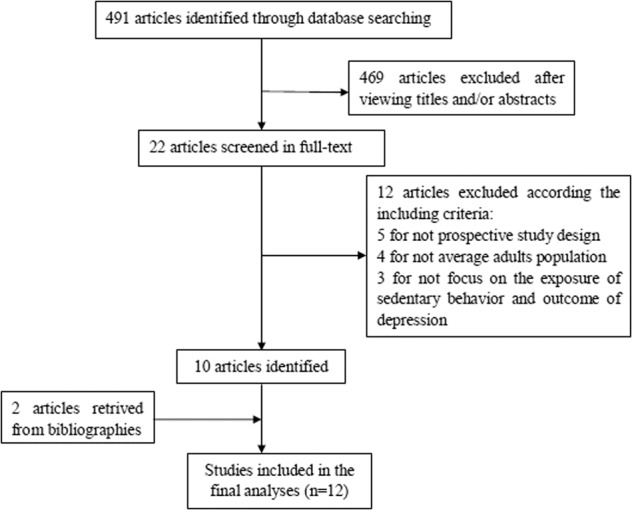
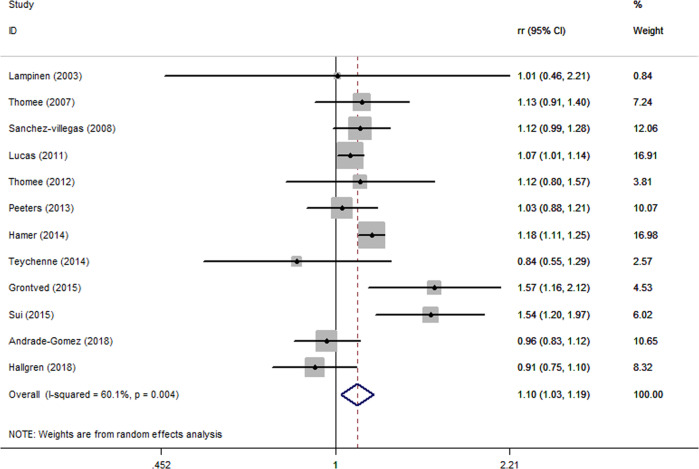
Epidemiological evidence on the association between sedentary behaviors and the risk of depression is inconsistent. We conducted a meta-analysis of prospective studies to identify the impact of sedentary behaviors on the risk of depression. We systematically searched in the PubMed and Embase databases to June 2019 for prospective cohort studies investigating sedentary behaviors in relation to the risk of depression. The pooled relative risks (RRs) and 95% confidence intervals (CIs) were calculated with random-effect meta-analysis. In addition, meta-regression analyses, subgroup analyses, and sensitivity analyses were performed to explore the potential sources of heterogeneity. Twelve prospective studies involving 128,553 participants were identified. A significantly positive association between sedentary behavior and the risk of depression was observed (RR = 1.10, 95% CI 1.03-1.19, I2 = 60.6%, P < 0.01). Subgroup analyses revealed that watching television was positively associated with the risk of depression (RR = 1.18, 95% CI 1.07-1.30), whereas using a computer was not (RR = 0.99, 95% CI 0.79-1.23). Mentally passive sedentary behaviors could increase the risk of depression (RR = 1.17, 95% CI 1.08-1.27), whereas the effect of mentally active sedentary behaviors were non-significant (RR = 0.98, 95% CI 0.83-1.15). Sedentary behaviors were positively related to depression defined by clinical diagnosis (RR = 1.08, 95% CI 1.03, 1.14), whereas the associations were statistically non-significant when depression was evaluated by the CES-D and the Prime-MD screening. The present study suggests that mentally passive sedentary behaviors, such as watching television, could increase the risk of depression. Interventions that reduce mentally passive sedentary behaviors may prevent depression.
Conflict of interest statement
The authors declare that they have no conflict of interest.
Figures
References
-
- McCarthy M, et al. Fitness moderates glycemic responses to sitting and light activity breaks. Med. Sci. Sports Exerc. 2017;49:2216–2222. - PubMed
-
- Sedentary Behaviour Research N. Letter to the editor: standardized use of the terms” sedentary” and” sedentary behaviours”. Appl. Physiol. Nutr. Metab. 2012;37:540–542. - PubMed
-
- Kikuchi H, et al. Distinct associations of different sedentary behaviors with health-related attributes among older adults. Prev. Med. 2014;67:335–339. - PubMed
-
- Hallgren M., et al. Cross-sectional and prospective relationships of passive and mentally active sedentary behaviours and physical activity with depression. Br. J. Psychiatry21, 1–7 (2019). - PubMed
-
- Carter S, Hartman Y, Holder S, Thijssen DH, Hopkins ND. Sedentary behavior and cardiovascular disease risk: mediating mechanisms. Exerc. sport Sci. Rev. 2017;45:80–86. - PubMed
Publication types
MeSH terms
LinkOut - more resources
Full Text Sources
Medical
