


Identification of biological mechanisms underlying a multidimensional ASD phenotype using machine learning
- PMID: 32066720
- PMCID: PMC7026098
- DOI: 10.1038/s41398-020-0721-1
Identification of biological mechanisms underlying a multidimensional ASD phenotype using machine learning
Abstract
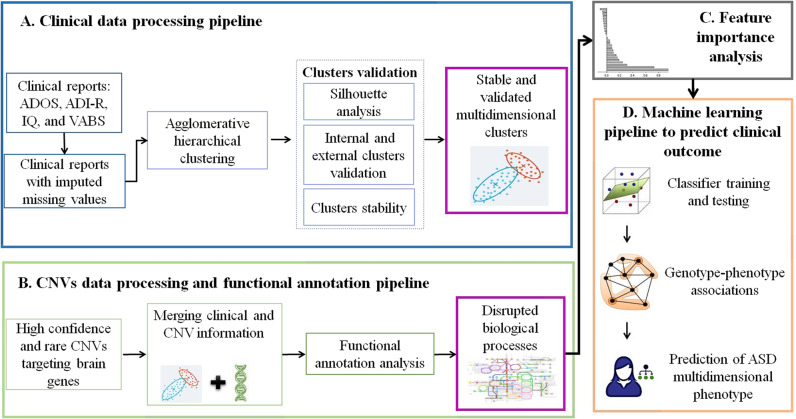
The complex genetic architecture of Autism Spectrum Disorder (ASD) and its heterogeneous phenotype makes molecular diagnosis and patient prognosis challenging tasks. To establish more precise genotype-phenotype correlations in ASD, we developed a novel machine-learning integrative approach, which seeks to delineate associations between patients' clinical profiles and disrupted biological processes, inferred from their copy number variants (CNVs) that span brain genes. Clustering analysis of the relevant clinical measures from 2446 ASD cases in the Autism Genome Project identified two distinct phenotypic subgroups. Patients in these clusters differed significantly in ADOS-defined severity, adaptive behavior profiles, intellectual ability, and verbal status, the latter contributing the most for cluster stability and cohesion. Functional enrichment analysis of brain genes disrupted by CNVs in these ASD cases identified 15 statistically significant biological processes, including cell adhesion, neural development, cognition, and polyubiquitination, in line with previous ASD findings. A Naive Bayes classifier, generated to predict the ASD phenotypic clusters from disrupted biological processes, achieved predictions with a high precision (0.82) but low recall (0.39), for a subset of patients with higher biological Information Content scores. This study shows that milder and more severe clinical presentations can have distinct underlying biological mechanisms. It further highlights how machine-learning approaches can reduce clinical heterogeneity by using multidimensional clinical measures, and establishes genotype-phenotype correlations in ASD. However, predictions are strongly dependent on patient's information content. Findings are therefore a first step toward the translation of genetic information into clinically useful applications, and emphasize the need for larger datasets with very complete clinical and biological information.
Conflict of interest statement
The authors declare that they have no conflict of interest.
Figures
References
-
- American Psychiatric Association. DIagnostic and Statistical Mental Disorders (DSM 5). (American Psychiatric Association, 2013).
-
- Devlin B, Scherer SW. Genetic architecture in autism spectrum disorder. Curr. Opin. Genet. Dev. 2012;22:229–237. - PubMed
-
- Croen LA, et al. The health status of adults on the autism spectrum. Autism. 2015;19:814–823. - PubMed
-
- Matson JL, Cervantes PE. Commonly studied comorbid psychopathologies among persons with autism spectrum disorder. Res. Developmental Disabilities. 2014;35:952–962. - PubMed
