. 2020 Feb 17;11(1):924.
doi: 10.1038/s41467-020-14723-0.

The first Australian plant foods at Madjedbebe, 65,000-53,000 years ago

Affiliations

The first Australian plant foods at Madjedbebe, 65,000-53,000 years ago

S Anna Florin et al. Nat Commun. .

Abstract

There is little evidence for the role of plant foods in the dispersal of early modern humans into new habitats globally. Researchers have hypothesised that early movements of human populations through Island Southeast Asia and into Sahul were driven by the lure of high-calorie, low-handling-cost foods, and that the use of plant foods requiring processing was not common in Sahul until the Holocene. Here we present the analysis of charred plant food remains from Madjedbebe rockshelter in northern Australia, dated to between 65 kya and 53 kya. We demonstrate that Australia's earliest known human population exploited a range of plant foods, including those requiring processing. Our finds predate existing evidence for such subsistence practices in Sahul by at least 23ky. These results suggest that dietary breadth underpinned the success of early modern human populations in this region, with the expenditure of labour on the processing of plants guaranteeing reliable access to nutrients in new environments.


Conflict of interest statement

The authors declare no competing interests.

Figures
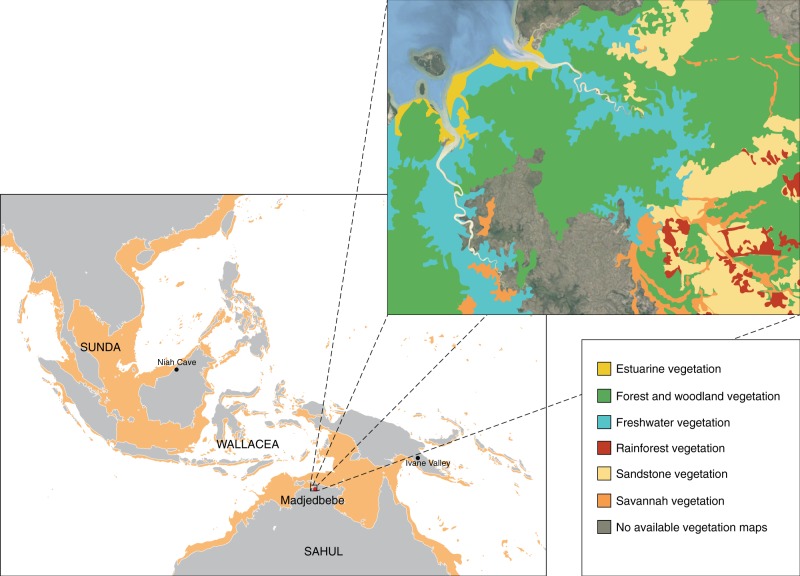
Fig. 1
Fig. 1. Site location.
a Regional map showing the location of Madjedbebe, and other sites mentioned in-text, adapted from Norman et al. 2018; b current distribution of vegetation communities in proximity to Madjedbebe, developed from map data provided by Google, Landsat/Copernicus, TerraMetrics, and vegetation maps of the Adelaide and Alligator Rivers area,.
Fig. 2
Fig. 2. Examples of endocarp from Phase 2.
a, b Buchanania sp. endocarp from C2/46(HR), a scale bar is 1 mm, b transverse section, scale bar is 500 µm; c Canarium australianum endocarp from C2/38(HR), scale bar is 500 µm; d C. australianum endocarp from C2/37(HR), close-up of internal surface, scale bar is 500 µm; e Polydrupe Pandanus sp. endocarp from C2/42(HR), transverse section, scale bar is 500 µm; f P. spiralis mesocarp from C2/37, scale bar is 200 µm; g, h Persoonia falcata endocarp from C2/37(HR), g scale bar is 1 mm, h close-up of internal surface, scale bar is 200 µm; i, j Terminalia sp. endocarp from C2/37(HR), i scale bar is 1 mm, j transverse section, scale bar is 200 µm. See the supporting online information and Supplementary Figs. 3-7 for detailed identification proofs and the corresponding reference materials. sl seed locule, vb vascular bundle, fb fibrous bundle.
Fig. 3
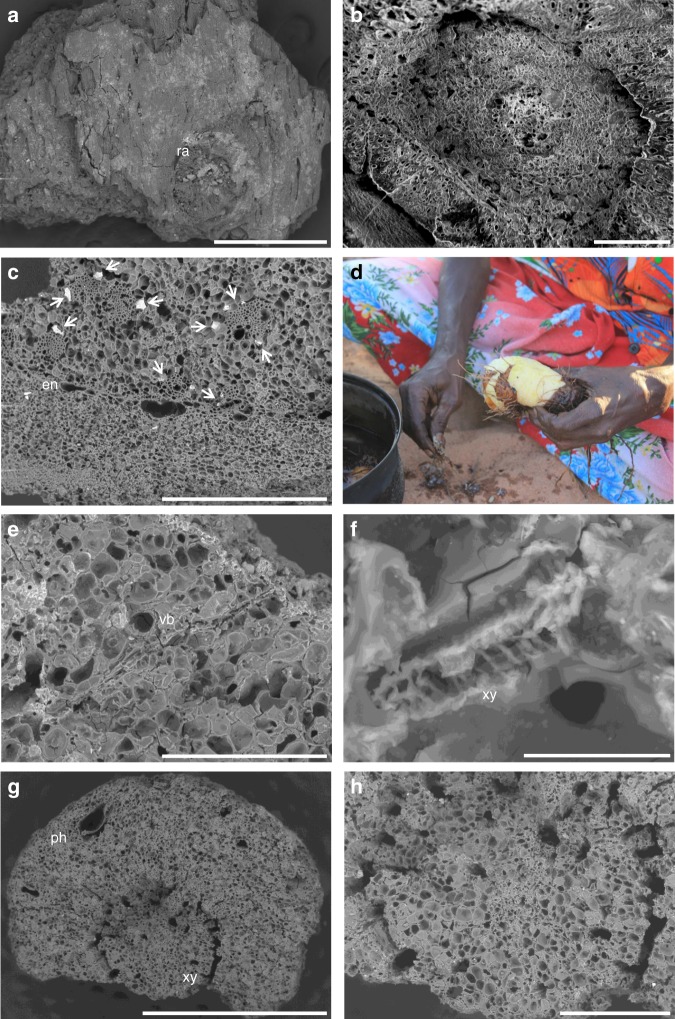
Fig. 3. Examples of vegetative parenchyma from Phase 2.
a, b Monocotyledonous stem-based storage organ Type A from C2/41; a depicting skin-patterning and root abscission scar, scale bar is 500 µm; b close-up of root abscission scar, scale bar is 100 µm; c transverse section of monocotyledonous stem-based storage organ Type A from C2/32 A, depicting an endodermis and a series of closed collateral vascular bundles, arrows point to phytoliths on edges of vascular bundles, scale bar is 500 µm; d MN peeling a ‘hairy’ Dioscorea bulbifera tuber beside a hearth built to cook it, photo taken by SAF; e, f longitudinal section of monocotyledonous stem-based storage organ Type B; e scale bar is 300 µm; f close-up of vascular bundle, scale bar is 20 µm; g, h transverse section of secondary-root storage organ Type A from C2/39 A; g scale bar is 2 mm; h close-up of central tract of xylem, scale bar is 500 µm. ra root abscission scar, en endodermis, vb vascular bundle, ph phloem, xy xylem.
Fig. 4
Fig. 4. Examples of Arecaeae family stem tissue from Phase 2.
ac Transverse section of Arecaceae stem Type A (cf. Livistona spp.) from C2/44, a scale bar is 1 mm, b close-up of fibrovascular bundle, scale bar is 100 µm, c close-up of globular echinate phytoliths, scale bar is 30 µm; d, f transverse section of Arecaceae stem Type B from C2/44, d scale bar is 500 µm, e close-up of fibrovascular bundle, scale bar is 200 µm; f transverse section of Arecaceae stem Type B from C2/45, close-up of globular echinate phytoliths, scale bar is 20 µm. See the supporting online information and Supplementary Fig. 8 for a detailed identification proof of Arecaceae stem Type A (cf. Livistona spp.) and the corresponding reference material. ph phloem, mx metaxylem, phy phytolith.

References

    1. Jones, M. in The Evolution of Hominin Diets: Integrating approaches to the study of Palaeolithic subsistence (eds Hublin, J.-J. & Richards, M. P.) 171–180 (Springer, 2009).
    1. Flannery, K. V. in TheDomestication and Exploitation of Plants and Animals (eds Ucko, P. J. & Dimbleby, G. W.) 73–100 (Duckworth, 1969).
    1. Stiner MC. Thirty years on the “Broad Spectrum Revolution” and paleolithic demography. Proc. Natl Acad. Sci. USA. 2001;98:6993–6996. doi: 10.1073/pnas.121176198. - DOI - PMC - PubMed
    1. Henry AG, Brooks AS, Piperno DR. Plant foods and the dietary ecology of Neanderthals and early modern humans. J. Hum. Evol. 2014;69:44–54. doi: 10.1016/j.jhevol.2013.12.014. - DOI - PubMed
    1. Larbey C, Mentzer SM, Ligouis B, Wurz S, Jones MK. Cooked starchy food in hearths ca. 120 kya and 65 kya (MIS 5e and MIS 4) from Klasies River Cave, South Africa. J. Hum. Evol. 2019;131:210–227. doi: 10.1016/j.jhevol.2019.03.015. - DOI - PubMed

Publication types