BMD-Related Genetic Risk Scores Predict Site-Specific Fractures as Well as Trabecular and Cortical Bone Microstructure
- PMID: 32067027
- PMCID: PMC7069346
- DOI: 10.1210/clinem/dgaa082
BMD-Related Genetic Risk Scores Predict Site-Specific Fractures as Well as Trabecular and Cortical Bone Microstructure
Abstract
Context: It is important to identify patients at highest risk of fractures.
Objective: To compare the separate and combined performances of bone-related genetic risk scores (GRSs) for prediction of forearm, hip and vertebral fractures separately, as well as of trabecular and cortical bone microstructure parameters separately.
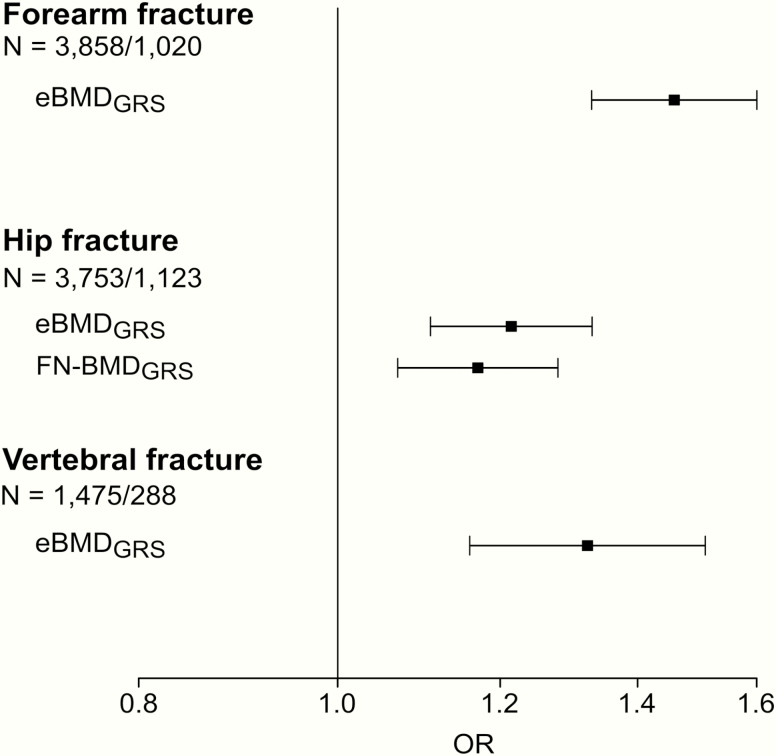
Design, setting, and participants: Using 1103 single nucleotide polymorphisms (SNPs) independently associated with estimated bone mineral density of the heel (eBMD), we developed a weighted GRS for eBMD and determined its contribution to fracture prediction beyond 2 previously developed GRSs for femur neck BMD (49 SNPs) and lumbar spine BMD (48 SNPs). Associations between these GRSs and forearm (ncases = 1020; ncontrols = 2838), hip (ncases = 1123; ncontrols = 2630) and vertebral (ncases = 288; ncontrols = 1187) fractures were evaluated in 3 Swedish cohorts. Associations between the GRSs and trabecular and cortical bone microstructure parameters (n = 426) were evaluated in the MrOS Sweden cohort.
Results: We found that eBMDGRS was the only significant independent predictor of forearm and vertebral fractures while both FN-BMDGRS and eBMDGRS were significant independent predictors of hip fractures. The eBMDGRS was the major GRS contributing to prediction of trabecular bone microstructure parameters while both FN-BMDGRS and eBMDGRS contributed information for prediction of cortical bone microstructure parameters.
Conclusions: The eBMDGRS independently predicts forearm and vertebral fractures while both FN-BMDGRS and eBMDGRS contribute independent information for prediction of hip fractures. We propose that eBMDGRS captures unique information about trabecular bone microstructure useful for prediction of forearm and vertebral fractures. These findings may facilitate personalized medicine to predict site-specific fractures as well as cortical and trabecular bone microstructure separately.
Keywords: bone microstructure; bone mineral density; cortical; fractures; genetic risk scores; trabecular.
© Endocrine Society 2020.
Figures



Comment in
-
Toward the era of precision fracture risk assessment.J Clin Endocrinol Metab. 2020 Jul 1;105(7):dgaa222. doi: 10.1210/clinem/dgaa222. J Clin Endocrinol Metab. 2020. PMID: 32313929 No abstract available.
References
-
- Kanis JA, Melton LJ 3rd, Christiansen C, Johnston CC, Khaltaev N. The diagnosis of osteoporosis. J Bone Miner Res. 1994;9(8):1137–1141. - PubMed
-
- Ohlsson C. Bone metabolism in 2012: Novel osteoporosis targets. Nat Rev Endocrinol. 2013;9(2):72–74. - PubMed
-
- Bauer DC, Ewing SK, Cauley JA, Ensrud KE, Cummings SR, Orwoll ES; Osteoporotic Fractures in Men (MrOS) Research Group Quantitative ultrasound predicts hip and non-spine fracture in men: the MrOS study. Osteoporos Int. 2007;18(6):771–777. - PubMed
-
- Bauer DC, Glüer CC, Cauley JA, et al. Broadband ultrasound attenuation predicts fractures strongly and independently of densitometry in older women. A prospective study. Study of Osteoporotic Fractures Research Group. Arch Intern Med. 1997;157(6):629–634. - PubMed
Publication types
MeSH terms
LinkOut - more resources
Full Text Sources
Medical
Miscellaneous