


Body mass index and height and risk of cutaneous melanoma: Mendelian randomization analyses
- PMID: 32068838
- PMCID: PMC7778056
- DOI: 10.1093/ije/dyaa009
Body mass index and height and risk of cutaneous melanoma: Mendelian randomization analyses
Abstract
Background: Height and body mass index (BMI) have both been positively associated with melanoma risk, although findings for BMI have been less consistent than height. It remains unclear, however, whether these associations reflect causality or are due to residual confounding by environmental and lifestyle risk factors. We re-evaluated these associations using a two-sample Mendelian randomization (MR) approach.
Methods: We identified single nucleotide polymorphisms (SNPs) for BMI and height from separate genome-wide association study (GWAS) meta-analyses. We obtained melanoma SNPs from the most recent melanoma GWAS meta-analysis comprising 12 874 cases and 23 203 controls. We used the inverse variance-weighted estimator to derive separate causal risk estimates across all SNP instruments for BMI and height.
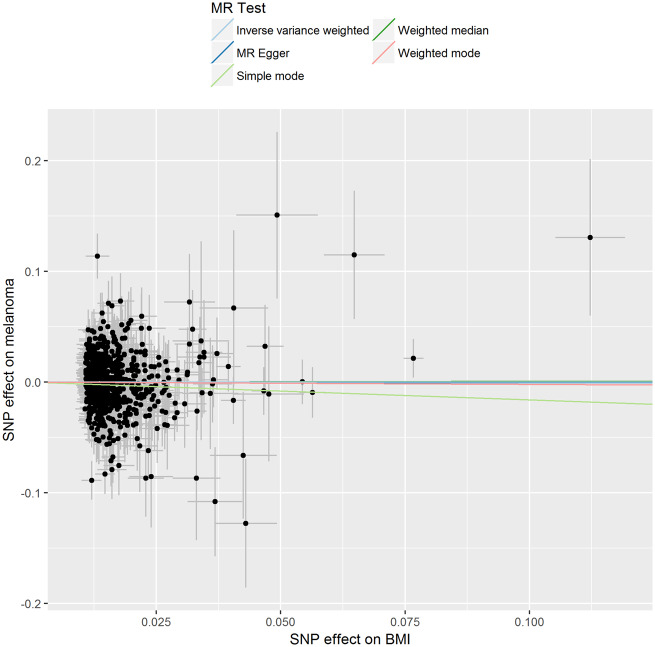
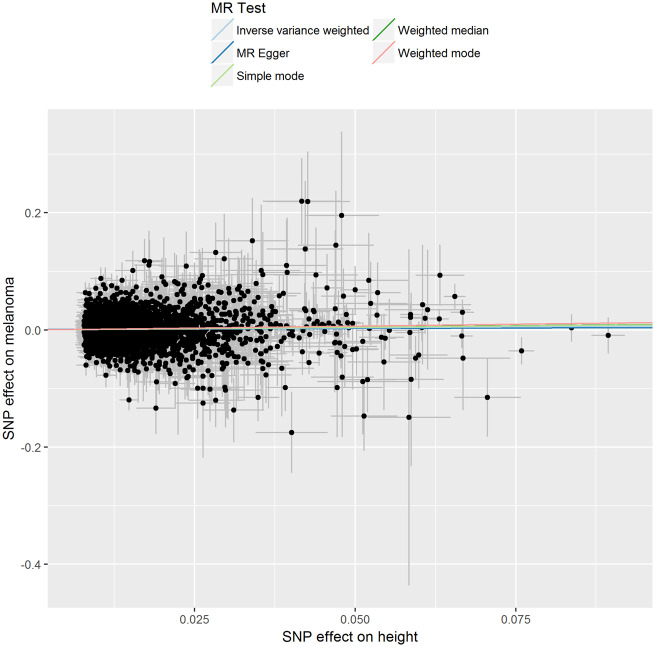
Results: Based on the combined estimate derived from 730 SNPs for BMI, we found no evidence of an association between genetically predicted BMI and melanoma [odds ratio (OR) per one standard deviation (1 SD) (4.6 kg/m2) increase in BMI 1.00, 95% confidence interval (CI): 0.91-1.11]. In contrast, we observed a positive association between genetically-predicted height (derived from a pooled estimate of 3290 SNPs) and melanoma risk [OR 1.08, 95% CI: 1.02-1.13, per 1 SD (9.27 cm) increase in height]. Sensitivity analyses using two alternative MR methods yielded similar results.
Conclusions: These findings provide no evidence for a causal association between higher BMI and melanoma, but support the notion that height is causally associated with melanoma risk. Mechanisms through which height influences melanoma risk remain unclear, and it remains possible that the effect could be mediated through diverse pathways including growth factors and even socioeconomic status.
Keywords: Body mass index; Mendelian randomization; body size; causality; height; melanoma; skin cancer.
© The Author(s) 2020; all rights reserved. Published by Oxford University Press on behalf of the International Epidemiological Association.
Figures
References
-
- International Agency for Research on Cancer. IARC Monograph on the Evaluation of Carcinogenic Risks to Humans; Ultraviolet Radiation. Lyon, France: International Agency for Research on Cancer, 1992.
-
- Gandini S, Sera F, Cattaruzza MS et al. Meta-analysis of risk factors for cutaneous melanoma: III. Family history, actinic damage and phenotypic factors. Eur J Cancer 2005;41:2040–059. - PubMed
-
- Sergentanis TN, Antoniadis AG, Gogas HJ et al. Obesity and risk of malignant melanoma: a meta-analysis of cohort and case-control studies. Eur J Cancer 2013;49:642–57. - PubMed
-
- Stenehjem JS, Veierod MB, Nilsen LT et al. Anthropometric factors and cutaneous melanoma: prospective data from the population-based Janus Cohort. Int J Cancer 2018;142:681–90. - PubMed
