Review
. 2020 Feb 13;21(4):1239.
doi: 10.3390/ijms21041239.

IL-33/IL-31 Axis in Osteoporosis

Affiliations
Review

IL-33/IL-31 Axis in Osteoporosis

Massimo De Martinis et al. Int J Mol Sci. .

Abstract

The study of the immunoskeletal interface has led to the discovery of numerous cytokines involved in the regulation of bone remodeling, providing valuable information on the pathogenesis of osteoporosis. The role of inflammatory cytokines of the Th1 and Th17 profile in osteoporosis is well known. Here we focus on two newly discovered Th2 cytokines, IL-31 and IL-33, whose implications in osteoporosis are recently emerging. Clinical and experimental observations suggest an important role of the IL-33/IL-31 axis in osteoporosis. IL-33 induces IL-31 secretion by Th2 cells and inhibits RANKL-dependent osteoclastogenesis, thus counteracting bone loss. IL-31 influences Th1/Th17 osteoclastogenetic inflammation and limits Th2 osteoprotective processes, thus favoring osteoporosis. Better knowledge of the role of IL-31 and IL-33 and their receptor complexes in osteoporosis could provide an interesting perspective for the development of new and more effective therapies, possibly with less side effects.

Keywords: IL-31; IL-33; allergy; bone; immunity; osteoimmunology; osteoporosis.


Conflict of interest statement

The authors declare no conflict of interest.

Figures
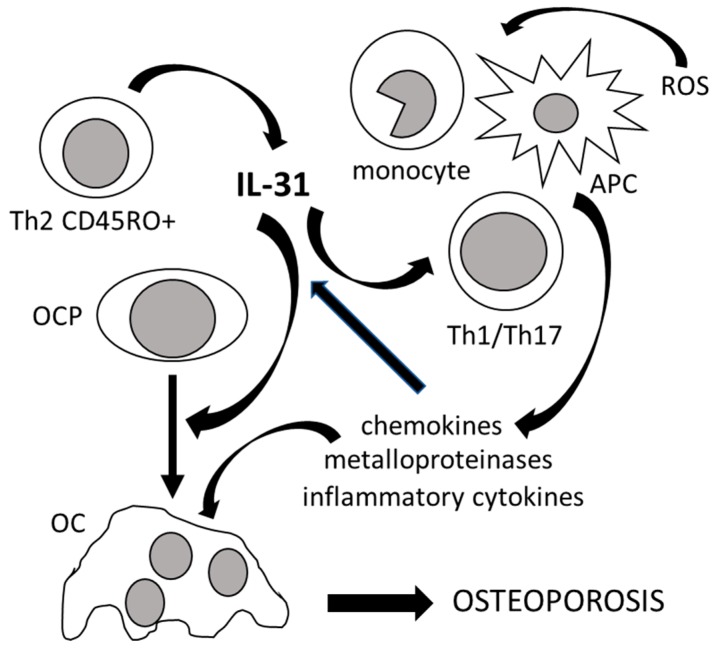
Figure 1
Figure 1
The role of IL-31 in bone remodeling. IL-31, mainly produced by T helper 2 memory cells (Th2 CD45RO+), promotes osteoclastogenesis by inducing the differentiation of osteoclast progenitors (OCP) into mature osteoclasts (OC). IL-31, in synergy with reactive oxygen species (ROS), also stimulates osteoclastogenesis indirectly by inducing antigen-presenting cells (APC), monocytes, and T helper 1 and 17 lymphocytes (Th1/Th17) to produce chemokines, metalloproteinases, and inflammatory cytokines, which in turn increase the production of IL-31. All of these events lead to the development of osteoporosis.
Figure 2
Figure 2
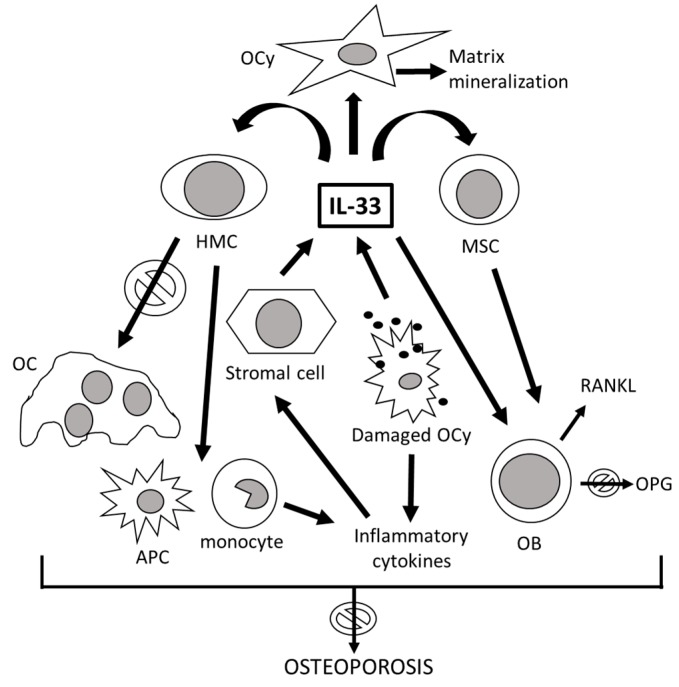
The role of IL-33 in bone remodeling. After inflammatory stimulation, the stromal cells produce IL-33, which directly blocks osteoclast (OC) formation from hemopoietic myeloid cells (HMC), shifting the osteoclast precursor differentiation towards cytokine-producing macrophages and antigen-presenting cells (APC). Damaged osteocytes (OCy), in addition to inducing inflammation, also release IL-33, which in turn stimulates the mineralization of the bone matrix. IL-33 acts directly by stimulating mature osteoblasts (OB) and their bone marrow progenitors, the mesenchymal stem cells (MSC), inducing their differentiation and maturation. Despite the production of the receptor activator of nuclear factor kappa-Β ligand (RANKL) and the partial blockage of the production of osteoprotegerin (OPG) by activated osteoblasts, the prevalent effect of IL-33 on the skeleton is anti-osteoporotic. Arrows with “forbidden” signal mean that il-33 has anti-osteoporotic activities.

References

    1. Akkawi I., Zmerly H. Osteoporosis: Current Concepts. Joints. 2018;6:122–127. doi: 10.1055/s-0038-1660790. - DOI - PMC - PubMed
    1. De Martinis M., Sirufo M.M., Ginaldi L. Osteoporosis: Current and Emerging Therapies Targeted to Immunological Checkpoints. Curr. Med. Chem. 2019;26:1–16. doi: 10.2174/0929867326666190730113123. - DOI - PMC - PubMed
    1. De Martinis M., Di Benedetto M.C., Mengoli L.P., Ginaldi L. Senile osteoporosis: Is it an immune-mediated disease? Inflamm. Res. 2006;55:399–404. doi: 10.1007/s00011-006-6034-x. - DOI - PubMed
    1. Ciccarelli F., De Martinis M., Ginaldi L. Glucocorticoids in patients with rheumatic diseases: Friends or enemies of bone? Curr. Med. Chem. 2015;22:596–603. doi: 10.2174/0929867321666141106125051. - DOI - PubMed
    1. Güler-Yüksel M., Hoes J.N., Bultink I.E., Lems W.F. Glucocorticoids, Inflammation and Bone. Calcif. Tissue Int. 2018;102:592–606. doi: 10.1007/s00223-017-0335-7. - DOI - PubMed