


The Effectiveness of Palate Re-Repair for Treating Velopharyngeal Insufficiency: A Systematic Review and Meta-Analysis
- PMID: 32070129
- PMCID: PMC7454201
- DOI: 10.1177/1055665620902883
The Effectiveness of Palate Re-Repair for Treating Velopharyngeal Insufficiency: A Systematic Review and Meta-Analysis
Abstract
Background: Palate re-repair has been proposed as an effective treatment for velopharyngeal insufficiency (VPI) with a low risk of obstructive sleep apnea (OSA). The authors conducted a systematic review and meta-analysis to determine the proportion of patients achieving normal speech resonance following palate re-repair for VPI, the proportion developing OSA, and the criteria for patient selection that are associated with increased effectiveness.
Methods: PubMed, Embase, and Scopus were searched from inception through April 2018 for English language articles evaluating palate re-repair for the treatment of VPI in patients with a repaired cleft palate. Inclusion criteria included reporting of hypernasality, nasal air emission, nasometry, additional VPI surgery, and/or OSA outcomes. Meta-analysis was conducted using random effects models. Risk of bias was assessed regarding criteria for patient selection, blinding of outcome assessors, and validity of speech assessment scale.
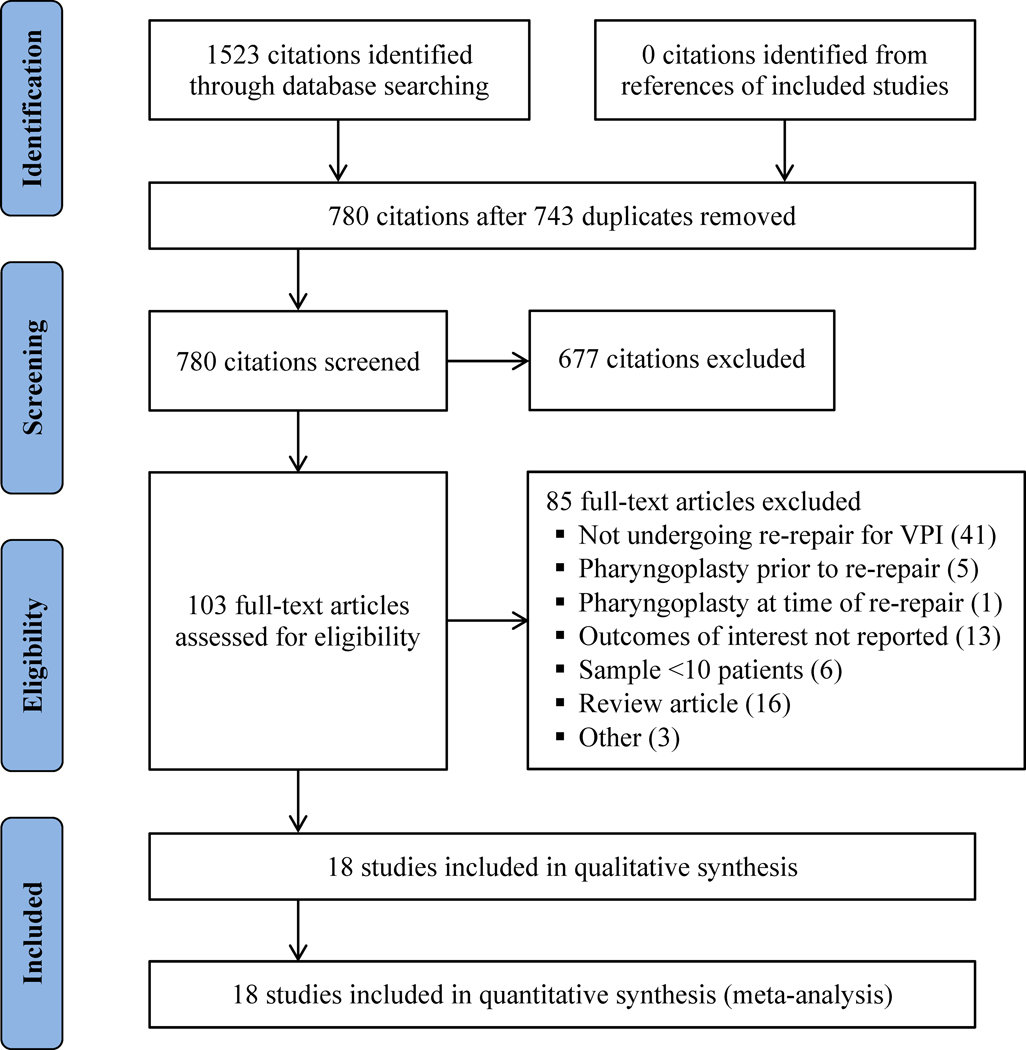
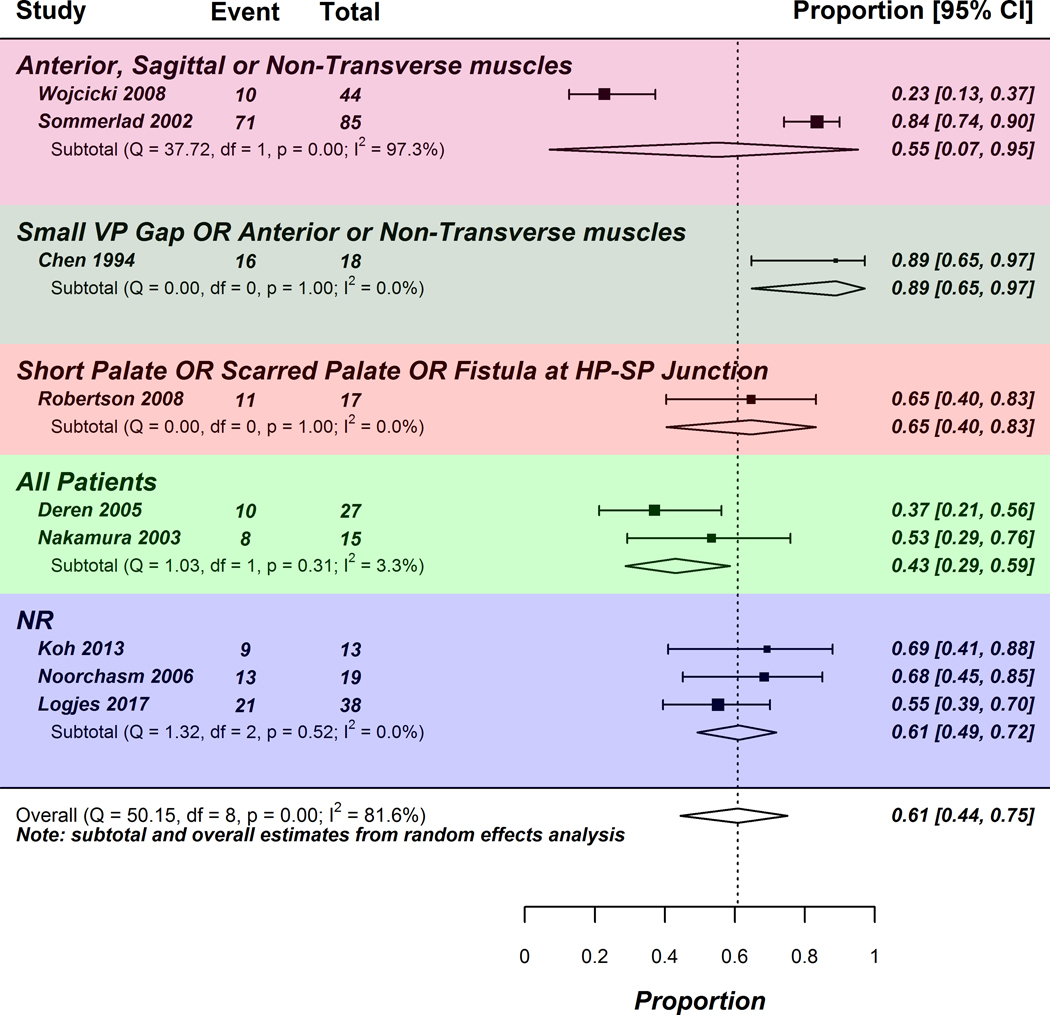
Results: Eighteen studies met inclusion criteria. The incidence of achieving no consistent hypernasality follow palate re-repair was 61% (95% confidence interval [CI]: 44%-75%). The incidence of additional surgery for persistent VPI symptoms was 21% (95% CI: 12%-33%). The incidence of OSA was 28% (95% CI: 13%-49%). Criteria for selecting patients to undergo re-repair varied, with anterior/sagittal position of palatal muscles (33%) and small velopharyngeal gap (22%) being the most common. No specific patient selection criteria led to superior speech outcomes (P = .6572).
Conclusions: Palate re-repair achieves normal speech resonance in many but not all patients with VPI. Further research is needed to identify the specific examination and imaging findings that predict successful correction of VPI with re-repair.
Keywords: cleft palate; meta-analysis; palatoplasty; re-repair; speech; systematic review; velopharyngeal insufficiency.
Figures


References
-
- Abdel-Aziz M, Hussien A, Kamel A, Azooz K, Fawaz M. The Impact of Velopharyngeal Surgery on the Polysomnographic Parameters After Cleft Palate Repair. J Craniofac Surg. 2018. - PubMed
-
- Abyholm F, D’Antonio L, Davidson Ward SL, Kjoll L, Saeed M, Shaw W, Sloan G, Whitby D, Worhington H, Wyatt R, et al. Pharyngeal flap and sphincterplasty for velopharyngeal insufficiency have equal outcome at 1 year postoperatively: results of a randomized trial. Cleft Palate Craniofac J. 2005;42:501–511. - PubMed
-
- Barbosa DA, Scarmagnani RH, Fukushiro AP, Trindade IE, Yamashita RP. Surgical outcome of pharyngeal flap surgery and intravelar veloplasty on the velopharyngeal function. Codas. 2013;25:451–455. - PubMed
-
- Berry RB, Brooks R, Gamaldo C, Harding SM, Lloyd RM, Quan SF, Troester MT, Vaughn BV. The AASM Manual for the Scoring of Sleep and Associated Events: Rules, Terminology and Technical Specifications, Version 2.5. Darien, IL: American Academy of Sleep Medicine; 2018.
-
- Blechner M, Williamson AA. Consequences of Obstructive Sleep Apnea in Children. Curr Probl Pediatr Adolesc Health Care. 2016;46:19–26. - PubMed
Publication types
MeSH terms
Grants and funding
LinkOut - more resources
Full Text Sources
Medical
Miscellaneous
