. 2020 Feb 18;19(1):19.
doi: 10.1186/s12933-020-00997-7.

Empagliflozin improved systolic blood pressure, endothelial dysfunction and heart remodeling in the metabolic syndrome ZSF1 rat

Affiliations

Empagliflozin improved systolic blood pressure, endothelial dysfunction and heart remodeling in the metabolic syndrome ZSF1 rat

Sin-Hee Park et al. Cardiovasc Diabetol. .

Abstract

Background: Empagliflozin (empa), a selective sodium-glucose cotransporter (SGLT)2 inhibitor, reduced cardiovascular mortality and hospitalization for heart failure in patients with type 2 diabetes at high cardiovascular risk independent of glycemic control. The cardiovascular protective effect of empa was evaluated in an experimental model of metabolic syndrome, the obese ZSF1 rat, and its' lean control.

Methods: Lean and obese ZSF1 rats were either non-treated or treated with empa (30 mg/kg/day) for 6 weeks. Vascular reactivity was assessed using mesenteric artery rings, systolic blood pressure by tail-cuff sphygmomanometry, heart function and structural changes by echocardiography, and protein expression levels by Western blot analysis.

Results: Empa treatment reduced blood glucose levels from 275 to 196 mg/dl in obese ZSF1 rats whereas normoglycemia (134 mg/dl) was present in control lean ZSF1 rats and was unaffected by empa. Obese ZSF1 rats showed increased systolic blood pressure, and blunted endothelium-dependent relaxations associated with the appearance of endothelium-dependent contractile responses (EDCFs) compared to control lean rats. These effects were prevented by the empa treatment. Obese ZSF1 rats showed increased weight of the heart and of the left ventricle volume without the presence of diastolic or systolic dysfunction, which were improved by the empa treatment. An increased expression level of senescence markers (p53, p21, p16), tissue factor, VCAM-1, SGLT1 and SGLT2 and a down-regulation of eNOS were observed in the aortic inner curvature compared to the outer one in the control lean rats, which were prevented by the empa treatment. In the obese ZSF1 rats, no such effects were observed. The empa treatment reduced the increased body weight and weight of lungs, spleen, liver and perirenal fat, hyperglycemia and the increased levels of total cholesterol and triglycerides in obese ZSF1 rats, and increased blood ketone levels and urinary glucose excretion in control lean and obese ZSF1 rats.

Conclusion: Empa reduced glucose levels by 28% and improved both endothelial function and cardiac remodeling in the obese ZSF1 rat. Empa also reduced the increased expression level of senescence, and atherothrombotic markers at arterial sites at risk in the control lean, but not obese, ZSF1 rat.

Keywords: Empagliflozin; Endothelial function; Heart function; Heart structure; Metabolic syndrome; SGLT2; Senescence; ZSF1.


Conflict of interest statement

This work was supported by an unrestricted research grant from Boehringer Ingelheim Pharma GmbH & Co. KG, Biberach, Germany.

Figures
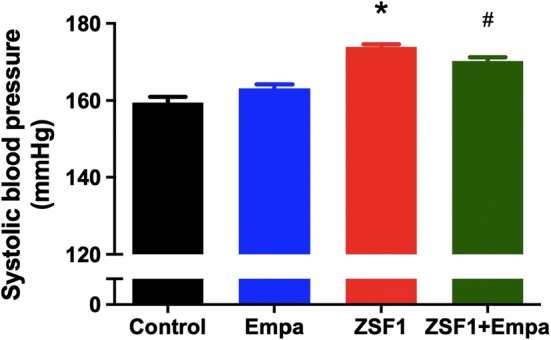
Fig. 1
Fig. 1
Effect of empagliflozin treatment on systolic blood pressure in the lean control and the ZSF1 groups. Values are shown as mean ± SEM of n = 9–10 per group. *P < 0.05 vs control group and #P < 0.05 vs ZSF1 group
Fig. 2
Fig. 2
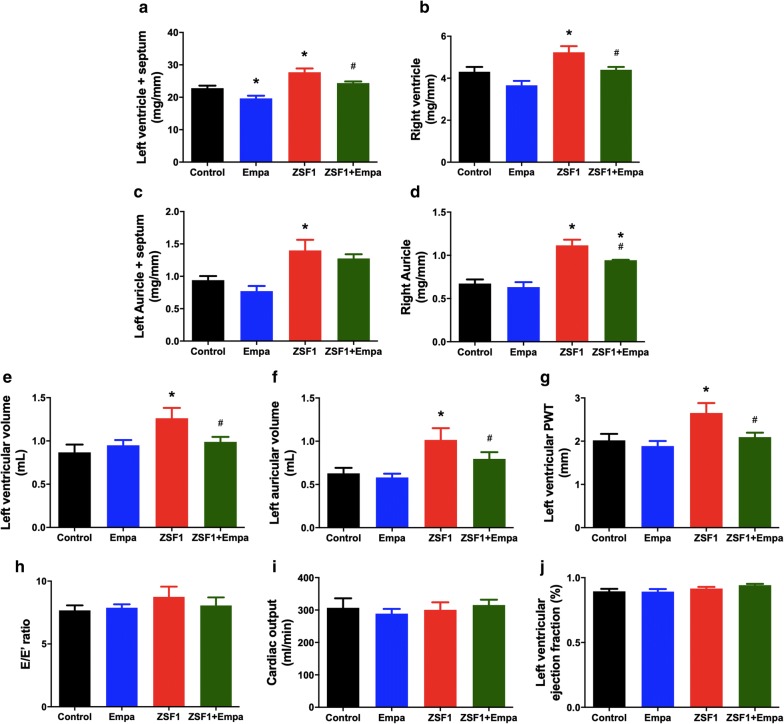
Oral intake of empagliflozin prevents heart remodeling in ZSF1 rats. ad All the four cavities of heart (left ventricle and septum, right ventricle, left auricle and septum and right auricle) were weighted and indexed to the respective tibial length. ej The different cardiac markers related to cardiac function and morphology were assessed by echocardiography. Values are shown as mean ± SEM of n = 6–10 per group. *P < 0.05 vs control group and #P < 0.05 vs ZSF1 group
Fig. 3
Fig. 3
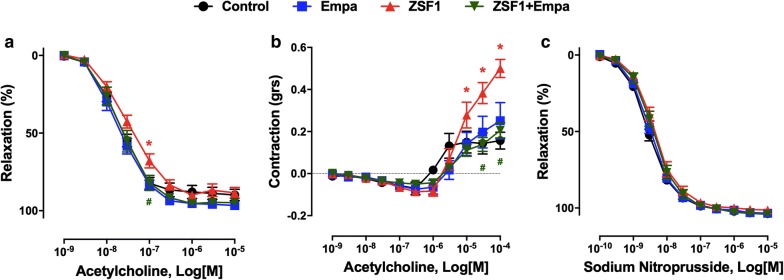
Effect of empagliflozin treatment on the endothelium-dependent relaxation and endothelium-dependent contractile response to acetylcholine in the lean control and ZSF1 groups. Arterial rings from the main mesenteric artery with endothelium were suspended in organ baths containing oxygenated Krebs buffer. For concentration-relaxation curves, rings were precontracted with phenylephrine (1 μM) before the addition of increasing concentrations of either acetylcholine (a) or the NO donor sodium nitroprusside (c). b Endothelium-dependent contractile responses (EDCF) were studied in the presence of Nω-nitro-l-arginine (300 μM) and UCL-1684 plus TRAM-34 (1 μM each) to prevent the formation of NO- and EDH-mediated relaxations, respectively. Rings were precontracted to about 20–30% of the maximal contraction with phenylephrine before the addition of increasing concentrations of acetylcholine. Values are shown as mean ± SEM of 8–10 rats per group. *P < 0.05 vs control group and #P < 0.05 vs ZSF1 group
Fig. 4
Fig. 4
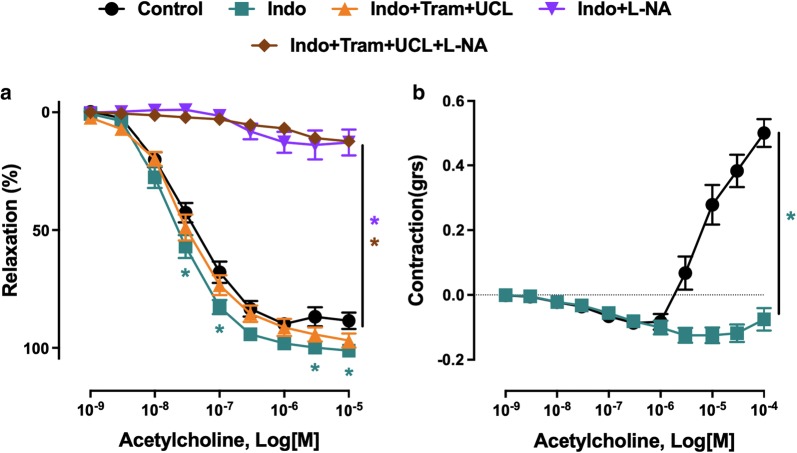
Characterization of endothelium-dependent relaxation and contractile responses to acetylcholine in mesenteric artery rings with endothelium of the ZSF1 group. Arterial rings from the main mesenteric artery with endothelium were suspended in organ baths containing oxygenated Krebs buffer. Pharmacological inhibitors were added 20 min before the contraction to phenylephrine to assess the role of the NO-mediated component (Nω-nitro-l-arginine, L-NA, 300 μM), the EDH-mediated component (UCL-1684 plus TRAM-34, UCL + Tram, 1 μM each), and the formation of vasoactive prostanoids (indomethacin, Indo, 10 μM). Rings were contracted with phenylephrine (1 μM) (a) or to about 20-30% of the maximal contraction (b) before the addition of increasing concentrations of acetylcholine. Values are shown as mean ± SEM of n = 8–10. *P < 0.05 vs control group
Fig. 5
Fig. 5
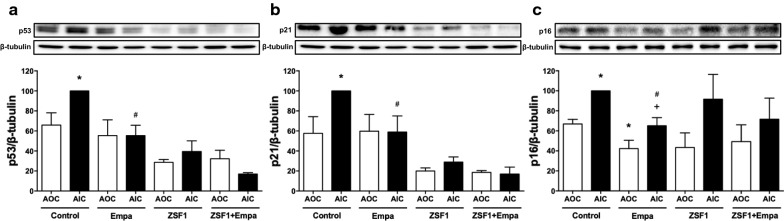
Effect of empagliflozin treatment on the expression level of senescence markers (p53, p21 and p16) in segments of the outer curvature (AOC), an arterial site at low risk, and in those of the inner curvature (AIC) of the aortic arch, an arterial site at high risk, in the lean control and ZSF1 groups as assessed by Western blot analysis. Results are shown as representative immunoblots (upper panels) and corresponding cumulative data (lower panels). Values are shown as mean ± SEM of n = 3–4 per group. *P < 0.05 vs AOC of control group and #P < 0.05 vs AIC of control group and +P < 0.05 vs AOC of Empa group
Fig. 6
Fig. 6
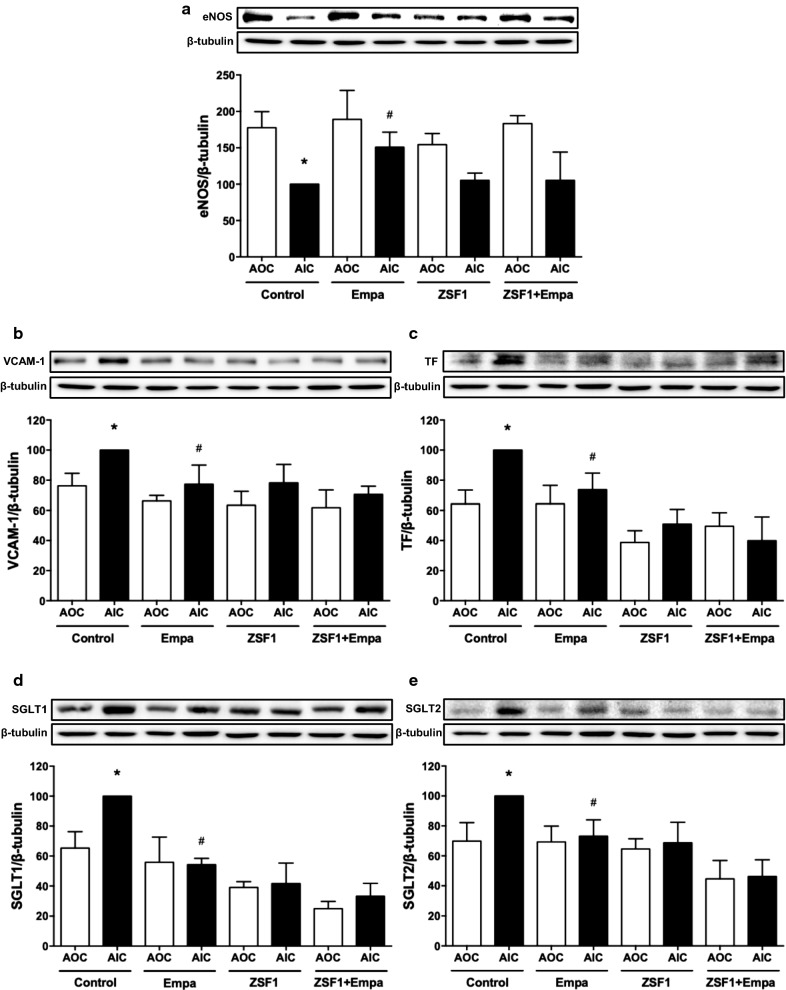
Effect of empagliflozin treatment on the expression level of eNOS (a), VCAM-1 (b), TF (c), SGLT1 (d) and SGLT2 (e) in segments of the AOC and in those of the AIC of the lean control and ZSF1 groups as assessed by Western blot analysis. Results are shown as representative immunoblots (upper panels) and corresponding cumulative data (lower panels). Values are shown as mean ± SEM of n = 3–4 per group. *P < 0.05 vs AOC of control group and #P < 0.05 vs AIC of control group

References

    1. Isomaa B, Almgren P, Tuomi T, Forsen B, Lahti K, Nissen M, Taskinen MR, Groop L. Cardiovascular morbidity and mortality associated with the metabolic syndrome. Diabetes Care. 2001;24(4):683–689. doi: 10.2337/diacare.24.4.683. - DOI - PubMed
    1. Laaksonen DE, Lakka HM, Niskanen LK, Kaplan GA, Salonen JT, Lakka TA. Metabolic syndrome and development of diabetes mellitus: application and validation of recently suggested definitions of the metabolic syndrome in a prospective cohort study. Am J Epidemiol. 2002;156(11):1070–1077. doi: 10.1093/aje/kwf145. - DOI - PubMed
    1. Lakka HM, Laaksonen DE, Lakka TA, Niskanen LK, Kumpusalo E, Tuomilehto J, Salonen JT. The metabolic syndrome and total and cardiovascular disease mortality in middle-aged men. JAMA. 2002;288(21):2709–2716. doi: 10.1001/jama.288.21.2709. - DOI - PubMed
    1. Lorenzo C, Okoloise M, Williams K, Stern MP, Haffner SM. The metabolic syndrome as predictor of type 2 diabetes: the San Antonio heart study. Diabetes Care. 2003;26(11):3153–3159. doi: 10.2337/diacare.26.11.3153. - DOI - PubMed
    1. Desroches S, Lamarche B. The evolving definitions and increasing prevalence of the metabolic syndrome. Appl Physiol Nutr Metab Physiologie appliquee, nutrition et metabolisme. 2007;32(1):23–32. doi: 10.1139/h06-095. - DOI - PubMed

Publication types

MeSH terms