


Genomic Characterization of Neisseria gonorrhoeae Strains from 2016 U.S. Sentinel Surveillance Displaying Reduced Susceptibility to Azithromycin
- PMID: 32071056
- PMCID: PMC7179607
- DOI: 10.1128/AAC.02420-19
Genomic Characterization of Neisseria gonorrhoeae Strains from 2016 U.S. Sentinel Surveillance Displaying Reduced Susceptibility to Azithromycin
Abstract
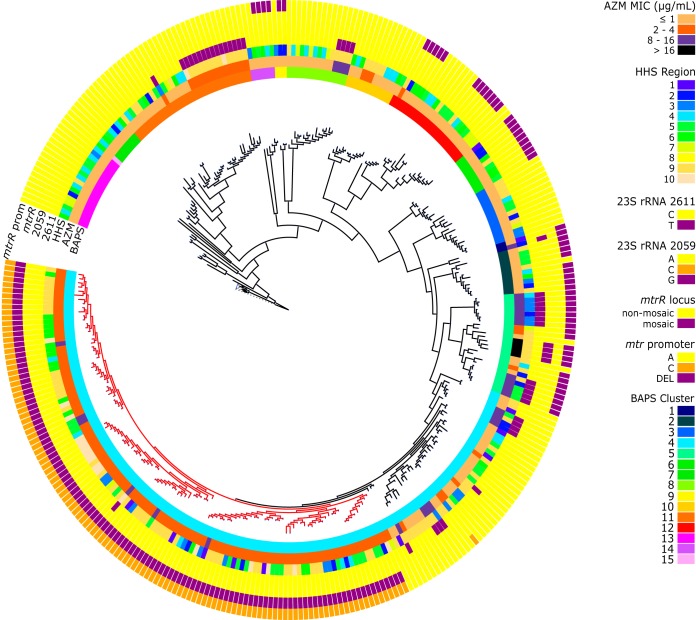
In 2016, the proportion of Neisseria gonorrhoeae isolates with reduced susceptibility to azithromycin rose to 3.6%. A phylogenetic analysis of 334 N. gonorrhoeae isolates collected in 2016 revealed a single, geographically diverse lineage of isolates with MICs of 2 to 16 μg/ml that carried a mosaic-like mtr locus, whereas the majority of isolates with MICs of ≥16 μg/ml appeared sporadically and carried 23S rRNA mutations. Continued molecular surveillance of N. gonorrhoeae isolates will identify new resistance mechanisms.
Keywords: 23S rRNA; Neisseria gonorrhoeae; antimicrobial resistance; azithromycin; mosaic-like mtrR.
Copyright © 2020 American Society for Microbiology.
Figures
References
-
- World Health Organization. 2017. Global priority list of antibiotic-resistant bacteria to guide research, discovery, and development of new antibiotics. World Health Organization, Geneva.
-
- Centers for Disease Control and Prevention. 2019. Antibiotic resistance threats in the United States, 2019. U.S. Department of Health and Human Services, Atlanta, GA: https://www.cdc.gov/drugresistance/pdf/threats-report/2019-ar-threats-re....
-
- Wan C, Li Y, Le WJ, Liu YR, Li S, Wang BX, Rice PA, Su XH. 2018. Increasing resistance to azithromycin in Neisseria gonorrhoeae in eastern Chinese cities: resistance mechanisms and genetic diversity among isolates from Nanjing. Antimicrob Agents Chemother 62:e02499-17. doi:10.1128/AAC.02499-17. - DOI - PMC - PubMed
-
- Martin I, Sawatzky P, Liu G, Allen V, Lefebvre B, Hoang L, Drews S, Horsman G, Wylie J, Haldane D, Garceau R, Ratnam S, Wong T, Archibald C, Mulvey MR. 2016. Decline in decreased cephalosporin susceptibility and increase in azithromycin resistance in Neisseria gonorrhoeae, Canada. Emerg Infect Dis 22:65–67. doi:10.3201/eid2201.151247. - DOI - PMC - PubMed
-
- Cole MJ, Spiteri G, Jacobsson S, Woodford N, Tripodo F, Amato-Gauci AJ, Unemo M, Euro-GASP Network. 2017. Overall low extended-spectrum cephalosporin resistance but high azithromycin resistance in Neisseria gonorrhoeae in 24 European countries, 2015. BMC Infect Dis 17:617. doi:10.1186/s12879-017-2707-z. - DOI - PMC - PubMed
Publication types
MeSH terms
Substances
LinkOut - more resources
Full Text Sources
Medical
