. 2020 Feb 18;11(1):944.
doi: 10.1038/s41467-020-14792-1.

Color-tunable ultralong organic room temperature phosphorescence from a multicomponent copolymer

Affiliations

Color-tunable ultralong organic room temperature phosphorescence from a multicomponent copolymer

Long Gu et al. Nat Commun. .

Abstract

Functional materials displaying tunable emission and long-lived luminescence have recently emerged as a powerful tool for applications in information encryption, organic electronics and bioelectronics. Herein, we present a design strategy to achieve color-tunable ultralong organic room temperature phosphorescence (UOP) in polymers through radical multicomponent cross-linked copolymerization. Our experiments reveal that by changing the excitation wavelength from 254 to 370 nm, these polymers display multicolor luminescence spanning from blue to yellow with a long-lived lifetime of 1.2 s and a maximum phosphorescence quantum yield of 37.5% under ambient conditions. Moreover, we explore the application of these polymers in multilevel information encryption based on the color-tunable UOP property. This strategy paves the way for the development of multicolor bio-labels and smart luminescent materials with long-lived emission at room temperature.


Conflict of interest statement

The authors declare no competing interests.

Figures
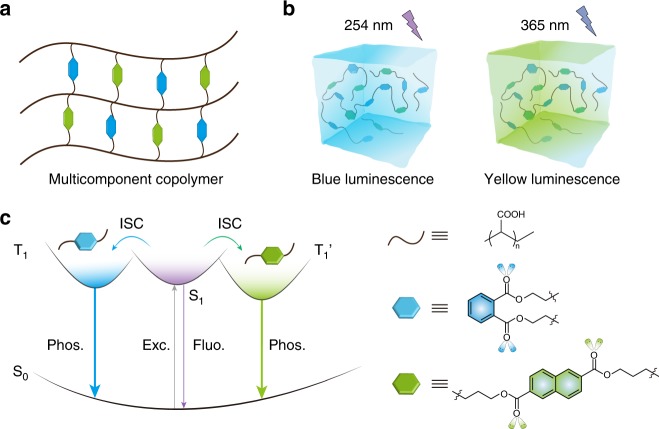
Fig. 1
Fig. 1. Schematic illustration of the color-tunable UOP multicomponent copolymer.
a Network structure of multicomponent copolymer by radical cross-linking copolymerization. The brown line and blue and yellow hexagons represent PAA chains and various luminophores, respectively. b Excitation-dependent UOP of multi-component copolymer under ambient conditions. The polymer exhibits color-tunable UOP emission upon changes in the excitation wavelength. c Proposed mechanism of color-tunable UOP at room temperature. Multiple triplet excited state T1 and T1’ generating from different excited singlet states S1 stem from the various luminophores through ISC. The rigid polymer microenvironment effectively restricts molecular motion for ultralong phosphorescence emission under ambient conditions.
Fig. 2
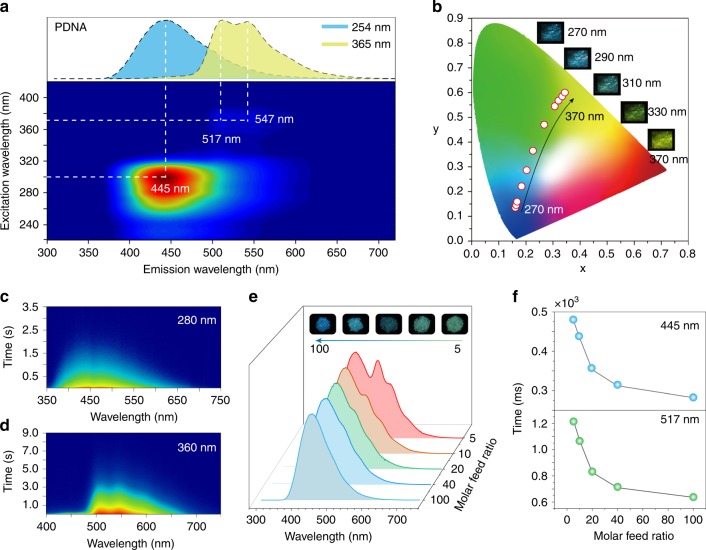
Fig. 2. Photophysical properties of multicomponent copolymer at room temperature.
a Excitation–phosphorescence mapping of polymer film PDNA under ambient conditions. The inset displays the phosphorescence spectra of the transparent film recorded at room temperature excited by 254 nm (blue) and 365 nm (yellow). b CIE chromaticity diagram for polymer PDNA with excitation varied from 270 to 370 nm. Inset: long-lived luminescence photographs of polymer film PDNA excited at 270, 290, 310, 330 and 370 nm, respectively. c, d Time-resolved emission spectra of PDNA at room temperature upon excitation at 280 and 360 nm, respectively. e Normalized phosphorescence spectra and the ultralong phosphorescence photographs (inserted images) of multicomponent copolymers with different molar feed ratio of MND:MDP:AA = 1:5:1000 (PDNA-5), 1:10:1000 (PDNA-10), 1:20:1000 (PDNA-20), 1:40:1000 (PDNA-40), and 1:100:1000 (PDNA-100) excited at 254 nm. f Phosphorescence lifetime of PDNA with different molar feed ratios of PDNA-5, PDNA-10, PDNA-20, PDNA-40, and PDNA-100 at 445 (top) and 517 nm (bottom) when excited at 254 and 360 nm at room temperature, respectively.
Fig. 3
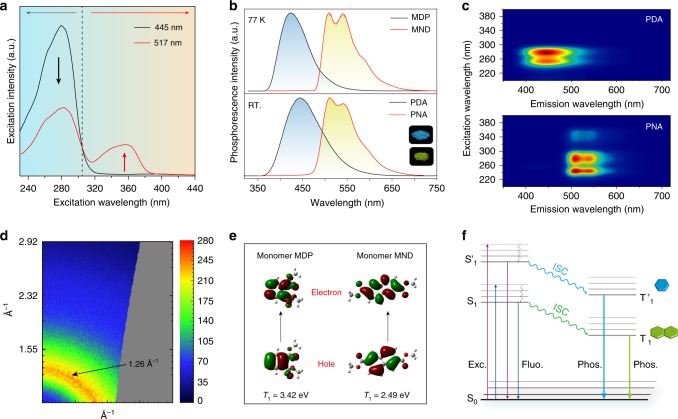
Fig. 3. Mechanism of color-tunable UOP in multicomponent copolymer at room temperature.
a Phosphorescence excitation spectra in polymer PDNA at 445 and 517 nm. b Normalized phosphorescence spectra of monomer MDP and MND in 2-methyltetrahydrofuran (1 × 10−5 M) at 77 K (top), as well as polymer PDA and PNA at room temperature (RT) (bottom) excited at 280 and 360 nm. c Polymer film excitation–phosphorescence mapping of PDA (top) and PNA (bottom) at room temperature. d WAXS pattern of polymer film PDNA. e Natural transition orbitals for the lowest triplet transitions of MDP and MND in gaseous state. f Proposed mechanism of the color-tunable UOP in multicomponent copolymer. Fluo. fluorescence, Phos. molecular phosphorescence, Exc. excitation.
Fig. 4
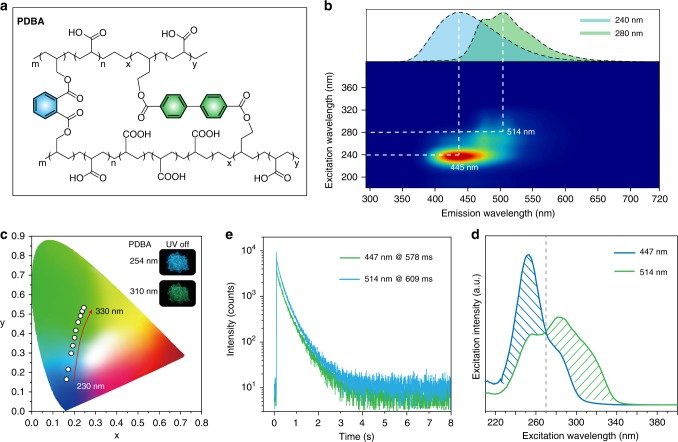
Fig. 4. Molecular structure and phosphorescence properties of the multicomponent copolymer PDBA under ambient conditions.
a Molecular structure of polymer PDBA. b Excitation–phosphorescence mapping of PDBA film. The inset image shows the phosphorescence spectra of PDBA excited by corresponding excitation wavelengths. c CIE chromaticity diagram for polymer PDBA with excitation varied from 230 to 330 nm. Inset: UOP photographs of polymer film PDBA excited at 254 and 310 nm after switching off the UV light, respectively. d Lifetime decay curves of bands at 447 and 514 nm in polymer PDBA, respectively. e Phosphorescence excitation spectra of polymer PDBA at 447 and 514 nm.
Fig. 5
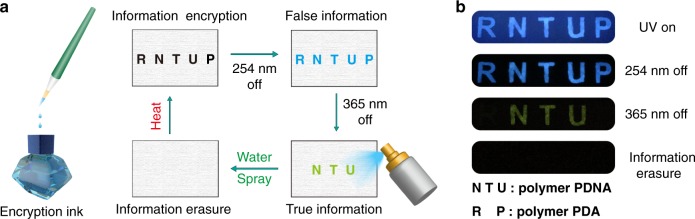
Fig. 5. Description of color-tunable UOP for multilevel information encryption.
a Process of information encryption by using the multi-component copolymer PDNA (NTU) and PDA (RP) as encryption ink under ambient conditions. b Long-lived luminescence photographs of letters (RNTUP and NTU) before and after switching off the UV light of 254 and 365 nm, respectively.

References

    1. Gu L, et al. Colour-tunable ultra-long organic phosphorescence of a single-component molecular crystal. Nat. Photon. 2019;13:406–411. doi: 10.1038/s41566-019-0408-4. - DOI
    1. Maldiney T, et al. The in vivo activation of persistent nanophosphors for optical imaging of vascularization, tumours and grafted cells. Nat. Mater. 2014;13:418–426. doi: 10.1038/nmat3908. - DOI - PubMed
    1. Liu X, et al. Binary temporal upconversion codes of Mn2+-activated nanoparticles for multilevel anti-counterfeiting. Nat. Commun. 2017;8:899. doi: 10.1038/s41467-017-00916-7. - DOI - PMC - PubMed
    1. Pan Z, Lu Y, Liu F. Sunlight-activated long-persistent luminescence in the near-infrared from Cr3+-doped zinc gallogermanates. Nat. Mater. 2012;11:58–63. doi: 10.1038/nmat3173. - DOI - PubMed
    1. Zhang G, Palmer G, Dewhirst M, Fraser C. A dual-emissive-materials design concept enables tumour hypoxia imaging. Nat. Mater. 2009;8:747–751. doi: 10.1038/nmat2509. - DOI - PMC - PubMed