. 2020 Feb 18;10(1):2867.
doi: 10.1038/s41598-020-59332-5.

Striking essential oil: tapping into a largely unexplored source for drug discovery

Affiliations

Striking essential oil: tapping into a largely unexplored source for drug discovery

Adam F Feyaerts et al. Sci Rep. .

Abstract

Essential oils (EOs) have been used therapeutically for centuries. In recent decades, randomized controlled (clinical) trials have supported efficacy in specific therapeutic indications for a few of them. Some EOs, their components or derivatives thereof have been approved as drugs. Nevertheless, they are still considered products that are mainly used in complementary and alternative medicine. EO components occupy a special niche in chemical space, that offers unique opportunities based on their unusual physicochemical properties, because they are typically volatile and hydrophobic. Here we evaluate selected physicochemical parameters, used in conventional drug discovery, of EO components present in a range of commercially available EOs. We show that, contrary to generally held belief, most EO components meet current-day requirements of medicinal chemistry for good drug candidates. Moreover, they also offer attractive opportunities for lead optimization or even fragment-based drug discovery. Because their therapeutic potential is still under-scrutinized, we propose that this be explored more vigorously with present-day methods.


Conflict of interest statement

The authors declare no competing interests.

Figures

Figure 1
Figure 1
Chemical structures of the five most frequently found u-cmcEOCs in our EO set (in descending order of frequency from left to right).
Figure 2
Figure 2
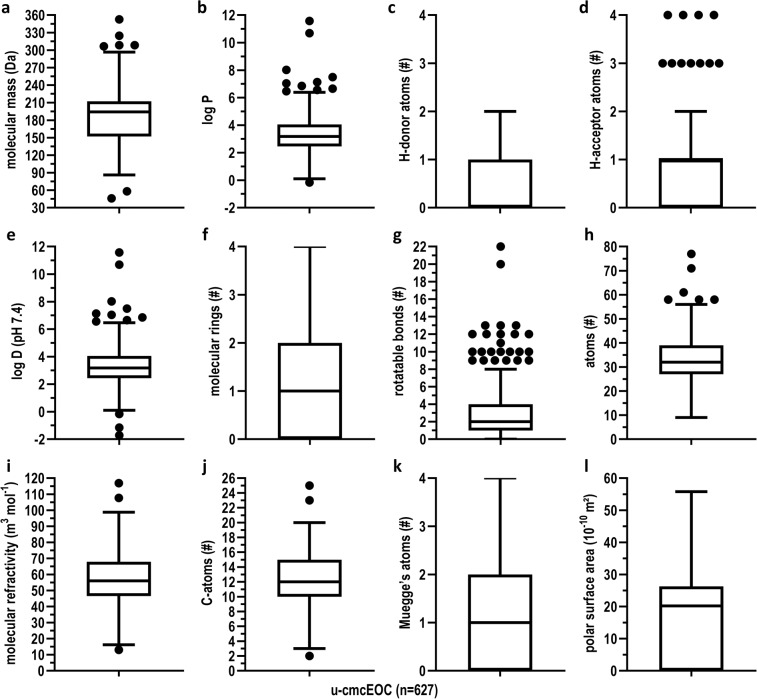
Summary of the values for the u-cmcEOCs (n = 627; Box 2) of the DDPs in the DDFs we used. Tukey boxplots of the DDP values for the u-cmcEOCs [minimum; 25th percentile; median; 75th percentile; maximum] (unit of measurement): (a) molecular mass [46.1; 152.2; 194.2; 212.4; 352.7] (Da), (b) log P [−0.16; 2.46; 3.18; 4.06; 11.58], (c) number of H-donor atoms [0; 0; 0; 1; 2], (d) number of H-acceptor atoms [0; 0; 1; 1; 4], (e) log D at pH 7.4 [−1.71; 2.44; 3.18; 4.06; 11.58], (f) number of molecular rings [0; 0; 1; 2; 4], (g) number of rotatable bonds [0; 1; 2; 4; 22], (h) number of atoms [9; 27; 32; 39; 77], (i) molecular refractivity [13.01; 46.50; 56.01; 67.90; 116.80] (m3 mol−1), (j) number of C-atoms [2; 10; 12; 15; 25], (k) Muegge’s atoms [0; 0; 1; 2; 4], (l) polar surface area [0.00; 0.00; 20.23; 26.30; 55.76] (10−10 m2). Values for the DDP fused aromatic rings were not summarized as for all but four u-cmcEOCs the values were zero. For more details on the Drug Discovery Parameters described in b, e, i, k, l, see the materials and methods section.

References

    1. Li JW, Vederas JC. Drug discovery and natural products: end of an era or an endless frontier? Sci. 2009;325:161–165. doi: 10.1126/science.1168243. - DOI - PubMed
    1. Rishton GM. Natural products as a robust source of new drugs and drug leads: past successes and present day issues. Am. J. Cardiol. 2008;101:43D–49D. doi: 10.1016/j.amjcard.2008.02.007. - DOI - PubMed
    1. Secretariat of the Convention on Biological Diversity (SCBD). The Nagoya protocol on access and benefit-sharing, https://www.cbd.int/abs/ (2018).
    1. Harvey AL, Edrada-Ebel R, Quinn RJ. The re-emergence of natural products for drug discovery in the genomics era. Nat. reviews. Drug. discovery. 2015;14:111–129. doi: 10.1038/nrd4510. - DOI - PubMed
    1. Charlotte H. Patenting natural products just got harder. Nat. Biotechnol. 2014;32:403. doi: 10.1038/nbt0514-403a. - DOI - PubMed

Publication types