Review
. 2020 May;21(5):255-267.
doi: 10.1038/s41580-020-0215-2. Epub 2020 Feb 18.

Target gene-independent functions of MYC oncoproteins

Affiliations
Review

Target gene-independent functions of MYC oncoproteins

Apoorva Baluapuri et al. Nat Rev Mol Cell Biol. 2020 May.

Abstract

Oncoproteins of the MYC family are major drivers of human tumorigenesis. Since a large body of evidence indicates that MYC proteins are transcription factors, studying their function has focused on the biology of their target genes. Detailed studies of MYC-dependent changes in RNA levels have provided contrasting models of the oncogenic activity of MYC proteins through either enhancing or repressing the expression of specific target genes, or as global amplifiers of transcription. In this Review, we first summarize the biochemistry of MYC proteins and what is known (or is unclear) about the MYC target genes. We then discuss recent progress in defining the interactomes of MYC and MYCN and how this information affects central concepts of MYC biology, focusing on mechanisms by which MYC proteins modulate transcription. MYC proteins promote transcription termination upon stalling of RNA polymerase II, and we propose that this mechanism enhances the stress resilience of basal transcription. Furthermore, MYC proteins coordinate transcription elongation with DNA replication and cell cycle progression. Finally, we argue that the mechanism by which MYC proteins regulate the transcription machinery is likely to promote tumorigenesis independently of global or relative changes in the expression of their target genes.


Conflict of interest statement

Competing interests

The authors declare no competing interests.

Figures
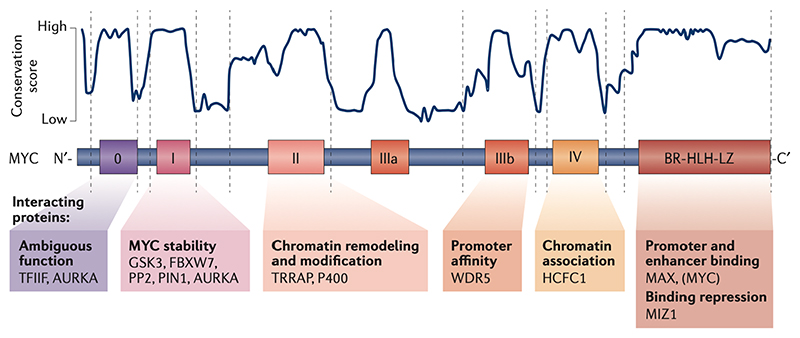
Figure 1
Figure 1. Protein domains of MYC and their canonical function.
Amino acid sequence analysis identified different degrees of conservation within MYC proteins. While the C-terminal domain responsible for DNA binding is entirely conserved only small stretches – the MYC boxes – show a high degree of conservation in the remaining part of the protein. The conservation score shown in the figure was calculated as described in REF . Function definitions of MYC boxes 0–IV are based on deletion and/or point mutations. Examples of proteins that interact with the relevant MYC boxes are indicated. AURKA, Aurora kinase A; BR, basic region; FBXL3, F-box and leucine rich repeat protein 3; FBXW7, F-box and WD repeat domain containing 7; GSK3,glycogen synthase kinase 3; HCFC1, host cell factor C1; MAX MYC associated factor X; MIZ1,MYC interacting zing finger protein 1; P400, E1A binding protein p400 ; PIN1, peptidylprolyl cis/trans isomerase NIMA-interaction 1; PP2A, serine/threonine protein phosphatase 2A; TFIIF, general transcription factor IIF subunit 1; TRRAP, transformation/transcription domain associated protein; WDR5, WD repeat domain 5.
Figure 2
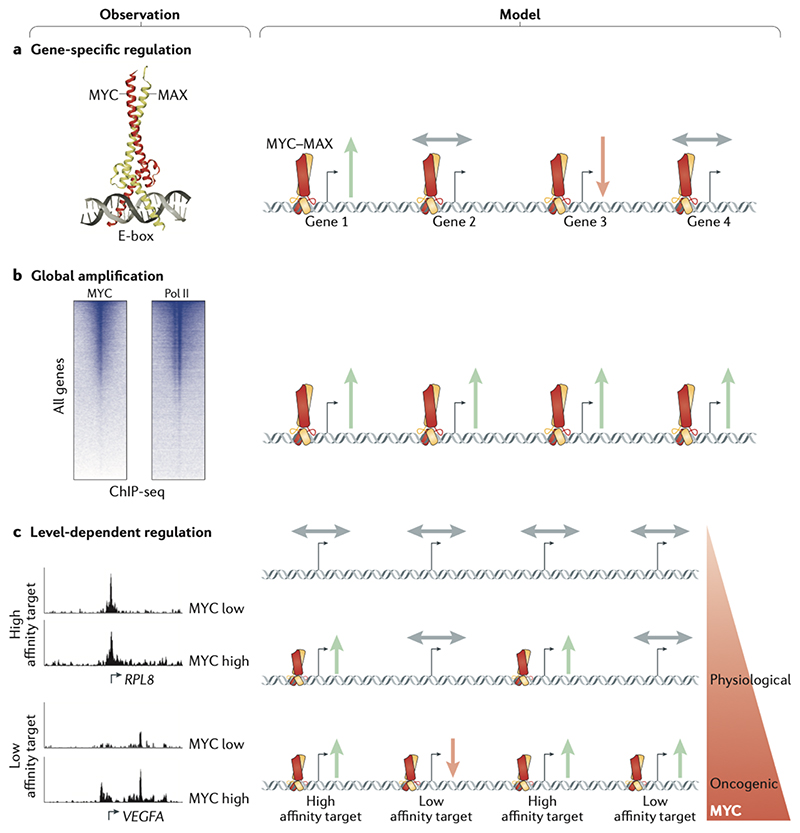
Figure 2. Models of gene regulation by MYC.
(a) Specific-gene regulation: Based on the study and structural elucidation of the Enhancerbox (E-box) binding by MYC, specific MYC-induced target genes were discovered and characterized. (b) Global gene activation: Genome-wide chromatin immunoprecipitation sequencing (ChIP-seq) studies of MYC identified that MYC binds at the promoters of most RNA polymerase II (Pol II)-bound and expressed genes. Accordingly, Myc induces a global increase in cellular mRNA levels in some biological systems. (c) Gene-specific affinity: Although MYC binding is detectable at most promoters, promoter affinities for MYC differ widely. Genes with high promoter–MYC affinity are bound and upregulated by MYC at physiological levels, but are not further induced at oncogenic levels, as binding is already saturated. Instead, oncogenic MYC upregulates low affinity target genes. The affinity model can reconcile the seemingly opposing specific gene and global gene models. Green arrows indicate activation, red arrow indicates repression and grey arrows indicate no regulation of genes. RPL8, 60S ribosomal protein L8; VEGFA, vascular endothelial growth factor A.
Figure 3
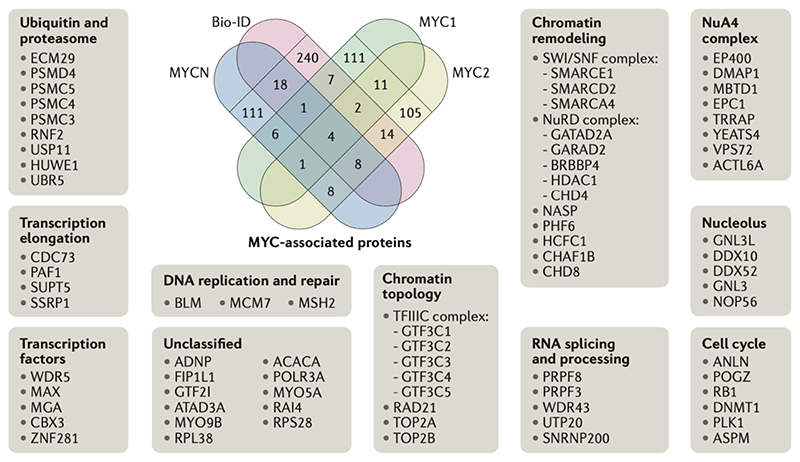
Figure 3. MYC-associated proteins
Schematic of the overlap of recently published MYC and MYCN interacting proteins,,,. Proteins appearing in at least two data sets are presented in the surrounding boxes and were used for functional annotation. Bio-ID techniques label proteins that are in close proximity to a protein of interest fused to a biotin ligase and was used in . The other datasets used immunopurification of MYC complexes:, MYC1 refers to , MYC2 to and MYCN to.
Figure 4
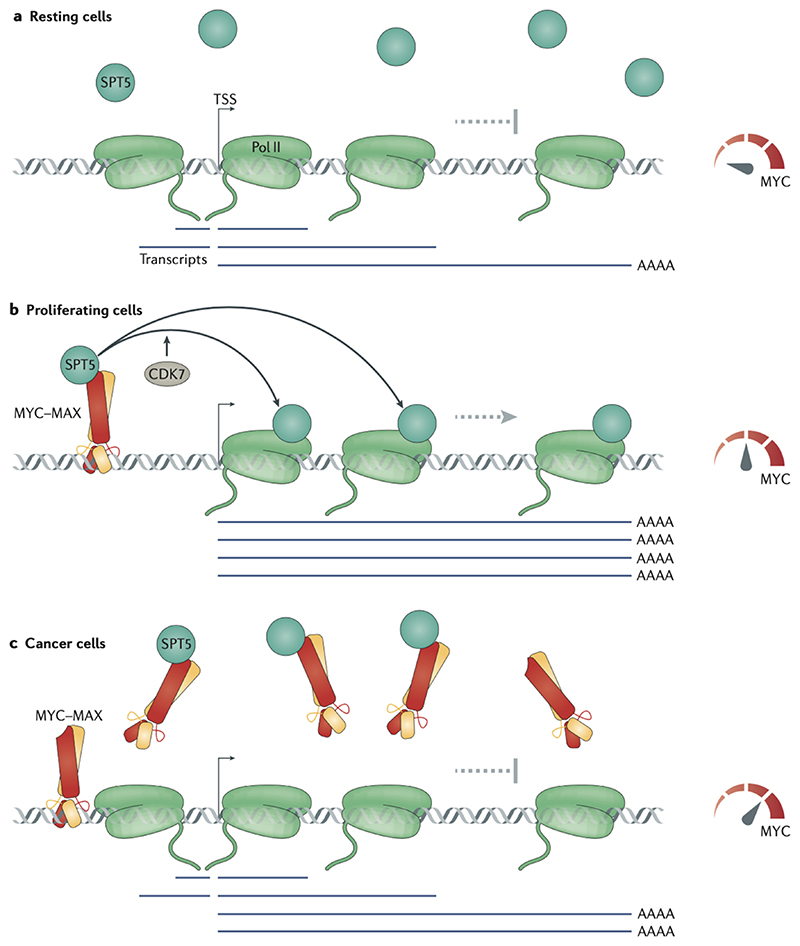
Figure 4. A handover-model of promoter-proximal function of MYC proteins
(a) In resting cells, which do not express MYC, the transcription elongation factor SPT5 is insufficiently recruited to RNA polymerase II (Pol II), which loses directionality and processivity, resulting in increase in the levels of antisense and abortive transcripts. (b) In growing cells, MYC is expressed, binds SPT5 and recruits it to promoters. The transfer of SPT5 from MYC to Pol II depends on cyclin-dependent kinase 7 (CDK7).Pol II associated with transcription elongation factors engages in productive (fast, processive and directional) transcription elongation and produces full-length mRNAs. (c) In cancer cells expressing high levels of MYC, a considerable fraction of SPT5 is sequestered by soluble MYC, and transcription is decreased at known MYC-repressed genes. TSS, transcription start site.
Figure 5
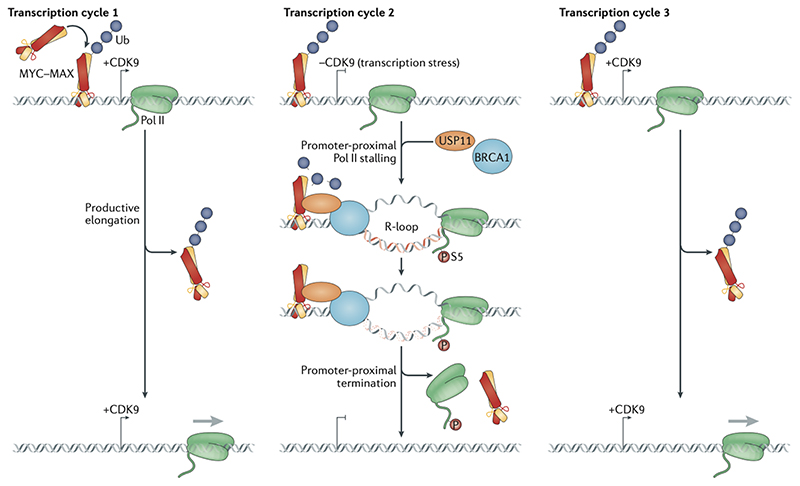
Figure 5. MYC binding at core promoters.
Model of global and possibly crucial functions of MYC proteins at all active promoters with very small effects on steady-state mRNA levels. MYC ubiquitylation allows cyclin-dependent kinase 9 (CDK9)-driven RNA polymerase II (Pol) II to generate the mRNA (Transcription Cycle # 1). However, in response to transcription stress, which induces or augments promoter-proximal Pol II stalling and R-loop formation, BRCA1 is recruited to the R-loop with the help of USP11, which de-ubiquitylates MYC, thereby allowing it to interact with BRCA1 (Transcription cycle # 2). This promotes the resolution of the R-loop and dissociation of the Pol II machinery, which makes the promoter ready for a new cycle where Pol II can again transcribe in a CDK9 driven manner (Transcription cycle # 3).

References

    1. Dang CV. MYC on the path to cancer. Cell. 2012;149:22–35. - PMC - PubMed
    1. Mateyak MK, Obaya AJ, Adachi S, Sedivy JM. Phenotypes of c-Myc-deficient rat fibroblasts isolated by targeted homologous recombination. Cell Growth Differ. 1997;8:1039–1048. - PubMed
    1. Sansom OJ, et al. Myc deletion rescues Apc deficiency in the small intestine. Nature. 2007;446:676–679. - PubMed
    1. Kawauchi D, et al. A mouse model of the most aggressive subgroup of human medulloblastoma. Cancer cell. 2012;21:168–180. - PMC - PubMed
    1. Vo BT, et al. The Interaction of Myc with Miz1 Defines Medulloblastoma Subgroup Identity. Cancer cell. 2016;29:5–16. - PMC - PubMed

Publication types