Review
. 2020 Feb 3:11:2040620720903531.
doi: 10.1177/2040620720903531. eCollection 2020.

Practical guidance for the management of acute lymphoblastic leukemia in the adolescent and young adult population

Affiliations
Review

Practical guidance for the management of acute lymphoblastic leukemia in the adolescent and young adult population

Francesca Carobolante et al. Ther Adv Hematol. .

Abstract

The outstanding therapeutic progress achieved with modern pediatric regimens in childhood acute lymphoblastic leukemia (ALL) led efforts to explore whether a similar treatment approach could be equally effective and safe in older patients, starting initially with older adolescents and young adults (AYA), variably defined in different studies by an age between 15-18 and 25-39 years. Several comparative and noncomparative trials of this type have been carried out during the last two decades, enrolling thousands of patients. Almost without exception, the new strategy improved patients' outcomes compared with traditional adult treatments in B-lineage and T-lineage Philadelphia (Ph) chromosome-negative B-ALL, while the use of tyrosine kinase inhibitors (TKI) led to comparative progress in Ph+ ALL, a former high-risk subset more typically observed in older age groups. At present, highly effective pediatric-based regimens warrant 5-year survival rates of 60-70% in AYA patients. In view of these data, the same approach was progressively extended to older patients, improving the results up to 55 years of age. Issues of treatment compliance and drug-related toxicity have thus far prevented a comparable therapeutic advancement in patients aged >55 years. This critical review updates and summarizes with pertinent examples this global, positive therapeutic change, and examines how to promote further progress with new targeted therapies that include novel immuno-therapeutics and other agents developed against the many molecular dysfunctions detectable in various ALL subsets. Substantial progress is expected to occur soon, bringing AYA survival figures very close to that of children, and also to improve the outcome of ALL at all ages.

Keywords: ALL; adolescent and young adults; therapy.


Conflict of interest statement

Conflict of interest statement: F. Carobolante, C. Skert: none; R. Bassan: fees, travel and accommodation expenses from Amgen, Pfizer, Shire, Servier, Incyte for consultancies and participation into boards and symposia; S. Chiaretti: fees, travel and accommodation expenses from Amgen, Pfizer, Shire, Incyte for consultancies and participation into boards and symposia.

Figures
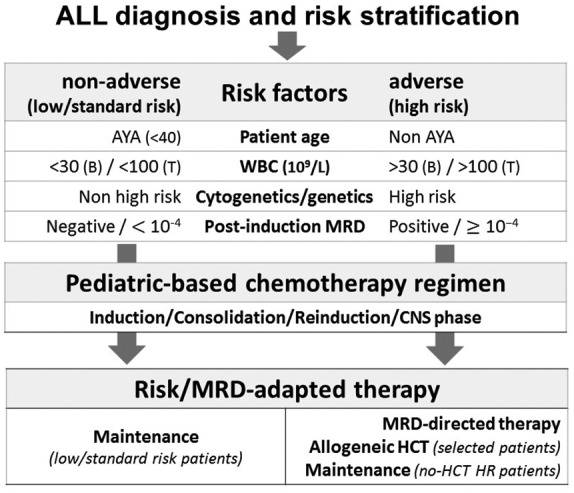
Figure 1.
Figure 1.
Prognosis to treatment relationships in AYA Ph– ALL. Different patient characteristics and clinicobiologic ALL subsets concur to determine the individual risk profile. Postinduction MRD analysis reflects patterns of chemosensitivity and refines the prognostic index, which is used to orientate postremission therapy reserving an allogeneic HCT to HR patients (see also Table 2 and Figure 2). MRD itself can be targeted with novel immunotherapeutics and other experimental agents (i.e. blinatumomab in CD19+ ALL, CAR-T cells, etc.). Regardless of risk class definition and transplantation policy (a decision related to specific protocol design), overall patient outcome is improved using pediatric-based rather than traditional adult chemotherapy protocols. ALL, acute lymphoblastic leukemia; AYA, adolescents and young adults; HCT, hematopoietic cell transplantation; HR, high risk; MRD, minimal (or measurable) residual disease; Ph–, Philadelphia chromosome-negative B-ALL.
Figure 2.
Figure 2.
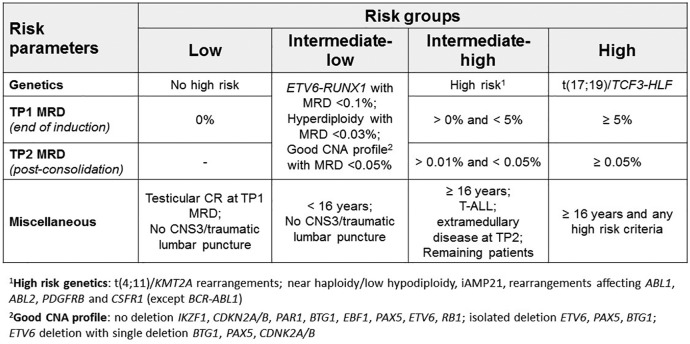
Recent example of combined risk stratification by genetics and MRD in Ph– ALL (patterned after UKALL study and as adopted in ALLTogether study. The present risk classification is used within the international ALLTogether project by the NOPHO group for AYAs aged up to 45 years. In this study T-ALL is considered a uniform genetic risk group. In B-lineage ALL (B-ALL), genetics/cytogenetics defines good, intermediate risk and HR groups (with the notable absence of Ph–like ALL; see text for details), and the intermediate risk class is subdivided according to CNA (involved genes are indicated). By study design, final risk classification allows patients to be allocated to intensive chemotherapy and maintenance (standard/low and low/intermediate risk group, experimental interventions with new agents (HR/intermediate risk group) and allogeneic HCT or chimeric antigen receptor T cell (HR group). ALL, acute lymphoblastic leukemia; AYA, adolescents and young adults; CNA, copy number alterations; HCT, hematopoietic cell transplantation; HR, high risk; MRD, minimal (or measurable) residual disease; Ph–, Philadelphia chromosome-negative B-ALL. aHR genetics: t(4;11)/KMT2A rearrangements; near haploidy/low hypodiploidy, iAMP21, rearrangements affecting ABL1, ABL2, PDGFRB, and CSFR1 (except BCR-ABL1). bGood CNA profile: no deletion IKZF1, CDKN2A/B, PAR1, BTG1, EBF1, PAX5, ETV6, RB1; isolated deletion ETV6, PAX5, BTG1; ETV6 deletion with single deletion BTG1, PAX5, CDNK2A/B.
Figure 3.
Figure 3.
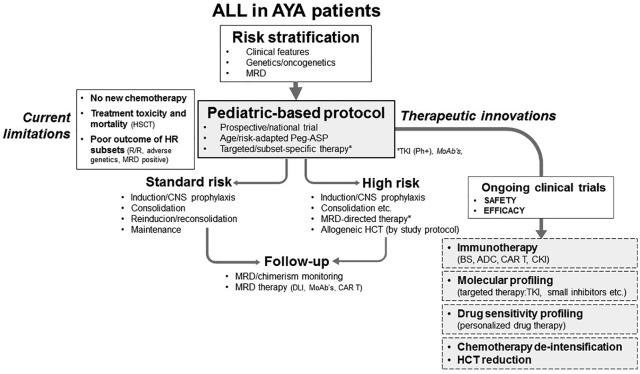
Current and future status of ALL therapy in AYA patients. The essential steps are a correct risk stratification (genetics, MRD), the use of an institutional/national pediatric-based protocol containing Peg-ASP among other elements, enriched whenever possible with targeting agents (Ph+ ALL: additional TKI therapy; B-ALL: monoclonal antibodies if CD20+, CD19+, CD22+), and with a prospective risk-oriented allogeneic HCT policy according to study protocol. Further improvements, under evaluation in ongoing trials, may be possible with the intensification of immunotherapy, the introduction of other targeting agents (as suggested by molecular profiling data), and the optimization of drug therapy (as suggested by drug sensitivity screening). New trials will have to evaluate novel drug combinations and sequences, demonstrating therapeutic progress with manageable toxicity, finally allowing depotentiation of intensive chemotherapy and reducing the need for allogeneic HCT. ALL, acute lymphoblastic leukemia; AYA, adolescents and young adults; HCT, hematopoietic cell transplantation; HR, high risk; MRD, minimal (or measurable) residual disease; Peg-ASP, pegylated-asparaginase; Ph–, Philadelphia chromosome-negative B-ALL; Ph+, Ph chromosome-positive B-ALL; TKI, tyrosine kinase inhibitor.

References

    1. Pui CH, Evans WE. A 50-year journey to cure childhood acute lymphoblastic leukemia. Semin Hematol 2013; 50: 185–196. - PMC - PubMed
    1. Hunger SP, Mullighan CG. Acute lymphoblastic leukemia in children. N Engl J Med 2015; 15: 1541–1552. - PubMed
    1. Siegel SE, Stock W, Johnson RH, et al. Pediatric-inspired treatment regimens for adolescents and young adults with Philadelphia chromosome-negative acute lymphoblastic leukemia: a review. JAMA Oncol 2018; 4: 725–734. - PMC - PubMed
    1. Curran E, Stock W. How I treat acute lymphoblastic leukemia in older adolescents and young adults. Blood 2015; 125: 3702–3710. - PMC - PubMed
    1. Boissel N, Baruchel A. Acute lymphoblastic leukemia in adolescent and young adults: treat as adults or as children? Blood 2018; 132: 351–361. - PubMed

LinkOut - more resources