


Validity of an under-mattress sensor for objective sleep measurement in critically ill patients: a prospective observational study
- PMID: 32071722
- PMCID: PMC7014714
- DOI: 10.1186/s40560-020-0433-x
Validity of an under-mattress sensor for objective sleep measurement in critically ill patients: a prospective observational study
Abstract
Background: Considering the adverse effects of sleep disturbance in critical care settings, accurate assessment could aid therapy; however, methodological inadequacies mean that no viable option is currently available. Research in healthy population has recently shown that a non-wearable sleep measurement device placed under the mattress of the bed could be beneficial in intensive care settings. Therefore, we aimed to validate this device compared with polysomnography (PSG) and to assess how it related to subjective sleep evaluations.
Methods: This observational study measured the sleep of critically ill adult patients. The primary goal was to validate the Nemuri SCAN (NSCAN; Paramount Bed Co., Ltd., Tokyo, Japan) against the reference standard PSG for 24 h. The secondary goal was to evaluate the association between the objective parameters obtained from NSCAN and PSG and the subjective report data obtained using the Richards-Campbell Sleep Questionnaire (RCSQ) for the nighttime.
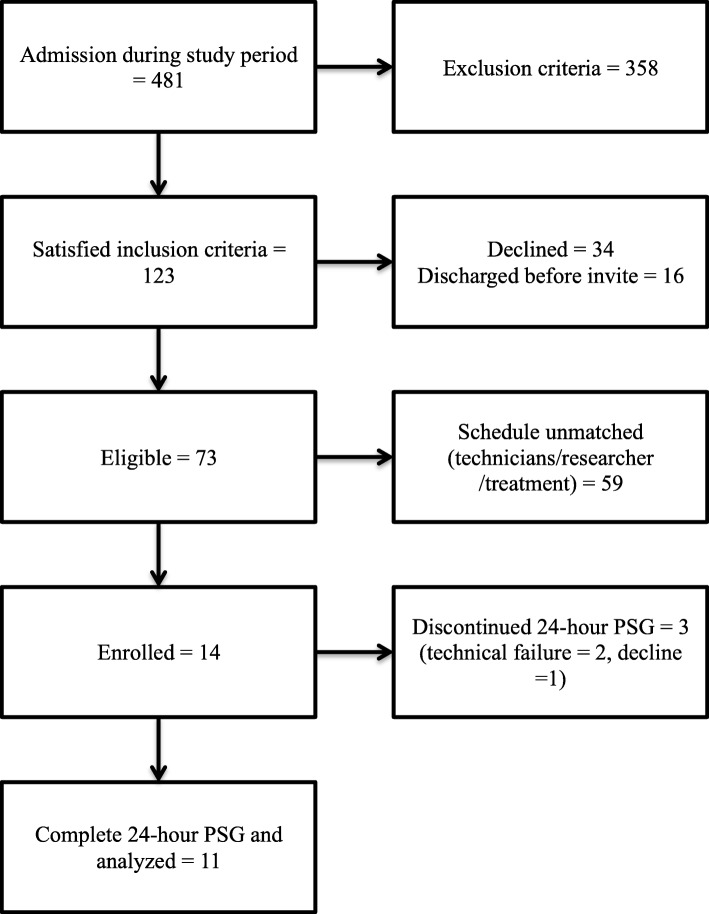
Results: Eleven participants were evaluated. The median of the total sleep time scored by PSG was 456.0 (353.0-517.5) min during the nighttime and 305.0 (186.2-542.5) min during the daytime. PSG over 24 h revealed significant decreases in restorative sleep, with excessive daytime sleep, but with a normal quantity of nighttime sleep. The agreement, sensitivity, and specificity rates (with 95% confidence intervals) for the NSCAN compared with PSG were 68.4% (67.9-69.0%), 90.1% (89.7-90.6%), and 38.7% (37.9-39.7%), respectively. The median RCSQ value when subjectively evaluating nighttime sleep was 68.0 (26.3-83.5); this showed no correlation with the NSCAN sleep parameters, despite a positive correlation with the ratio of the stage N2 isolated or combined with restorative sleep in the PSG assessment.
Conclusions: NSCAN had moderate agreement, high sensitivity, and poor specificity in intensive care settings, which is most likely due to its inability to identify immobile wakefulness often observed in critically ill patients or sleep depth. This remains a barrier to its use in the assessment of subjective sleep quality.
Trial registration: This investigation was part of an interventional trial registered with the University Hospital Medical Information Network Individual Clinical Trials Registry (UMIN000026350, http://www.umin.ac.jp/icdr/index-j.html) on March 1, 2017.
Keywords: Critically ill patients; Polysomnography; Richards–Campbell Sleep Questionnaire; Sleep evaluation; Sleep measurement.
© The Author(s). 2020.
Conflict of interest statement
Competing interestsThe authors declare that they have no competing interests.
References
LinkOut - more resources
Full Text Sources
