The nutritional status of children living within institutionalized care: a systematic review
- PMID: 32071812
- PMCID: PMC7007983
- DOI: 10.7717/peerj.8484
The nutritional status of children living within institutionalized care: a systematic review
Abstract
Background: There are an estimated 2.7 million children living within institutionalized care worldwide. This review aimed to evaluate currently available data on the nutrition status of children living within institutionalized care.
Methods: We searched four databases (Pubmed/Medline, CINHAL Plus, Embase and Global Health Database) for relevant articles published from January 1990 to January 2019. Studies that included information on anthropometry or micronutrient status of children living within institutionalized care were eligible for inclusion. The review is registered on PROSPERO: CRD42019117103.
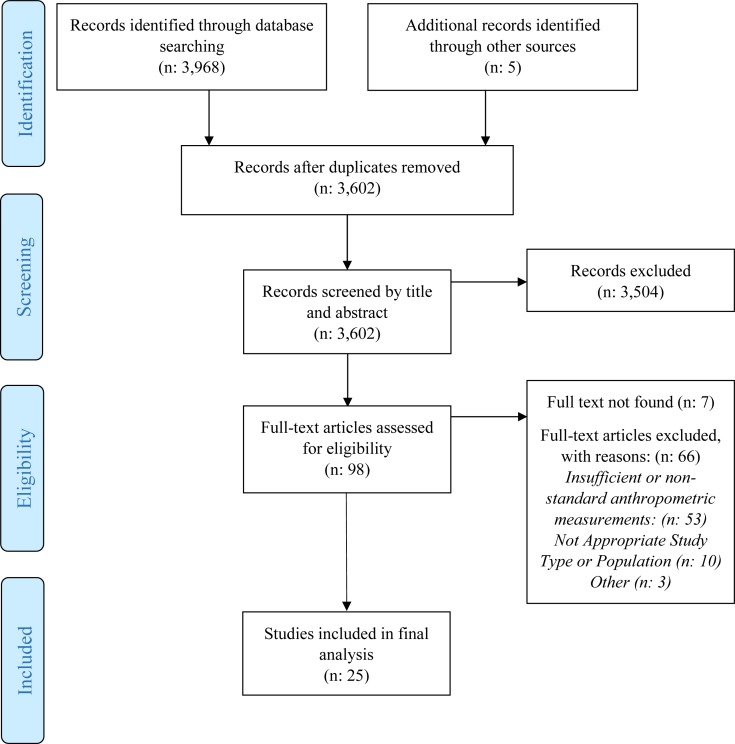
Results: From 3,602 titles screened, we reviewed 98 full texts, of which 25 papers were eligible. Two (8%) studies reported data from multiple countries, nine (36%) were from Asia, four (16%) from Africa, three (12%) from Eastern Europe, four (16%) from the European Union and one (4%) from each of the remaining regions (Middle East, South America and the Caribbean). Twenty-two (88%) were cross sectional. Ten (40%) of the studies focused on children >5 years, seven (28%) on children <5 years, seven (28%) covered a wide age range and one did not include ages. Low birth weight prevalence ranged from 25-39%. Only five (20%) included information on children with disabilities and reported prevalence from 8-75%. Prevalence of undernutrition varied between ages, sites and countries: stunting ranged from 9-72%; wasting from 0-27%; underweight from 7-79%; low BMI from 5-27%. Overweight/obesity ranged from 10-32% and small head circumference from 17-41%. The prevalence of HIV was from 2-23% and anemia from 3-90%. Skin conditions or infections ranged from 10-31% and parasites from 6-76%. Half the studies with dietary information found inadequate intake or diet diversity. Younger children were typically more malnourished than older children, with a few exceptions. Children living within institutions were more malnourished than community peers, although children living in communities were also often below growth standards. High risk of bias was found.
Conclusions: This study highlights the limited amount of evidence-based data available on the nutritional status of children in institutions. Of the studies reviewed, children living within institutionalized care were commonly malnourished, with undernutrition affecting young children particularly. Micronutrient deficiencies and obesity were also prevalent. Data quality was often poor: as well as suboptimal reporting of anthropometry, few looked for or described disabilities, despite disability being common in this population and having a large potential impact on nutrition status. Taken together, these findings suggest a need for greater focus on improving nutrition for younger children in institutions, especially those with disabilities. More information is needed about the nutritional status of the millions of children living within institutionalized care to fully address their right and need for healthy development.
Keywords: Anthropometry; Children with disabilities; Malnutrition; Nutrition; Nutritional deficiency; Orphanage; Children; Institutionalized care; Low birth weight; Residential care.
©2020 DeLacey et al.
Conflict of interest statement
Emily DeLacey, Michael Quiring and Caryl Garcia are employed by Holt International.
References
-
- Baron AM, Baron YM, Spencer NJ. The care and health needs of children in residential care in the Maltese Islands. Child: Care, Health and Development. 2001;27:251–262. - PubMed
-
- Bin Shaziman S, Rani MDM, Aripin KNN, Hamid NA, Sulaiman WNW, Rahman ZA, Abdullah MY. Assessing nutritional knowledge, attitudes and practices and body mass index of adolescent residents of orphanage institutions in Selangor and Malacca. Pakistan Journal of Nutrition. 2017;16:406–411. doi: 10.3923/pjn.2017.406.411. - DOI
-
- Black RE, Victora CG, Walker SP, Bhutta ZA, Christian P, De Onis M, Ezzati M, Grantham-McGregor S, Katz J, Martorell R, Uauy R. Maternal and child undernutrition and overweight in low-income and middle-income countries. The Lancet. 2013;382:427–451. doi: 10.1016/s0140-6736(13)60937-x. - DOI - PubMed
-
- Braitstein P, Ayaya S, Nyandiko WM, Kamanda A, Koech J, Gisore P, Atwoli L, Vreeman RC, Duefield C, Ayuku DO. Nutritional status of orphaned and separated children and adolescents living in community and institutional environments in uasin gishu county, kenya. PLOS ONE. 2013;8:e70054. doi: 10.1371/journal.pone.0070054. - DOI - PMC - PubMed
LinkOut - more resources
Full Text Sources