


Cumulative social disadvantage and risk of attention deficit hyperactivity disorder: Results from a nationwide cohort study
- PMID: 32072007
- PMCID: PMC7016018
- DOI: 10.1016/j.ssmph.2020.100548
Cumulative social disadvantage and risk of attention deficit hyperactivity disorder: Results from a nationwide cohort study
Abstract
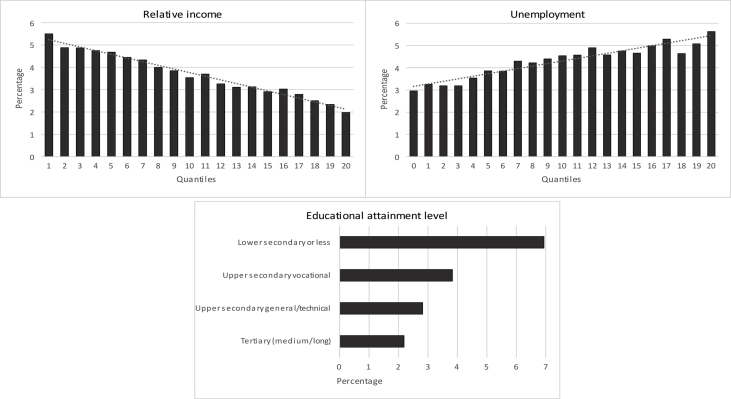
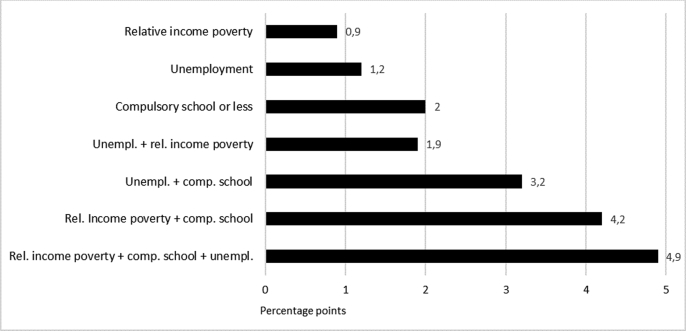
Socioeconomic factors correlate with mental health and affect individual life chances. However, the influence of specific and cumulative social disadvantages on children's mental health problems has received little attention. Previous studies have primarily used global measures of mental health problems or aggregated indicators of socioeconomic status. We contribute to this research by including multiple indicators of parental social disadvantage to study independent and accumulative effects. The study focuses on the Attention Deficit/Hyperactivity Disorder (ADHD), which is known to affect children's educational and socioeconomic trajectories. ADHD is one of the most common child mental health problems and although heredity has been estimated to 76 percent, research suggests that a large social component remains in the prevalence. We exploit comprehensive high-quality registry data for the entire population of children born 1990-1999 in Denmark (N = 632,725). The ADHD prevalence is 3.68 percent. Estimates from linear probability models show that parental unemployment, relative income poverty, and low educational attainment increase children's risk of ADHD with 2.1 (95% CI 1.8-2.3), 2.3 (95% CI 2.1-2.5), and 3.5 percentage points (95% CI 3.3-3.7), respectively. Children who live with all three disadvantages face an increased risk of 4.9 percentage points.
Keywords: ADHD; Cumulative social disadvantage; Mental health; Social gradient in diagnosis.
© 2020 The Authors. Published by Elsevier Ltd.
Figures
References
-
- Anderson L.R. Adolescent mental health and behavioural problems, and intergenerational social mobility: A decomposition of health selection effects. Social Science & Medicine. 2018;197:153–160. October 2017. - PubMed
-
- Apgar V. A proposal for a new method of evaluation of the newborn infant. Anesthesia & Analgesia. 1953;120(5):1056–1059. - PubMed
-
- Atladottir H.O., Gyllenberg D., Langridge A., Sandin S., Hansen S.N., Leonard H. The increasing prevalence of reported diagnoses of childhood psychiatric disorders: A descriptive multinational comparison. European Child & Adolescent Psychiatry. 2014;24(2):173–183. - PubMed
-
- Bauman L.J. Cumulative social disadvantage and child health. Pediatrics. 2006;117(4):1321–1328. - PubMed
LinkOut - more resources
Full Text Sources
