


[Measuring physical fitness in the German National Cohort-methods, quality assurance, and first descriptive results]
- PMID: 32072217
- PMCID: PMC12254163
- DOI: 10.1007/s00103-020-03100-3
[Measuring physical fitness in the German National Cohort-methods, quality assurance, and first descriptive results]
Erratum in
-
Erratum zu: Messung der körperlichen Fitness in der NAKO Gesundheitsstudie – Methoden, Qualitätssicherung und erste deskriptive Ergebnisse.Bundesgesundheitsblatt Gesundheitsforschung Gesundheitsschutz. 2025 Sep;68(9):1052-1053. doi: 10.1007/s00103-025-04083-9. Bundesgesundheitsblatt Gesundheitsforschung Gesundheitsschutz. 2025. PMID: 40643668 Free PMC article. German. No abstract available.
Abstract
Physical fitness is defined as an individual's ability to be physically active. The main components are cardiorespiratory fitness (CRF), muscle strength, and flexibility. Regardless of physical activity level, physical fitness is an important determinant of morbidity and mortality.The aim of the current study was to describe the physical fitness assessment methodology in the German National Cohort (NAKO) and to present initial descriptive results in a subsample of the cohort.In the NAKO, hand grip strength (GS) and CRF as physical fitness components were assessed at baseline using a hand dynamometer and a submaximal bicycle ergometer test, respectively. Maximum oxygen uptake (VO2max) was estimated as a result of the bicycle ergometer test. The results of a total of 99,068 GS measurements and 3094 CRF measurements are based on a data set at halftime of the NAKO baseline survey (age 20-73 years, 47% men).Males showed higher values of physical fitness compared to women (males: GS = 47.8 kg, VO2max = 36.4 ml·min-1 · kg-1; females: GS = 29.9 kg, VO2max = 32.3 ml · min-1 · kg-1). GS declined from the age of 50 onwards, whereas VO2max levels decreased continuously between the age groups of 20-29 and ≥60 years. GS and VO2max showed a linear positive association after adjustment for body weight (males β = 0.21; females β = 0.35).These results indicate that the physical fitness measured in the NAKO are comparable to other population-based studies. Future analyses in this study will focus on examining the independent relations of GS and CRF with risk of morbidity and mortality.
Die körperliche Fitness ist das Maß für die individuelle Fähigkeit, körperlich aktiv zu sein. Ihre wesentlichen Komponenten sind die kardiorespiratorische Fitness (Cardiorespiratory Fitness, CRF), die Muskelkraft und die Beweglichkeit. Neben der körperlichen Aktivität ist die körperliche Fitness ein wesentlicher Prädiktor für Morbidität und Mortalität.
Ziel der Arbeit sind die Beschreibung der Erhebungsmethoden körperlicher Fitness in der NAKO Gesundheitsstudie und die Darstellung erster deskriptiver Ergebnisse.
In der NAKO-Basiserhebung wurden die maximale Handgreifkraft (Grip Strength, GS) und die CRF als Komponenten der körperlichen Fitness über ein Handdynamometer bzw. über einen Fahrradergometertest mit submaximaler Belastung erhoben. Daraus wurde die maximale Sauerstoffaufnahme (VO2max) zur Beurteilung der CRF abgeleitet. Die Ergebnisse von insgesamt 99.068 GS-Messungen und 3094 Messungen der CRF beruhen auf einem Datensatz zur Halbzeit der Basiserhebung der NAKO (Alter 20–73 Jahre, 47 % Männer).
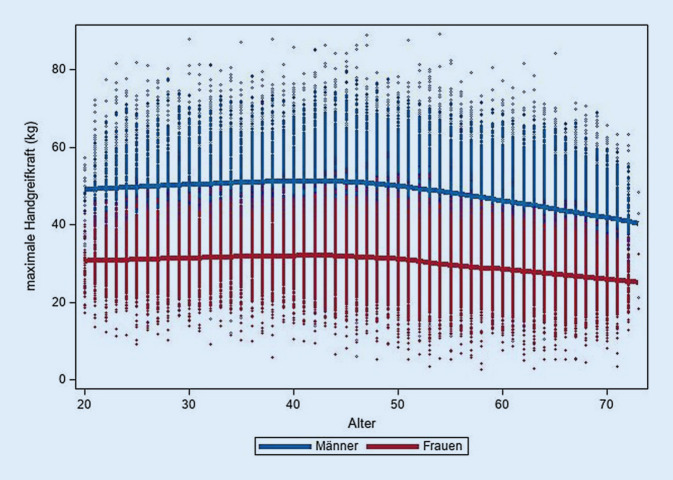
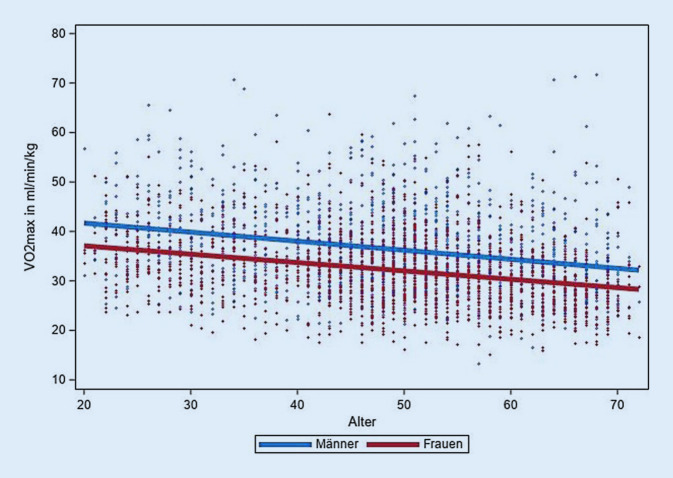
Männer zeigten im Vergleich zu Frauen höhere Werte der körperlichen Fitness (Männer: GS = 47,8 kg, VO2max = 36,4 ml·min−1 · kg−1; Frauen: GS = 29,9 kg, VO2max = 32,3 ml·min−1 · kg−1). Ungefähr ab dem 50. Lebensjahr konnte ein Rückgang der GS verzeichnet werden, wohingegen die CRF ab der Altersgruppe 20–29 Jahre bis zu den ≥60-Jährigen kontinuierlich abfiel. Die GS und die VO2max zeigten nach Korrektur für das Körpergewicht einen linear positiven Zusammenhang (Männer β = 0,21; Frauen β = 0,35).
Die Analysen zeigten eine gute Übereinstimmung der Verteilung der körperlichen Fitness in der NAKO im Vergleich zu anderen bevölkerungsbasierten Studien. Zukünftige Auswertungen werden insbesondere die unabhängige Bedeutung der GS und CRF bei der Prädiktion von Morbidität und Mortalität beleuchten.
Keywords: Cardiorespiratory fitness; German National Cohort; Grip strength; Muscle strength; Physical fitness.
Figures


References
-
- Leong DP, Teo KK, Rangarajan S et al (2015) Prognostic value of grip strength: findings from the prospective urban rural epidemiology (PURE) study. Lancet 386:266–273 - PubMed
-
- Garcia-Hermoso A, Cavero-Redondo I, Ramirez-Velez R et al (2018) Muscular strength as a predictor of all-cause mortality in an apparently healthy population: a systematic review and meta-analysis of data from approximately 2 million men and women. Arch Phys Med Rehabil 99:2100–2113 - PubMed
-
- Bohannon RW (2008) Hand-grip dynamometry predicts future outcomes in aging adults. J Geriatr Phys Ther 31:3–10 - PubMed
MeSH terms
Substances
LinkOut - more resources
Full Text Sources
Medical
Miscellaneous
