


Assessing the validity of and factors that influence accurate self-reporting of HIV status after testing: a population-based study
- PMID: 32073446
- PMCID: PMC7553190
- DOI: 10.1097/QAD.0000000000002513
Assessing the validity of and factors that influence accurate self-reporting of HIV status after testing: a population-based study
Erratum in
-
Assessing the validity of and factors that influence accurate self-reporting of HIV status after testing: a population-based study: Erratum.AIDS. 2020 Nov 1;34(13):1993. doi: 10.1097/01.aids.0000718360.87464.8d. AIDS. 2020. PMID: 33009016 No abstract available.
Abstract
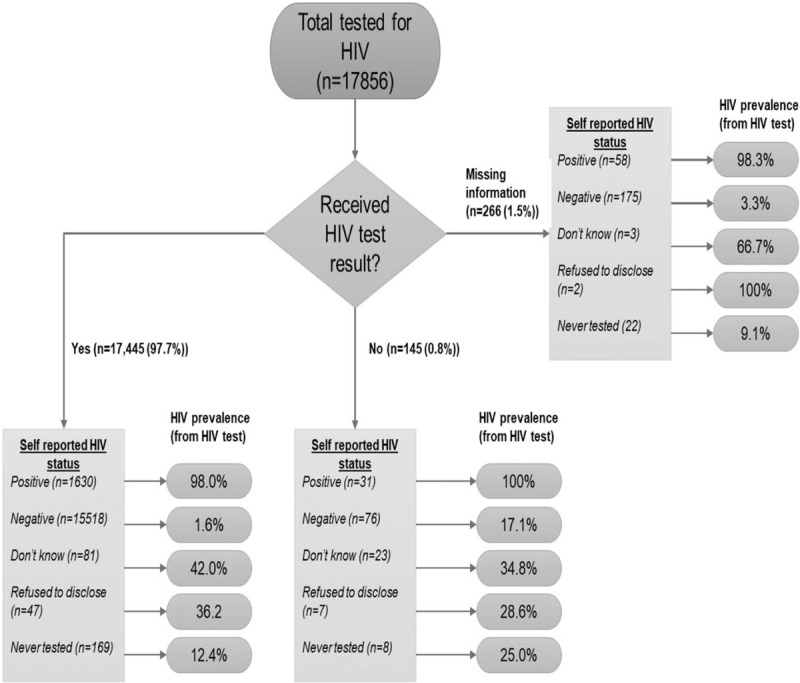
Objectives: To assess the validity of self-reported HIV status, and investigate factors that influence accurate reporting of HIV-positive status, in a population tested and informed of their HIV test result.
Design: Prospective cohort study.
Methods: We compared self-reported HIV status with biomarker-confirmed HIV test status among participants of Karonga Health and Demographic Surveillance Site in rural northern Malawi. We linked information on HIV test results to subsequent self-reported HIV status, and calculated sensitivity, specificity, positive predictive value and negative predictive value for self-reported HIV status (considered as a diagnostic test). We used Poisson regression with robust variance estimators to examine predictors of accurate self-reporting of HIV-positive status.
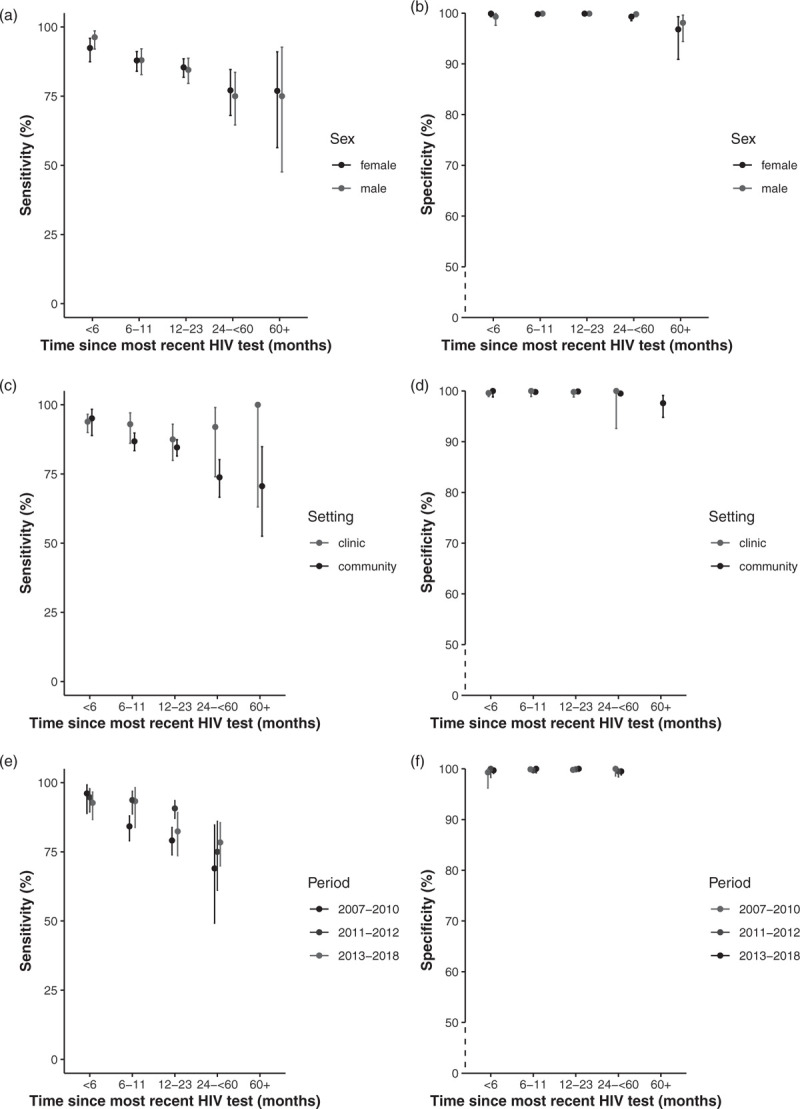
Results: Among 17 445 adults who tested for HIV, were recorded as having received their HIV test results, and had a subsequent self-reported HIV status between 2007 and 2018: positive predictive value of self-reported HIV status was 98.0% (95% confidence interval: 97.3-98.7); negative predictive value was 98.3 (98.1-98.5); sensitivity was 86.1% (84.5-87.7); and specificity was 99.8% (99.7-99.9). Among true HIV-positive people, those who were younger, interviewed in community settings, and had tested for HIV longer ago were more likely to misreport their HIV-positive status.
Conclusion: In this setting, self-report provides good estimates of test-detected HIV prevalence, suggesting that it can be used when HIV test results are not available. Despite frequent HIV testing, younger people and those interviewed in community settings were less likely to accurately report their HIV-positive status. More research on barriers to self-reporting of HIV status is needed in these subgroups.
Conflict of interest statement
All studies contributing the data for current analysis were funded by the Wellcome Trust (Grant ref # 098610/Z/12/Z). S.C. is a Commonwealth scholar funded by the UK government.
Where authors are identified as personnel of the International Agency for Research on Cancer/WHO, the authors alone are responsible for the views expressed in this article and they do not necessarily represent the decisions, policy or views of the International Agency for Research on Cancer/WHO.
Figures
References
-
- Fishel Joy D, Barrère B, Kishor S. Validity of data on self-reported HIV status in Malawi and Uganda and implications for measurement of arv coverage. DHS methodological reports. Rockville (MD): ICF International; 2014.
Publication types
MeSH terms
Grants and funding
LinkOut - more resources
Full Text Sources
Medical
