Computational Mechanisms of Effort and Reward Decisions in Patients With Depression and Their Association With Relapse After Antidepressant Discontinuation
- PMID: 32074255
- PMCID: PMC7042923
- DOI: 10.1001/jamapsychiatry.2019.4971
Computational Mechanisms of Effort and Reward Decisions in Patients With Depression and Their Association With Relapse After Antidepressant Discontinuation
Abstract
Importance: Nearly 1 in 3 patients with major depressive disorder who respond to antidepressants relapse within 6 months of treatment discontinuation. No predictors of relapse exist to guide clinical decision-making in this scenario.
Objectives: To establish whether the decision to invest effort for rewards represents a persistent depression process after remission, predicts relapse after remission, and is affected by antidepressant discontinuation.
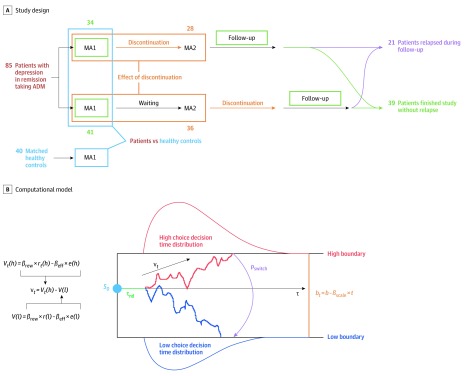
Design, setting, and participants: This longitudinal randomized observational prognostic study in a Swiss and German university setting collected data from July 1, 2015, to January 31, 2019, from 66 healthy controls and 123 patients in remission from major depressive disorder in response to antidepressants prior to and after discontinuation. Study recruitment took place until January 2018.
Exposure: Discontinuation of antidepressants.
Main outcomes and measures: Relapse during the 6 months after discontinuation. Choice and decision times on a task requiring participants to choose how much effort to exert for various amounts of reward and the mechanisms identified through parameters of a computational model.
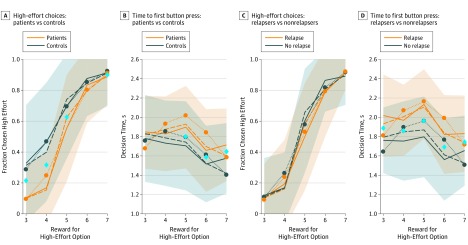
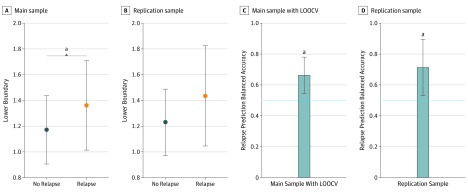
Results: A total of 123 patients (mean [SD] age, 34.5 [11.2] years; 94 women [76%]) and 66 healthy controls (mean [SD] age, 34.6 [11.0] years; 49 women [74%]) were recruited. In the main subsample, mean (SD) decision times were slower for patients (n = 74) compared with controls (n = 34) (1.77 [0.38] seconds vs 1.61 [0.37] seconds; Cohen d = 0.52; P = .02), particularly for those who later relapsed after discontinuation of antidepressants (n = 21) compared with those who did not relapse (n = 39) (1.95 [0.40] seconds vs 1.67 [0.34] seconds; Cohen d = 0.77; P < .001). This slower decision time predicted relapse (accuracy = 0.66; P = .007). Patients invested less effort than healthy controls for rewards (F1,98 = 33.970; P < .001). Computational modeling identified a mean (SD) deviation from standard drift-diffusion models that was more prominent for patients than controls (patients, 0.67 [1.56]; controls, -0.71 [1.93]; Cohen d = 0.82; P < .001). Patients also showed higher mean (SD) effort sensitivity than controls (patients, 0.31 [0.92]; controls, -0.08 [1.03]; Cohen d = 0.51; P = .05). Relapsers differed from nonrelapsers in terms of the evidence required to make a decision for the low-effort choice (mean [SD]: relapsers, 1.36 [0.35]; nonrelapsers, 1.17 [0.26]; Cohen d = 0.65; P = .02). Group differences generally did not reach significance in the smaller replication sample (27 patients and 21 controls), but decision time prediction models from the main sample generalized to the replication sample (validation accuracy = 0.71; P = .03).
Conclusions and relevance: This study found that the decision to invest effort was associated with prospective relapse risk after antidepressant discontinuation and may represent a persistent disease process in asymptomatic remitted major depressive disorder. Markers based on effort-related decision-making could potentially inform clinical decisions associated with antidepressant discontinuation.
Conflict of interest statement
Figures
References
-
- Bauer M, Pfennig A, Severus E, Whybrow PC, Angst J, Möller HJ; World Federation of Societies of Biological Psychiatry. Task Force on Unipolar Depressive Disorders . World Federation of Societies of Biological Psychiatry (WFSBP) guidelines for biological treatment of unipolar depressive disorders, part 1: update 2013 on the acute and continuation treatment of unipolar depressive disorders. World J Biol Psychiatry. 2013;14(5):334-385. doi: 10.3109/15622975.2013.804195 - DOI - PubMed
-
- National Institute for Health and Clinical Excellence Guidance: Depression: The Treatment and Management of Depression in Adults (Updated Edition). Leicester, UK: British Psychological Society; 2010. - PubMed