


Analytical Technique Optimization on the Detection of β-cyclocitral in Microcystis Species
- PMID: 32075007
- PMCID: PMC7070943
- DOI: 10.3390/molecules25040832
Analytical Technique Optimization on the Detection of β-cyclocitral in Microcystis Species
Abstract
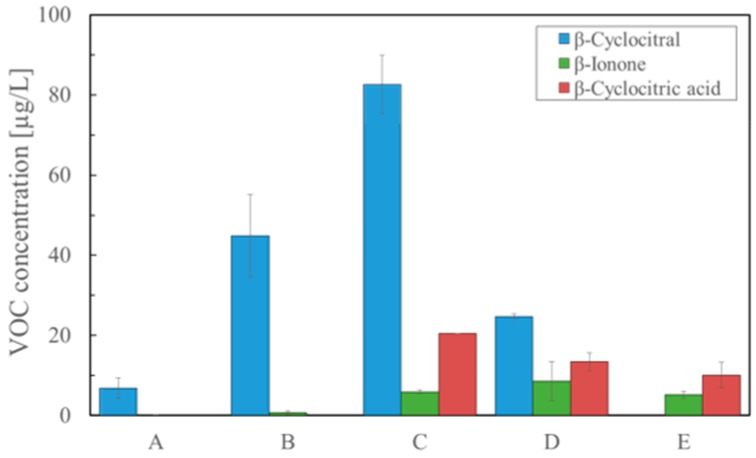
β-Cyclocitral, specifically produced by Microcystis, is one of the volatile organic compounds (VOCs) derived from cyanobacteria and has a lytic activity. It is postulated that β-cyclocitral is a key compound for regulating the occurrence of cyanobacteria and related microorganisms in an aquatic environment. β-Cyclocitral is sensitively detected when a high density of the cells is achieved from late summer to autumn. Moreover, it is expected to be involved in changes in the species composition of cyanobacteria in a lake. Although several analysis methods for β-cyclocitral have already been reported, β-cyclocitral could be detected using only solid phase micro-extraction (SPME), whereas it could not be found at all using the solvent extraction method in a previous study. In this study, we investigated why β-cyclocitral was detected using only SPME GC/MS. Particularly, three operations in SPME, i.e., extraction temperature, sample stirring rate, and the effect of salt, were examined for the production of β-cyclocitral. Among these, heating (60 °C) was critical for the β-cyclocitral formation. Furthermore, acidification with a 1-h storage was more effective than heating when comparing the obtained amounts. The present results indicated that β-cyclocitral did not exist as the intact form in cells, because it was formed by heating or acidification of the resulting intermediates during the analysis by SPME. The obtained results would be helpful to understand the formation and role of β-cyclocitral in an aquatic environment.
Keywords: Microcystis; SPME; analysis; volatile organic compounds.
Conflict of interest statement
The authors declare no conflict of interest.
Figures


References
-
- O’Neil J.M., Davis T.W., Burford M.A., Gobler C.J. The rise of harmful cyanobacteria blooms: The potential roles of eutrophication and climate change. Harmful Algae. 2012;14:313–334. doi: 10.1016/j.hal.2011.10.027. - DOI
-
- Jüttner F., Höflacher B., Wurster K. Seasonal analysis of volatile organic biogenic substances (VOBS) in freshwater phytoplankton populations dominated by Dinobryon, Microcystis and Aphanizomenon. J. Phycol. 1986;22:169–175. doi: 10.1111/j.1529-8817.1986.tb04160.x. - DOI
-
- Jones G.J., Korth W. In situ production of volatile odour compounds by river and reservoir phytoplankton populations in Australia. Water Sci. Technol. 1995;31:145–151. doi: 10.2166/wst.1995.0424. - DOI
MeSH terms
Substances
Grants and funding
LinkOut - more resources
Full Text Sources
Miscellaneous
